
Tarsus, Paul’s birthplace, is at least 4,000 years old. In 41 B.C., Antony and Cleopatra held a celebrated meeting there.
At least seven of Paul’s relatives are mentioned in the New Testament. At the end of his letter to the Romans, Paul greets as “relatives” Andronicus and Junia, Jason, Sosipater, and Lucius. In addition, Acts mentions Paul’s sister and his nephew, who helped Paul in prison (Acts 23:16–22).
It is possible that Paul’s “relative” Lucius is Luke, the author of the Gospel and the Acts of the Apostles. On his second missionary journey, Paul may have gone to Troas (where Luke lived—or at least where he joined Paul) because he knew a relative he could stay with there (Acts 16:8, 11).
What type of fish did Paul eat? Probably not catfish. Catfish was the largest native fish of the Sea of Galilee (sometimes weighing up to 20 pounds), but Jewish dietary laws would have prevented at least the early Paul from eating fish without scales (Deut. 14:10).
It’s not clear exactly how Paul supported himself on his missionary journeys. Luke calls him a “tent-maker” (skenopoios), which suggests Paul was a weaver of tent cloth from goats’ hair. The term, however, can also mean “leatherworker.” Other early translations of Luke’s term mean “maker of leather thongs” and “shoemaker.”
Paul, the “Apostle to the Gentiles,” had plenty of opportunity to preach to Jews in his travels. There were some four to five million Jews living abroad in the first century. Every major city had at least one synagogue, and Rome had at least eleven. The Jewish population of Rome alone was 40,000–50,000.
Wine was a common drink of Paul’s day, but it was not the wine of our day. In the Greco-Roman world, pure wine was considered strong and unpleasant, so some Greeks diluted wine with seawater. In cold weather, city snack shops in Italy sold hot wine.
Paul read pagan poets. In his writings, he quotes Epimenides of Crete (Tit. 1:12), Aratus of Cilicia (Acts 17:28) and Menander, author of the Greek comedy Thais (1 Cor. 15:33).
Many Roman men of Paul’s day curled their hair. Men also applied oil and grease to their hair; it was one way people de-loused themselves. These concoctions were made from such substances as the marrow of deer bones, the fat of bears and sheep, and the excrement of rats.
Demand for wild animals for entertainment in Paul’s day turned hunting into a major business. Gladiatorial shows usually included animal hunts or fights with leopards, panthers, bears, lions, tigers, elephants, ostriches, and gazelles. In 55 B.C. at Pompeii’s games, 400 leopards and 600 lions were killed. In A.D. 80, at the dedication of the Colosseum by Emperor Titus, 9,000 animals were killed in a hundred days.
Paul may have recorded some of the New Testament church’s hymns. Many scholars think Paul is quoting hymns in passages like 1 Corinthians 13 and Philippians 2:1–11.
Paul’s letters, not the Gospels, give us the earliest information we have about Jesus. All his letters were probably written before the first Gospel was penned. The earliest reference to the sayings of Jesus come from 1 Thessalonians, which Paul wrote about A.D. 50.
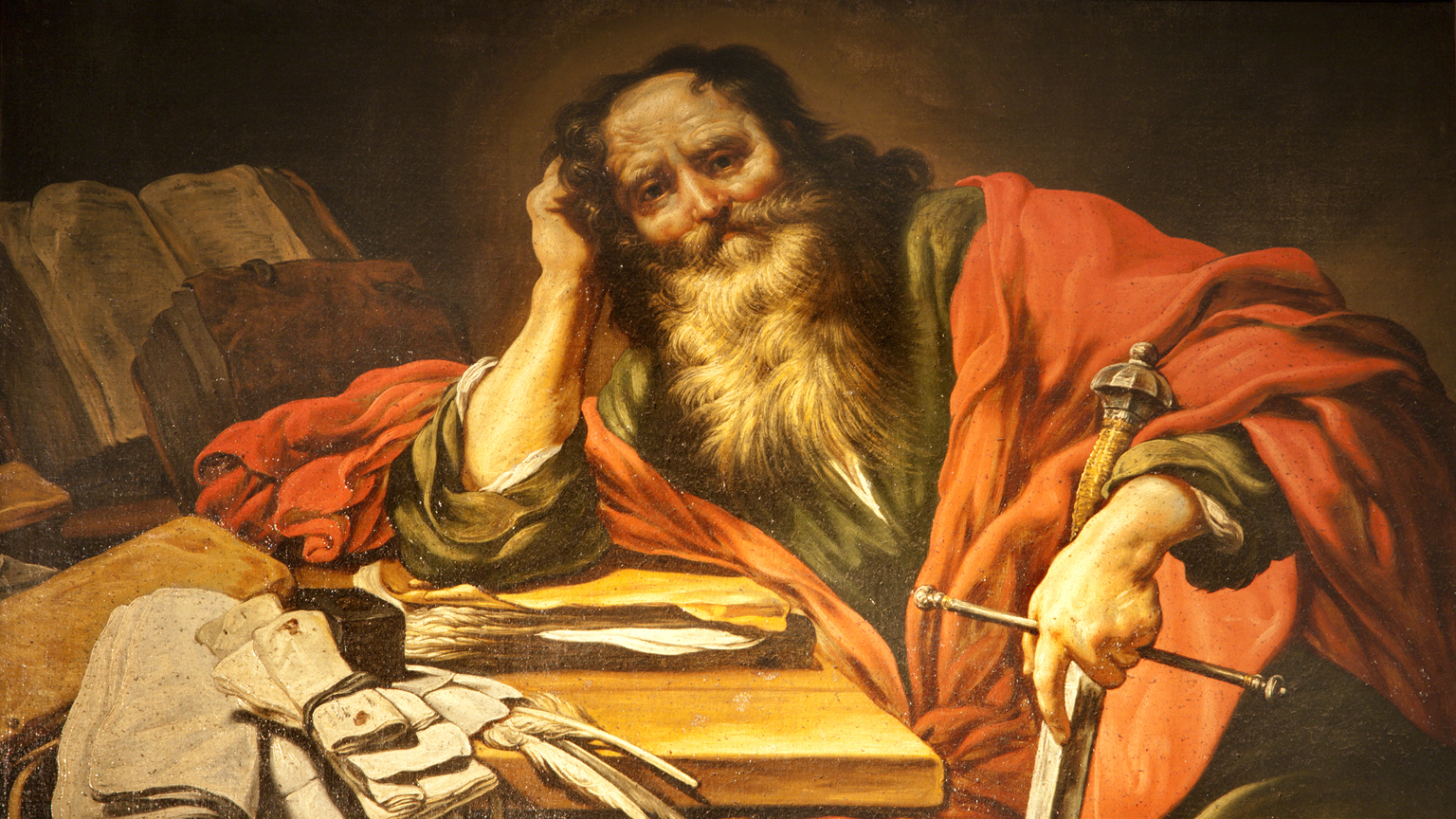
He may have not been as old as the Rembrandt painting on cover implies, but Paul lived a relatively long life. He was probably born about A.D. 6 and probably died about A.D. 64—which means he may have died at about age 58, an old age given the times and the hard life he lived.
In later art, Paul is often depicted with a sword and book, which is said to symbolize the manner of his death (beheading by sword), and his writings, which became “the sword of the Spirit.”
Marvin R. Wilson is professor of biblical and theological studies at Gordon College, Wenham, Massachusetts. He is author of Our Father Abraham: Jewish Roots to the Christian Faith (Eerdmans, 1989).
Copyright © 1995 by the author or Christianity Today/Christian History magazine. Click here for reprint information on Christian History.