






More than 150 Christian organizations have joined United Response to New Era (URNE), an effort coordinated by the Evangelical Council for Financial Accountability (ECFA) to make the best out of the nightmarish circumstances resulting from the collapse of the Pennsylvania-based Foundation for New Era Philanthropy (CT, June 19, 1995, p. 40).
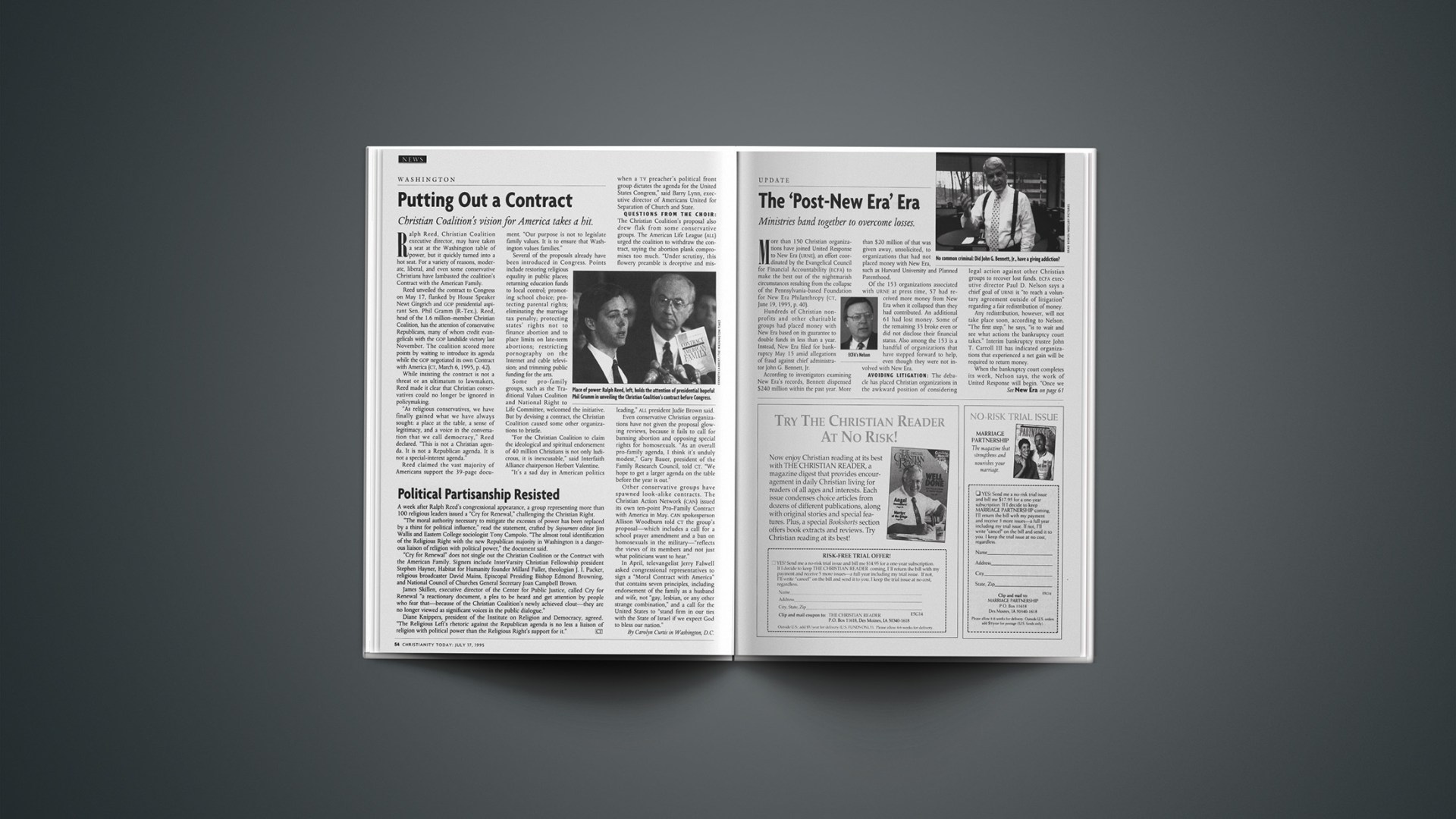
Hundreds of Christian nonprofits and other charitable groups had placed money with New Era based on its guarantee to double funds in less than a year. Instead, New Era filed for bankruptcy May 15 amid allegations of fraud against chief administrator John G. Bennett, Jr.
According to investigators examining New Era’s records, Bennett dispensed $240 million within the past year. More than $20 million of that was given away, unsolicited, to organizations that had not placed money with New Era, such as Harvard University and Planned Parenthood.
Of the 153 organizations associated with URNE at press time, 57 had received more money from New Era when it collapsed than they had contributed. An additional 61 had lost money. Some of the remaining 35 broke even or did not disclose their financial status. Also among the 153 is a handful of organizations that have stepped forward to help, even though they were not involved with New Era.
AVOIDING LITIGATION: The debacle has placed Christian organizations in the awkward position of considering legal action against other Christian groups to recover lost funds. ECFA executive director Paul D. Nelson says a chief goal of URNE is “to reach a voluntary agreement outside of litigation” regarding a fair redistribution of money.
Any redistribution, however, will not take place soon, according to Nelson. “The first step,” he says, “is to wait and see what actions the bankruptcy court takes.” Interim bankruptcy trustee John T. Carroll III has indicated organizations that experienced a net gain will be required to return money.
When the bankruptcy court completes its work, Nelson says, the work of United Response will begin. “Once we have done all we can do, we’d like to see a passing of the offering plate to help organizations that are still hurting the most,” Nelson says. “That is the beautiful witness we would love to come as result of a terrible circumstance.”
FISCAL STRESS: The New Era fiasco has created financial stress not just for organizations that lost money, but for those that have spent what they received.
The Arlington, Virginia-based Enterprise Development International, for example, invested no money with New Era but received—and spent—more than $156,000 in unsolicited grants. President Robert Hancock says the organization is committed “on moral and biblical grounds” to repay the grants, “even though it puts our organization in jeopardy.”
For a time, Wheaton, Illinois-based Chapel of the Air Ministries, which was counting on $450,000 from New Era that never came, teetered on the brink of extinction. According to the organization’s CEO, Randall Mains, Chapel’s situation was “so bleak that the board wrestled with whether or not to continue the ministry.”
The board, Mains says, voted unanimously to “take a step of faith.” Since then, an unexpected major gift and the support of ministry friends have kept it afloat. “I think we’ve turned a corner and feel hopeful about our future,” Mains says, “but we’re not out of the woods yet. We’re still having to struggle to meet payroll every two weeks.”
PROBABLE INDICTMENT: The U.S. Securities and Exchange Commission (SEC) has charged Bennett with misusing $55 million. In a civil suit against Bennett, the SEC has alleged that he diverted more than $4 million to his own private businesses and that he paid himself an average of more than $26,000 a week in consulting fees. Most observers believe an indictment is inevitable once state and federal authorities complete investigations. Bennett has stated that he has done nothing wrong but, based on the advice of legal counsel, has declined to elaborate.
According to the SEC, the anonymous donors Bennett claimed were the basis of New Era’s generosity never existed. Some of the country’s best known and most highly respected philanthropists and nonprofit organizations believed they did.
Among those who did not trust Bennett, however, was Wally Erickson, board member and former president of the Colorado Springs-based Compassion International. Erickson told CT that Compassion hired Bennett in 1979 as a fundraiser. Despite’s Bennett’s written reports indicating success, Compassion was not receiving any money. “When I flew out there to confront him,” recalls Erickson, “he admitted he’d been lying—turning in falsified reports. He said he was sorry.” Erickson says he prayed with Bennett but terminated the relationship.
Because of this experience, Compassion decided not to associate with New Era, even after Bennett late last year presented an unsolicited $100,000 check. (Erickson says this money will be returned.) Erickson says he did not warn other organizations because “Mr. Bennett indicated he had undergone a spiritual conversion, so I thought it was possible things had changed. There is a thin line between slander and fair warning.”
No one who knows Bennett personally considered him a common criminal. Some speculate that Bennett is “addicted” to giving. The ego gratification he received, they surmise, led him, compulsively, to give away money he did not have.
WHAT HAPPENED? Hindsight has led to accusations both of avarice and naivete on the part of organizations involved with New Era. Wesley Willmer, board chair of the Christian Stewardship Association, believes such allegations are unfounded. “Greed suggests that organizations wanted more than they needed,” says Willmer, an authority on ethics and fundraising. “All of the organizations I’m aware of who gave money to New Era were trying to meet legitimate ministry objectives.”
Willmer, who is also vice president for university advancement at Biola University, said Biola had enough questions about New Era that it set up an escrow account instead of turning its money over to Bennett. “Our finance people and auditors were concerned that they could not produce acceptable audited financial statements.”
Spring Arbor economics professor Albert Meyer, who blew the whistle on New Era, says, “There is simply no substitute for certified, audited financial statements.” According to Meyer, audited statements should be considered standard due-diligence procedure. Neither Meyer nor Willmer, however, fault organizations involved with New Era.
Neither does Nancy Axelrod, president of the Washington, D.C.-based National Center for Nonprofit Boards. She says Bennett succeeded by exploiting relationships of trust within the nonprofit community and by using the familiar and successful concepts of matching gifts and anonymous donors.
Copyright © 1995 Christianity Today. Click for reprint information.
ctcurrmrw5T8055576b







