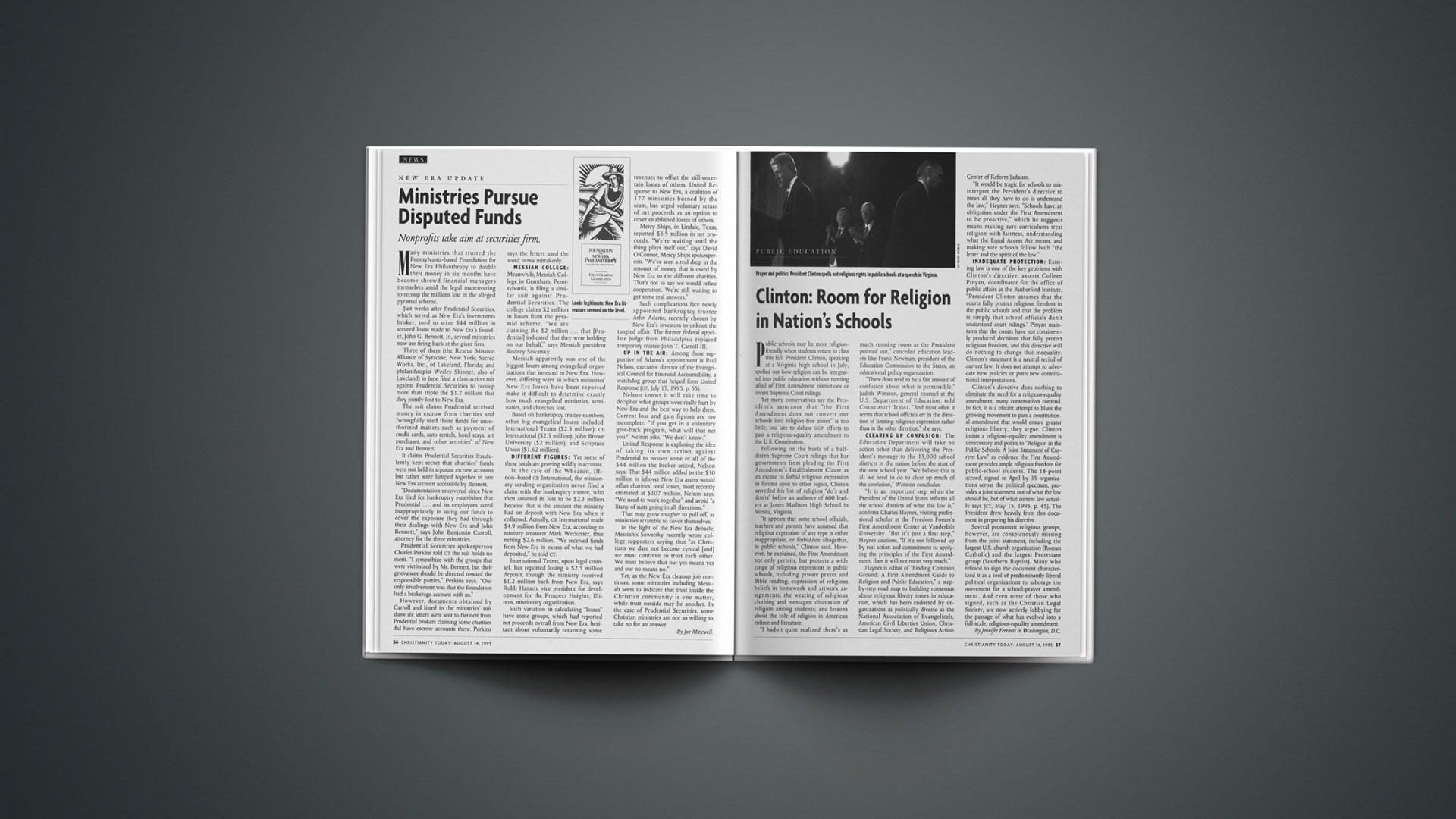

Public schools may be more religion-friendly when students return to class this fall. President Clinton, speaking at a Virginia high school in July, spelled out how religion can be integrated into public education without running afoul of First Amendment restrictions or recent Supreme Court rulings.
Yet many conservatives say the President’s assurance that “the First Amendment does not convert our schools into religion-free zones” is too little, too late to defuse gop efforts to pass a religious-equality amendment to the U.S. Constitution.
Following on the heels of a half-dozen Supreme Court rulings that bar governments from pleading the First Amendment’s Establishment Clause as an excuse to forbid religious expression in forums open to other topics, Clinton unveiled his list of religion “do’s and don’ts” before an audience of 600 leaders at James Madison High School in Vienna, Virginia.
“It appears that some school officials, teachers and parents have assumed that religious expression of any type is either inappropriate, or forbidden altogether, in public schools,” Clinton said. However, he explained, the First Amendment not only permits, but protects a wide range of religious expression in public schools, including private prayer and Bible reading; expression of religious beliefs in homework and artwork assignments; the wearing of religious clothing and messages; discussion of religion among students; and lessons about the role of religion in American culture and literature.
“I hadn’t quite realized there’s as much running room as the President pointed out,” conceded education leaders like Frank Newman, president of the Education Commission to the States, an educational policy organization.
“There does tend to be a fair amount of confusion about what is permissible,” Judith Winston, general counsel at the U.S. Department of Education, told Christianity Today. “And most often it seems that school officials err in the direction of limiting religious expression rather than in the other direction,” she says.
CLEARING UP CONFUSION: The Education Department will take no action other than delivering the President’s message to the 15,000 school districts in the nation before the start of the new school year. “We believe this is all we need to do to clear up much of the confusion,” Winston concludes.
“It is an important step when the President of the United States informs all the school districts of what the law is,” confirms Charles Haynes, visiting professional scholar at the Freedom Forum’s First Amendment Center at Vanderbilt University. “But it’s just a first step,” Haynes cautions. “If it’s not followed up by real action and commitment to applying the principles of the First Amendment, then it will not mean very much.”
Haynes is editor of “Finding Common Ground: A First Amendment Guide to Religion and Public Education,” a step-by-step road map to building consensus about religious liberty issues in education, which has been endorsed by organizations as politically diverse as the National Association of Evangelicals, American Civil Liberties Union, Christian Legal Society, and Religious Action Center of Reform Judaism.
“It would be tragic for schools to misinterpret the President’s directive to mean all they have to do is understand the law,” Haynes says. “Schools have an obligation under the First Amendment to be proactive,” which he suggests means making sure curriculums treat religion with fairness, understanding what the Equal Access Act means, and making sure schools follow both “the letter and the spirit of the law.”
INADEQUATE PROTECTION: Existing law is one of the key problems with Clinton’s directive, asserts Colleen Pinyan, coordinator for the office of public affairs at the Rutherford Institute. “President Clinton assumes that the courts fully protect religious freedom in the public schools and that the problem is simply that school officials don’t understand court rulings.” Pinyan maintains that the courts have not consistently produced decisions that fully protect religious freedom, and this directive will do nothing to change that inequality. Clinton’s statement is a neutral recital of current law. It does not attempt to advocate new policies or push new constitutional interpretations.
Clinton’s directive does nothing to eliminate the need for a religious-equality amendment, many conservatives contend. In fact, it is a blatant attempt to blunt the growing movement to pass a constitutional amendment that would ensure greater religious liberty, they argue. Clinton insists a religious-equality amendment is unnecessary and points to “Religion in the Public Schools: A Joint Statement of Current Law” as evidence the First Amendment provides ample religious freedom for public-school students. The 18-point accord, signed in April by 35 organizations across the political spectrum, provides a joint statement not of what the law should be, but of what current law actually says (ct, May 15, 1995, p. 45). The President drew heavily from this document in preparing his directive.
Several prominent religious groups, however, are conspicuously missing from the joint statement, including the largest U.S. church organization (Roman Catholic) and the largest Protestant group (Southern Baptist). Many who refused to sign the document characterized it as a tool of predominantly liberal political organizations to sabotage the movement for a school-prayer amendment. And even some of those who signed, such as the Christian Legal Society, are now actively lobbying for the passage of what has evolved into a full-scale, religious-equality amendment.
By Jennifer Ferranti in Washington, D.C.
Copyright © 1995 Christianity Today. Click for reprint information.
ctcurrtk5T90575814