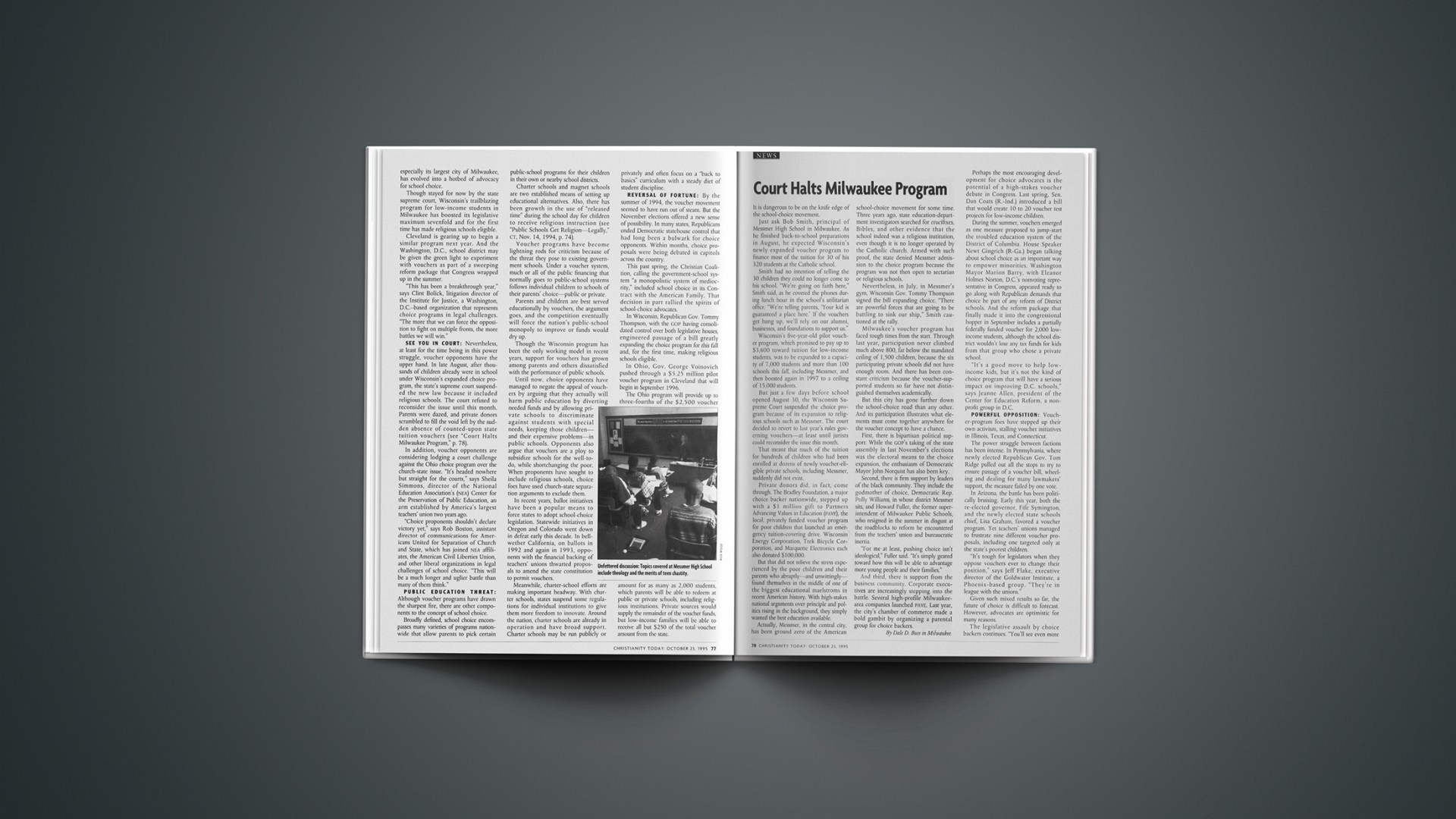

It is dangerous to be on the knife edge of the school-choice movement.
Just ask Bob Smith, principal of Messmer High School in Milwaukee. As he finished back-to-school preparations in August, he expected Wisconsin’s newly expanded voucher program to finance most of the tuition for 30 of his 320 students at the Catholic school.
Smith had no intention of telling the 30 children they could no longer come to his school. “We’re going on faith here,” Smith said, as he covered the phones during lunch hour in the school’s utilitarian office. “We’re telling parents, ‘Your kid is guaranteed a place here.’ If the vouchers get hung up, we’ll rely on our alumni, businesses, and foundations to support us.”
Wisconsin’s five-year-old pilot voucher program, which promised to pay up to $3,600 toward tuition for low-income students, was to be expanded to a capacity of 7,000 students and more than 100 schools this fall, including Messmer, and then boosted again in 1997 to a ceiling of 15,000 students.
But just a few days before school opened August 30, the Wisconsin Supreme Court suspended the choice program because of its expansion to religious schools such as Messmer. The court decided to revert to last year’s rules governing vouchers—at least until jurists could reconsider the issue this month.
That meant that much of the tuition for hundreds of children who had been enrolled at dozens of newly voucher-eligible private schools, including Messmer, suddenly did not exist.
Private donors did, in fact, come through. The Bradley Foundation, a major choice backer nationwide, stepped up with a $1 million gift to Partners Advancing Values in Education (PAVE), the local, privately funded voucher program for poor children that launched an emergency tuition-covering drive. Wisconsin Energy Corporation, Trek Bicycle Corporation, and Marquette Electronics each also donated $100,000.
But that did not relieve the stress experienced by the poor children and their parents who abruptly—and unwittingly—found themselves in the middle of one of the biggest educational maelstroms in recent American history. With high-stakes national arguments over principle and politics rising in the background, they simply wanted the best education available.
Actually, Messmer, in the central city, has been ground zero of the American school-choice movement for some time. Three years ago, state education-department investigators searched for crucifixes, Bibles, and other evidence that the school indeed was a religious institution, even though it is no longer operated by the Catholic church. Armed with such proof, the state denied Messmer admission to the choice program because the program was not then open to sectarian or religious schools.
Nevertheless, in July, in Messmer’s gym, Wisconsin Gov. Tommy Thompson signed the bill expanding choice. “There are powerful forces that are going to be battling to sink our ship,” Smith cautioned at the rally.
Milwaukee’s voucher program has faced tough times from the start. Through last year, participation never climbed much above 800, far below the mandated ceiling of 1,500 children, because the six participating private schools did not have enough room. And there has been constant criticism because the voucher-supported students so far have not distinguished themselves academically.
But this city has gone further down the school-choice road than any other. And its participation illustrates what elements must come together anywhere for the voucher concept to have a chance.
First, there is bipartisan political support: While the GOP’s taking of the state assembly in last November’s elections was the electoral means to the choice expansion, the enthusiasm of Democratic Mayor John Norquist has also been key.
Second, there is firm support by leaders of the black community. They include the godmother of choice, Democratic Rep. Polly Williams, in whose district Messmer sits, and Howard Fuller, the former superintendent of Milwaukee Public Schools, who resigned in the summer in disgust at the roadblocks to reform he encountered from the teachers’ union and bureaucratic inertia.
“For me at least, pushing choice isn’t ideological,” Fuller said. “It’s simply geared toward how this will be able to advantage more young people and their families.”
And third, there is support from the business community. Corporate executives are increasingly stepping into the battle. Several high-profile Milwaukee-area companies launched PAVE. Last year, the city’s chamber of commerce made a bold gambit by organizing a parental group for choice backers.
By Dale D. Buss in Milwaukee.