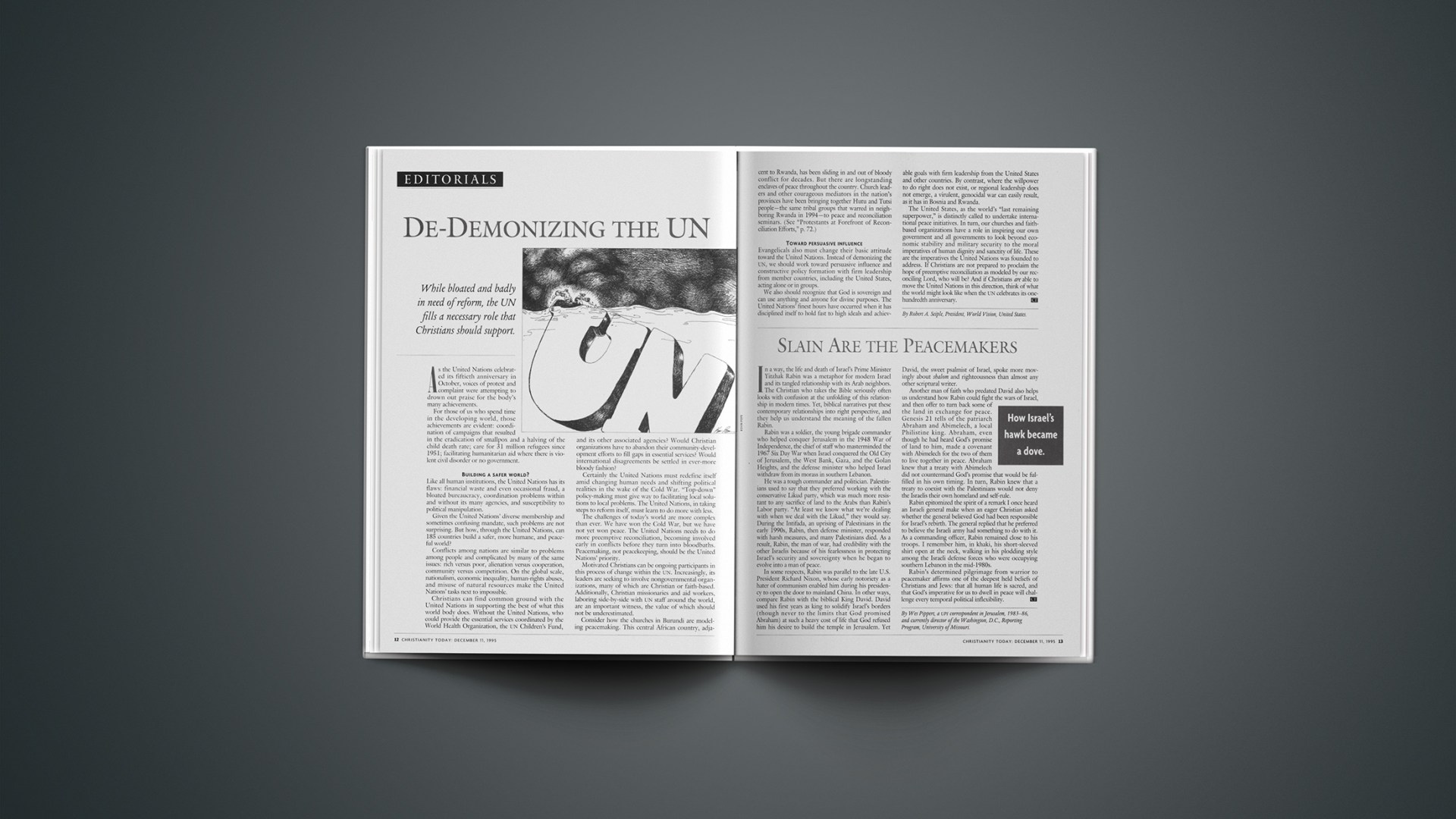

As the United Nations celebrated its fiftieth anniversary in October, voices of protest and complaint were attempting to drown out praise for the body's many achievements.
For those of us who spend time in the developing world, those achievements are evident: coordination of campaigns that resulted in the eradication of smallpox and a halving of the child death rate; care for 31 million refugees since 1951; facilitating humanitarian aid where there is violent civil disorder or no government.
BUILDING A SAFER WORLD?
Like all human institutions, the United Nations has its flaws: financial waste and even occasional fraud, a bloated bureaucracy, coordination problems within and without its many agencies, and susceptibility to political manipulation.
Given the United Nations' diverse membership and sometimes confusing mandate, such problems are not surprising. But how, through the United Nations, can 185 countries build a safer, more humane, and peaceful world?
Conflicts among nations are similar to problems among people and complicated by many of the same issues: rich versus poor, alienation versus cooperation, community versus competition. On the global scale, nationalism, economic inequality, human-rights abuses, and misuse of natural resources make the United Nations' tasks next to impossible.
Christians can find common ground with the United Nations in supporting the best of what this world body does. Without the United Nations, who could provide the essential services coordinated by the World Health Organization, the UN Children's Fund, and its other associated agencies? Would Christian organizations have to abandon their community-development efforts to fill gaps in essential services? Would international disagreements be settled in ever-more bloody fashion?
Certainly the United Nations must redefine itself amid changing human needs and shifting political realities in the wake of the Cold War. "Top-down" policy-making must give way to facilitating local solutions to local problems. The United Nations, in taking steps to reform itself, must learn to do more with less.
The challenges of today's world are more complex than ever. We have won the Cold War, but we have not yet won peace. The United Nations needs to do more preemptive reconciliation, becoming involved early in conflicts before they turn into bloodbaths. Peacemaking, not peacekeeping, should be the United Nations' priority.
Motivated Christians can be ongoing participants in this process of change within the UN. Increasingly, its leaders are seeking to involve nongovernmental organizations, many of which are Christian or faith-based. Additionally, Christian missionaries and aid workers, laboring side-by-side with UN staff around the world, are an important witness, the value of which should not be underestimated.
Consider how the churches in Burundi are modeling peacemaking. This central African country, adjacent to Rwanda, has been sliding in and out of bloody conflict for decades. But there are longstanding enclaves of peace throughout the country. Church leaders and other courageous mediators in the nation's provinces have been bringing together Hutu and Tutsi people—the same tribal groups that warred in neighboring Rwanda in 1994—to peace and reconciliation seminars. (See "Protestants at Forefront of Reconciliation Efforts," in this issue.)
TOWARD PERSUASIVE INFLUENCE
Evangelicals also must change their basic attitude toward the United Nations. Instead of demonizing the UN, we should work toward persuasive influence and constructive policy formation with firm leadership from member countries, including the United States, acting alone or in groups.
We also should recognize that God is sovereign and can use anything and anyone for divine purposes. The United Nations' finest hours have occurred when it has disciplined itself to hold fast to high ideals and achievable goals with firm leadership from the United States and other countries. By contrast, where the willpower to do right does not exist, or regional leadership does not emerge, a virulent, genocidal war can easily result, as it has in Bosnia and Rwanda.
The United States, as the world's "last remaining superpower," is distinctly called to undertake international peace initiatives. In turn, our churches and faith-based organizations have a role in inspiring our own government and all governments to look beyond economic stability and military security to the moral imperatives of human dignity and sanctity of life. These are the imperatives the United Nations was founded to address. If Christians are not prepared to proclaim the hope of preemptive reconciliation as modeled by our reconciling Lord, who will be? And if Christians are able to move the United Nations in this direction, think of what the world might look like when the UN celebrates its one-hundredth anniversary.
Copyright © 1995 Christianity Today. Click for reprint information.