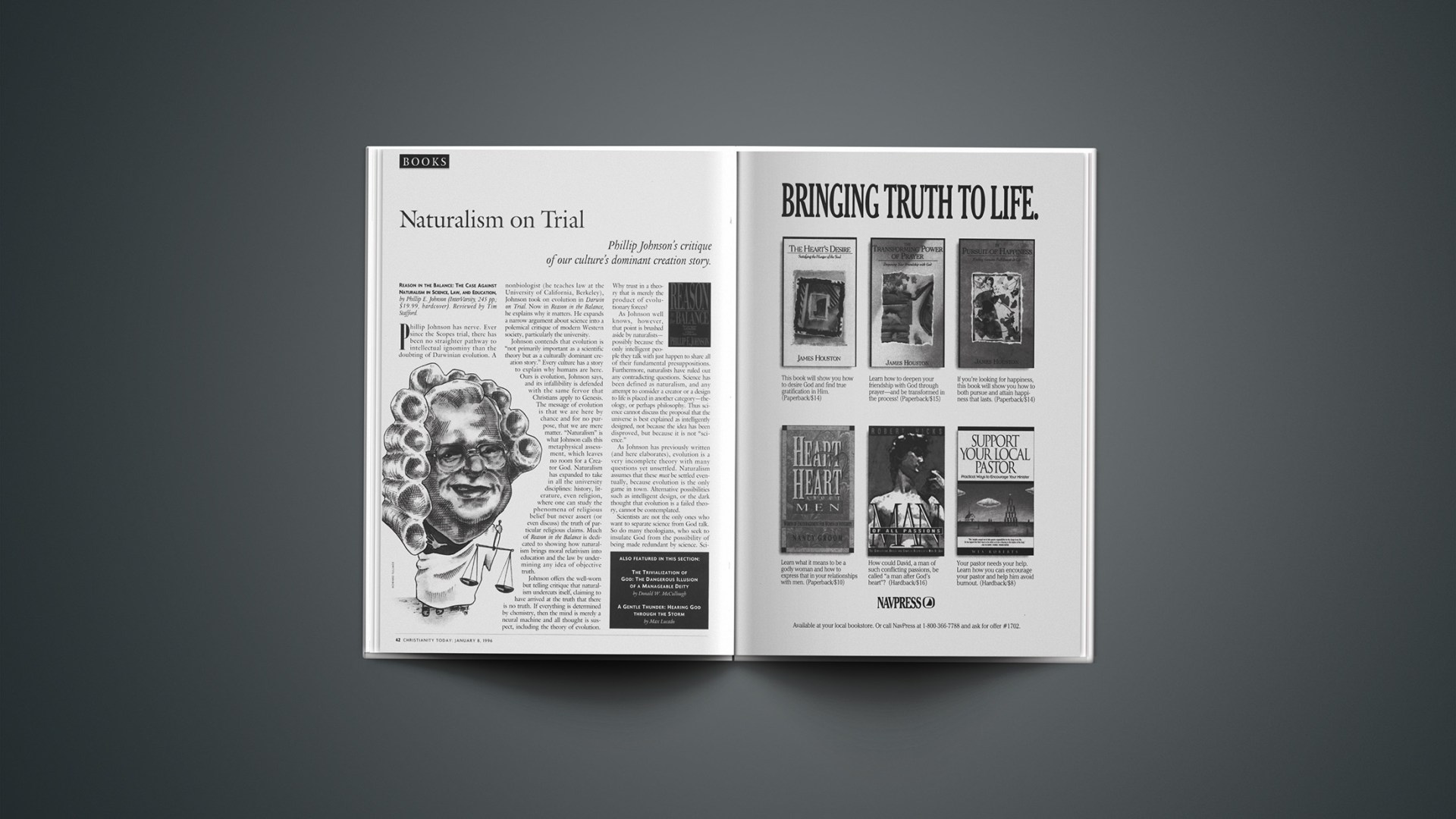

“Reason in the Balance: The Case Against Naturalism in Science, Law, and Education,” by Phillip E. Johnson (InterVarsity, 245 pp.; $19.99, hardcover). Reviewed by Tim Stafford.
Phillip Johnson has nerve. Ever since the Scopes trial, there has been no straighter pathway to intellectual ignominy than the doubting of Darwinian evolution. A nonbiologist (he teaches law at the University of California, Berkeley), Johnson took on evolution in “Darwin on Trial.” Now in “Reason in the Balance,” he explains why it matters. He expands a narrow argument about science into a polemical critique of modern Western society, particularly the university.
Johnson contends that evolution is “not primarily important as a scientific theory but as a culturally dominant creation story.” Every culture has a story to explain why humans are here. Ours is evolution, Johnson says, and its infallibility is defended with the same fervor that Christians apply to Genesis. The message of evolution is that we are here by chance and for no purpose, that we are mere matter. “Naturalism” is what Johnson calls this metaphysical assessment, which leaves no room for a Creator God. Naturalism has expanded to take in all the university disciplines: history, literature, even religion, where one can study the phenomena of religious belief but never assert (or even discuss) the truth of particular religious claims. Much of “Reason in the Balance” is dedicated to showing how naturalism brings moral relativism into education and the law by undermining any idea of objective truth.
Johnson offers the well-worn but telling critique that naturalism undercuts itself, claiming to have arrived at the truth that there is no truth. If everything is determined by chemistry, then the mind is merely a neural machine and all thought is suspect, including the theory of evolution. Why trust in a theory that is merely the product of evolutionary forces?
As Johnson well knows, however, that point is brushed aside by naturalists–possibly because the only intelligent people they talk with just happen to share all of their fundamental presuppositions. Furthermore, naturalists have ruled out any contradicting questions. Science has been defined as naturalism, and any attempt to consider a creator or a design to life is placed in another category–theology, or perhaps philosophy. Thus science cannot discuss the proposal that the universe is best explained as intelligently designed, not because the idea has been disproved, but because it is not “science.”
As Johnson has previously written (and here elaborates), evolution is a very incomplete theory with many questions yet unsettled. Naturalism assumes that these must be settled eventually, because evolution is the only game in town. Alternative possibilities such as intelligent design, or the dark thought that evolution is a failed theory, cannot be contemplated.
Scientists are not the only ones who want to separate science from God talk. So do many theologians, who seek to insulate God from the possibility of being made redundant by science. Science and theology operate in different realms, they say. Johnson perceives this as a rhetorical device useful to both sides for squelching debate. He prefers to say that if science can really show that God is unnecessary, we should accept that he does not exist rather than try to preserve him as a phantom.
It is evident that Johnson relishes an argument, and that he believes scientists (and other scholars) have suppressed free inquiry:
In the past geology had to free itself from religious bias so that it could consider possibilities like an old earth or the occurrence of ice ages rather than a worldwide flood. That job was accomplished long ago, and now scientific thought is restricted by naturalistic bias. Methodological naturalism is a bias in the sense that it constricts the mind, by limiting the possibilities open to serious consideration.
Johnson seems to believe that the tide has begun to turn away from naturalism. For as long as possible, however, the king wants to avoid a debate over the divine right of kings, and naturalistic science wants to avoid debate over whether naturalism is proved or merely assumed. Johnson seeks to force the discussion into the open. The heavy-handed methods of his scornful critics suggest that they sense their vulnerability.
In “Reason in the Balance” Johnson is on his natural turf. He is not a scientist. He is, however, an expert logician, and his arguments about the nature of the debate ring true. He has, as it were, asked for a reopening of the Scopes trial. He appears confident that God will do better the second time around–or at least that he, Johnson, will prove a better advocate than William Jennings Bryan did. The most interesting fact, if we imagine such a retrial, is how the antagonists have changed places. Clarence Darrow had a field day attacking the pious orthodoxy of creationism. Today evolution has become the pious orthodoxy, and it is creationists who hold the daring views too shocking for children to hear.
Copyright © 1996 Christianity Today. Click for reprint information.