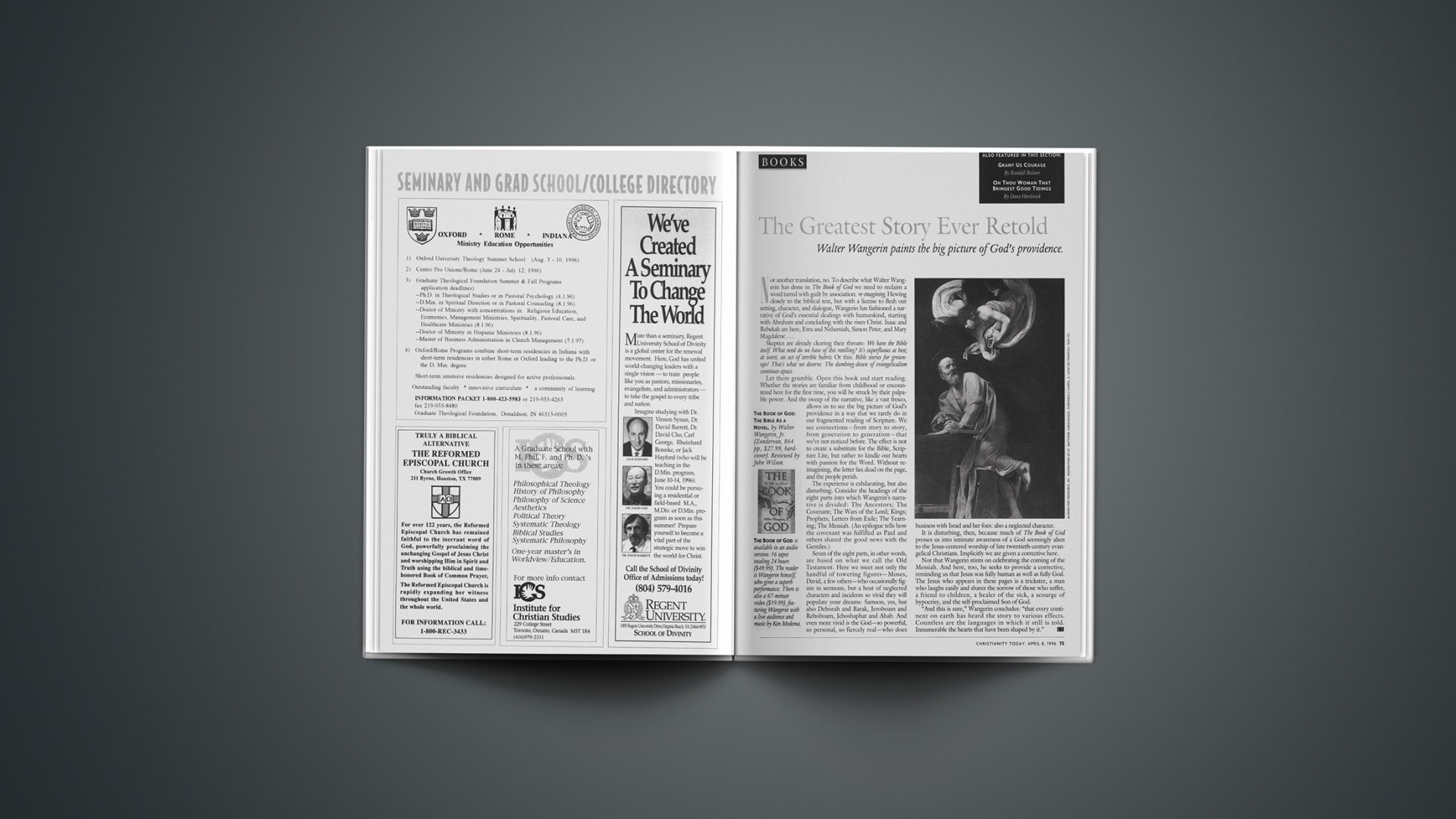

“The Book of God: The Bible As a Novel, by Walter Wangerin,” Jr. (Zondervan, 864 pp., $27.99, hardcover). Reviewed by John Wilson.
Not another translation, no. To describe what Walter Wangerin has done in “The Book of God” we need to reclaim a word tarred with guilt by association: re-imagining. Hewing closely to the biblical text, but with a license to flesh out setting, character, and dialogue, Wangerin has fashioned a narrative of God’s essential dealings with humankind, starting with Abraham and concluding with the risen Christ. Isaac and Rebekah are here, Ezra and Nehemiah, Simon Peter, and Mary Magdalene …
Skeptics are already clearing their throats: We have the Bible itself. What need do we have of this retelling? It’s superfluous at best; at worst, an act of terrible hubris. Or this: Bible stories for grown-ups! That’s what we deserve. The dumbing-down of evangelicalism continues apace.
Let them grumble. Open this book and start reading. Whether the stories are familiar from childhood or encountered here for the first time, you will be struck by their palpable power. And the sweep of the narrative, like a vast fresco, allows us to see the big picture of God’s providence in a way that we rarely do in our fragmented reading of Scripture. We see connections—from story to story, from generation to generation—that we’ve not noticed before. The effect is not to create a substitute for the Bible, Scripture Lite, but rather to kindle our hearts with passion for the Word. Without re-imagining, the letter lies dead on the page, and the people perish.
The experience is exhilarating, but also disturbing. Consider the headings of the eight parts into which Wangerin’s narrative is divided: The Ancestors; The Covenant; The Wars of the Lord; Kings; Prophets; Letters from Exile; The Yearning; The Messiah. (An epilogue tells how the covenant was fulfilled as Paul and others shared the good news with the Gentiles.)
Seven of the eight parts, in other words, are based on what we call the Old Testament. Here we meet not only the handful of towering figures—Moses, David, a few others—who occasionally figure in sermons, but a host of neglected characters and incidents so vivid they will populate your dreams: Samson, yes, but also Deborah and Barak, Jeroboam and Rehoboam, Jehoshaphat and Ahab. And even more vivid is the God—so powerful, so personal, so fiercely real—who does business with Israel and her foes: also a neglected character.
It is disturbing, then, because much of “The Book of God” presses us into intimate awareness of a God seemingly alien to the Jesus-centered worship of late twentieth-century evangelical Christians. Implicitly we are given a corrective here.
Not that Wangerin stints on celebrating the coming of the Messiah. And here, too, he seeks to provide a corrective, reminding us that Jesus was fully human as well as fully God. The Jesus who appears in these pages is a trickster, a man who laughs easily and shares the sorrow of those who suffer, a friend to children, a healer of the sick, a scourge of hypocrisy, and the self-proclaimed Son of God.
“And this is sure,” Wangerin concludes: “that every continent on earth has heard the story to various effects. Countless are the languages in which it still is told. Innumerable the hearts that have been shaped by it.”
“The Book of God” is available in an audio version: 16 tapes totaling 24 hours ($49.99). The reader is Wangerin himself, who gives a superb performance. There is also a 67-minute video ($19.99), featuring Wangerin with a live audience and music by Ken Medema.
Copyright © 1996 Christianity Today. Click for reprint information.