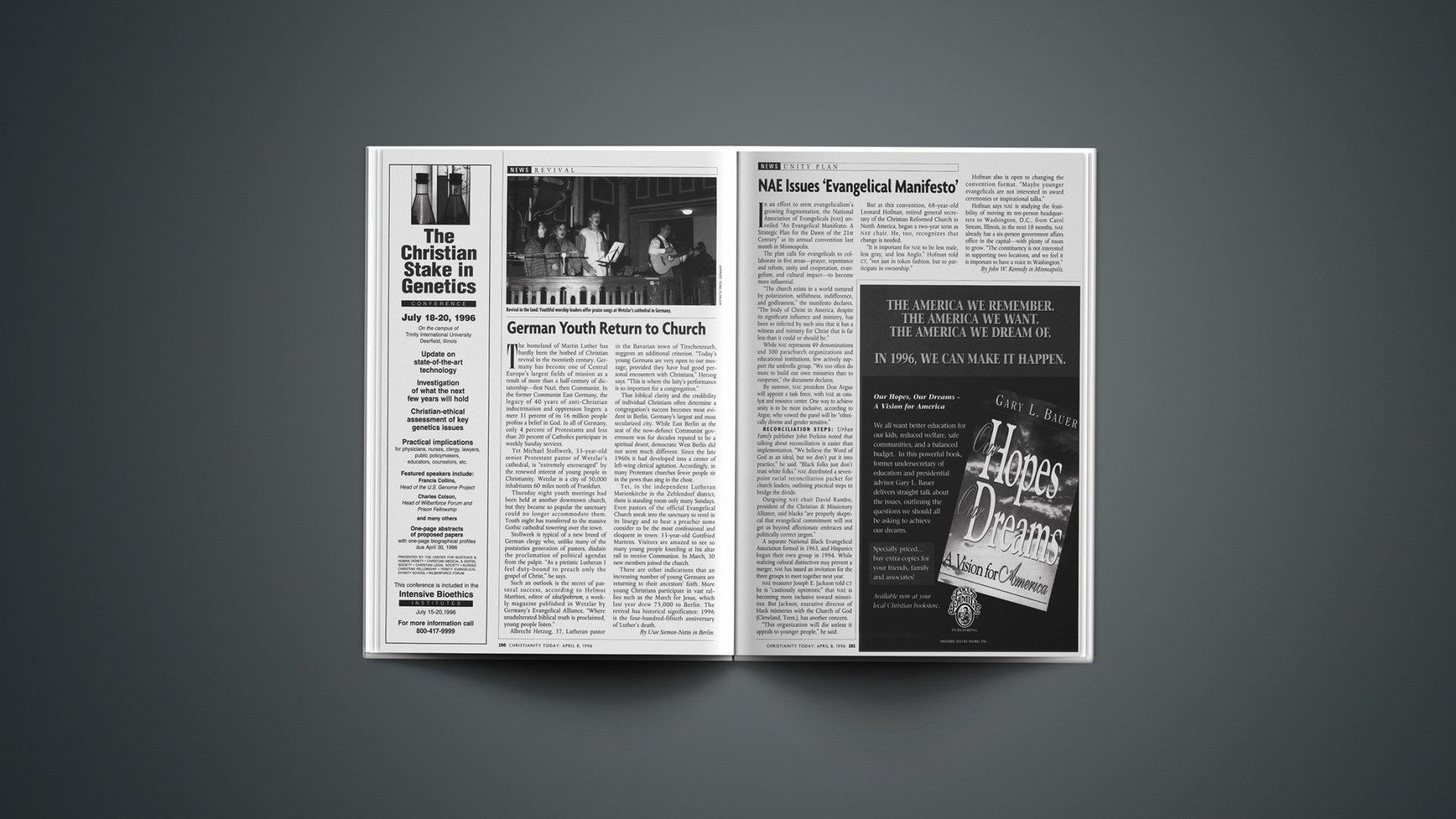

The homeland of Martin Luther has hardly been the hotbed of Christian revival in the twentieth century. Germany has become one of Central Europe’s largest fields of mission as a result of more than a half-century of dictatorship—first Nazi, then Communist. In the former Communist East Germany, the legacy of 40 years of anti-Christian indoctrination and oppression lingers: a mere 31 percent of its 16 million people profess a belief in God. In all of Germany, only 4 percent of Protestants and less than 20 percent of Catholics participate in weekly Sunday services.
Yet Michael Stollwerk, 33-year-old senior Protestant pastor of Wetzlar’s cathedral, is “extremely encouraged” by the renewed interest of young people in Christianity. Wetzlar is a city of 50,000 inhabitants 60 miles north of Frankfurt.
Thursday night youth meetings had been held at another downtown church, but they became so popular the sanctuary could no longer accommodate them. Youth night has transferred to the massive Gothic cathedral towering over the town.
Stollwerk is typical of a new breed of German clergy who, unlike many of the postsixties generation of pastors, disdain the proclamation of political agendas from the pulpit. “As a pietistic Lutheran I feel duty-bound to preach only the gospel of Christ,” he says.
Such an outlook is the secret of pastoral success, according to Helmut Matthies, editor of “ideaSpektrum,” a weekly magazine published in Wetzlar by Germany’s Evangelical Alliance. “Where unadulterated biblical truth is proclaimed, young people listen.”
Albrecht Herzog, 37, Lutheran pastor in the Bavarian town of Tirschenreuth, suggests an additional criterion. “Today’s young Germans are very open to our message, provided they have had good personal encounters with Christians,” Herzog says. “This is where the laity’s performance is so important for a congregation.”
That biblical clarity and the credibility of individual Christians often determine a congregation’s success becomes most evident in Berlin, Germany’s largest and most secularized city. While East Berlin as the seat of the now-defunct Communist government was for decades reputed to be a spiritual desert, democratic West Berlin did not seem much different. Since the late 1960s it had developed into a center of left-wing clerical agitation. Accordingly, in many Protestant churches fewer people sit in the pews than sing in the choir.
Yet, in the independent Lutheran Marienkirche in the Zehlendorf district, there is standing room only many Sundays. Even pastors of the official Evangelical Church sneak into the sanctuary to revel in its liturgy and to hear a preacher some consider to be the most confessional and eloquent in town: 33-year-old Gottfried Martens. Visitors are amazed to see so many young people kneeling at his altar rail to receive Communion. In March, 30 new members joined the church.
There are other indications that an increasing number of young Germans are returning to their ancestors’ faith. More young Christians participate in vast rallies such as the March for Jesus, which last year drew 75,000 to Berlin. The revival has historical significance: 1996 is the four-hundred-fiftieth anniversary of Luther’s death.
Copyright © 1996 Christianity Today. Click for reprint information.