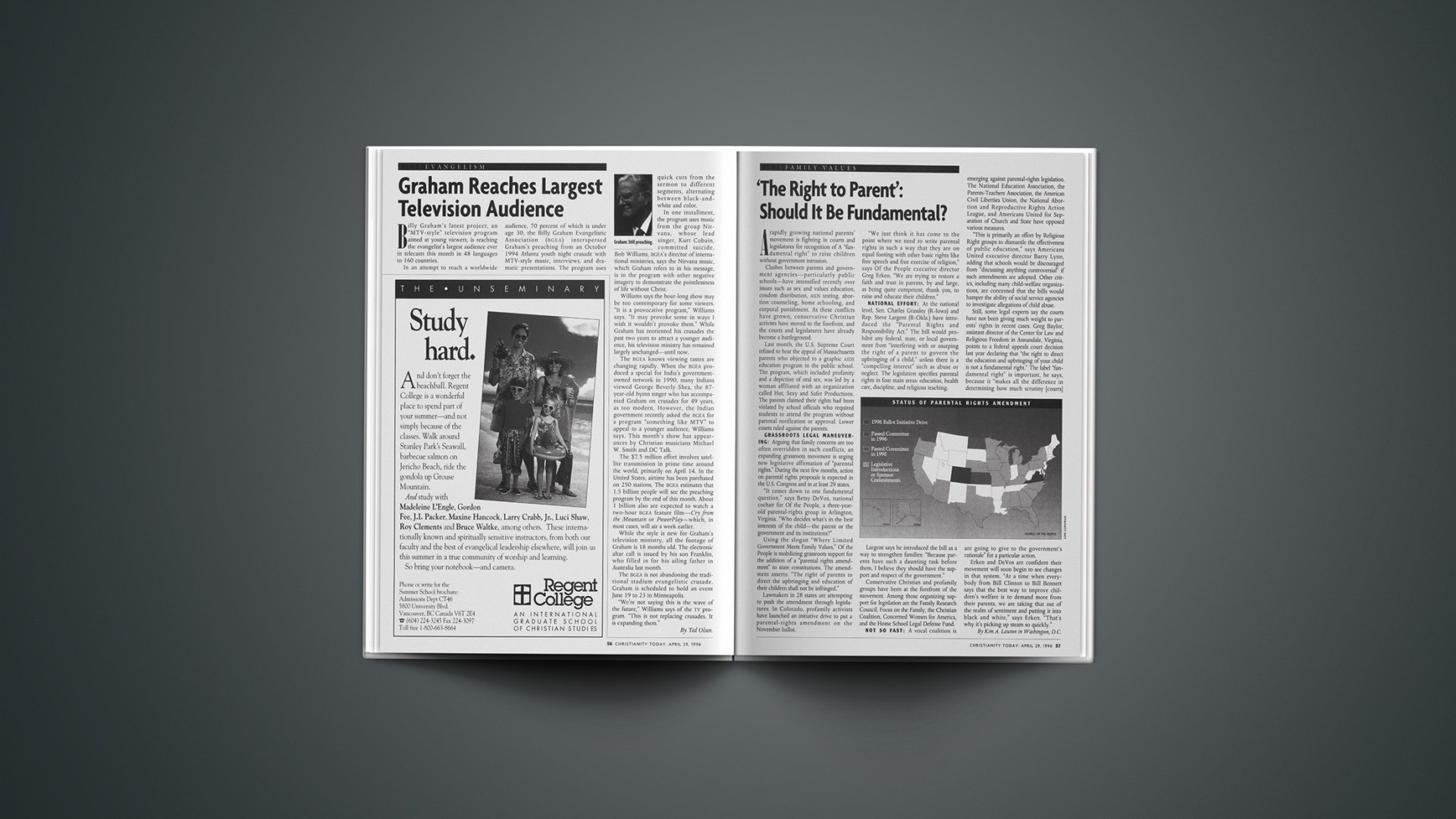

A rapidly growing national parents’ movement is fighting in courts and legislatures for recognition of A “fundamental right” to raise children without government intrusion.
Clashes between parents and government agencies–particularly public schools–have intensified recently over issues such as sex and values education, condom distribution, AIDS testing, abortion counseling, home schooling, and corporal punishment. As these conflicts have grown, conservative Christian activists have moved to the forefront, and the courts and legislatures have already become a battleground.
Last month, the U.S. Supreme Court refused to hear the appeal of Massachusetts parents who objected to a graphic AIDS education program in the public school. The program, which included profanity and a depiction of oral sex, was led by a woman affiliated with an organization called Hot, Sexy and Safer Productions. The parents claimed their rights had been violated by school officials who required students to attend the program without parental notification or approval. Lower courts ruled against the parents.
GRASSROOTS LEGAL MANEUVERING: Arguing that family concerns are too often overridden in such conflicts, an expanding grassroots movement is urging new legislative affirmation of “parental rights.” During the next few months, action on parental rights proposals is expected in the U.S. Congress and in at least 29 states.
“It comes down to one fundamental question,” says Betsy DeVos, national cochair for Of the People, a three-year-old parental-rights group in Arlington, Virginia. “Who decides what’s in the best interests of the child–the parent or the government and its institutions?”
Using the slogan “Where Limited Government Meets Family Values,” Of the People is mobilizing grassroots support for the addition of a “parental rights amendment” to state constitutions. The amendment asserts: “The right of parents to direct the upbringing and education of their children shall not be infringed.”
Lawmakers in 28 states are attempting to push the amendment through legislatures. In Colorado, profamily activists have launched an initiative drive to put a parental-rights amendment on the November ballot.
“We just think it has come to the point where we need to write parental rights in such a way that they are on equal footing with other basic rights like free speech and free exercise of religion,” says Of the People executive director Greg Erken. “We are trying to restore a faith and trust in parents, by and large, as being quite competent, thank you, to raise and educate their children.”
NATIONAL EFFORT: At the national level, Sen. Charles Grassley (R-Iowa) and Rep. Steve Largent (R-Okla.) have introduced the “Parental Rights and Responsibility Act.” The bill would prohibit any federal, state, or local government from “interfering with or usurping the right of a parent to govern the upbringing of a child,” unless there is a “compelling interest” such as abuse or neglect. The legislation specifies parental rights in four main areas: education, health care, discipline, and religious teaching.
Largent says he introduced the bill as a way to strengthen families: “Because parents have such a daunting task before them, I believe they should have the support and respect of the government.”
Conservative Christian and profamily groups have been at the forefront of the movement. Among those organizing support for legislation are the Family Research Council, Focus on the Family, the Christian Coalition, Concerned Women for America, and the Home School Legal Defense Fund.
NOT SO FAST: A vocal coalition is emerging against parental-rights legislation. The National Education Association, the Parents-Teachers Association, the American Civil Liberties Union, the National Abortion and Reproductive Rights Action League, and Americans United for Separation of Church and State have opposed various measures.
“This is primarily an effort by Religious Right groups to dismantle the effectiveness of public education,” says Americans United executive director Barry Lynn, adding that schools would be discouraged from “discussing anything controversial” if such amendments are adopted. Other critics, including many child-welfare organizations, are concerned that the bills would hamper the ability of social service agencies to investigate allegations of child abuse.
Still, some legal experts say the courts have not been giving much weight to parents’ rights in recent cases. Greg Baylor, assistant director of the Center for Law and Religious Freedom in Annandale, Virginia, points to a federal appeals court decision last year declaring that “the right to direct the education and upbringing of your child is not a fundamental right.” The label “fundamental right” is important, he says, because it “makes all the difference in determining how much scrutiny [courts] are going to give to the government’s rationale” for a particular action.
Erken and DeVos are confident their movement will soon begin to see changes in that system. “At a time when everybody from Bill Clinton to Bill Bennett says that the best way to improve children’s welfare is to demand more from their parents, we are taking that out of the realm of sentiment and putting it into black and white,” says Erken. “That’s why it’s picking up steam so quickly.”
Copyright © 1996 Christianity Today. Click for reprint information.