
“Do not be afraid, Mary, for you have found favor with God. And now, you will conceive in your womb and bear a son, and you will name him Jesus” (NRSV).
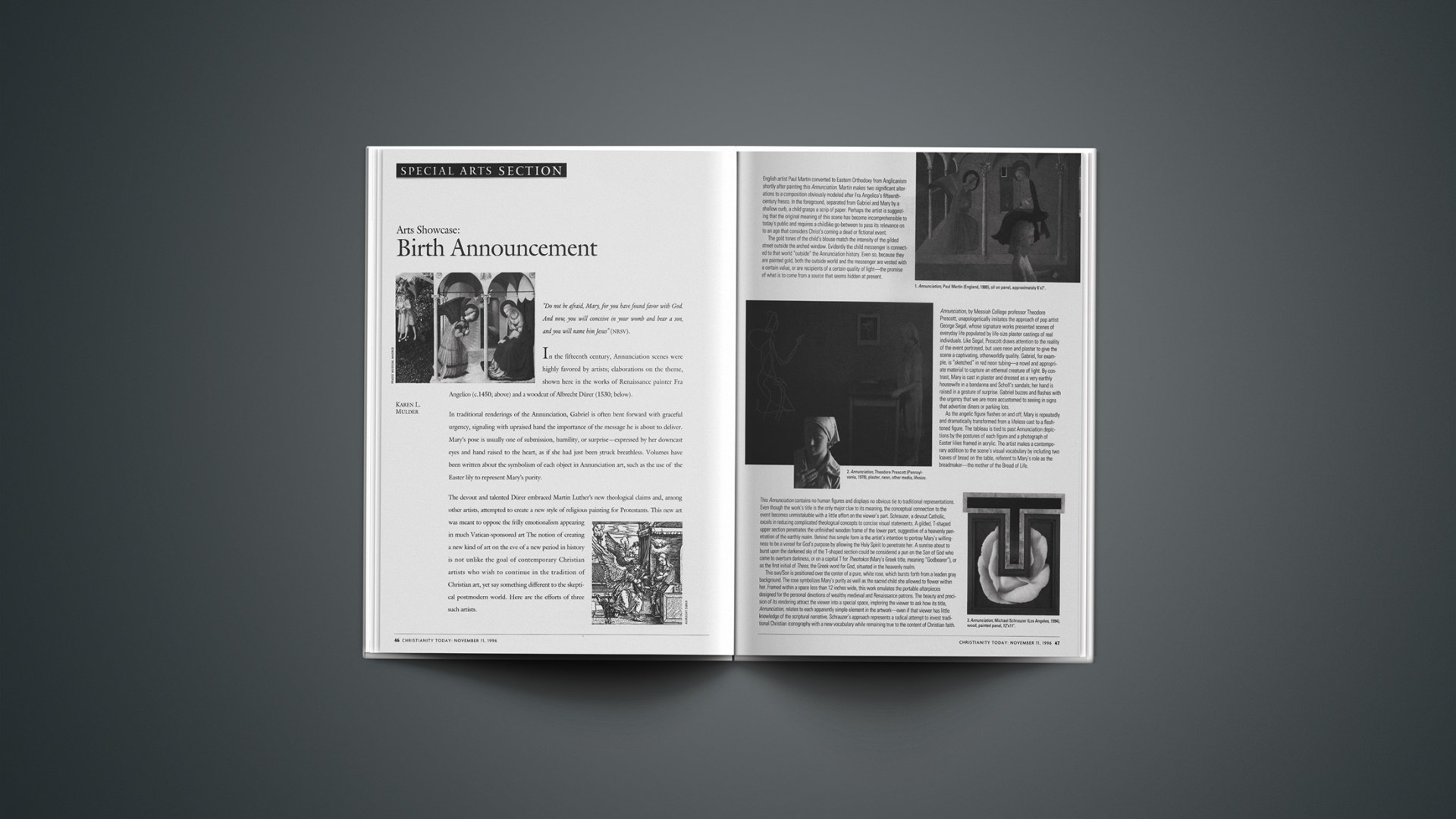
In the fifteenth century, Annunciation scenes were highly favored by artists; elaborations on the theme, shown here in the works of Renaissance painter Fra Angelico and a woodcut of Albrecht Dürer.
In traditional renderings of the Annunciation, Gabriel is often bent forward with graceful urgency, signaling with upraised hand the importance of the message he is about to deliver. Mary’s pose is usually one of submission, humility, or surprise—expressed by her downcast eyes and hand raised to the heart, as if she had just been struck breathless. Volumes have been written about the symbolism of each object in Annunciation art, such as the use of the Easter lily to represent Mary’s purity.
The devout and talented D?mbraced Martin Luther’s new theological claims and, among other artists, attempted to create a new style of religious painting for Protestants. This new art was meant to oppose the frilly emotionalism appearing in much Vatican-sponsored art The notion of creating a new kind of art on the eve of a new period in history is not unlike the goal of contemporary Christian artists who wish to continue in the tradition of Christian art, yet say something different to the skeptical postmodern world. Here are the efforts of three such artists.
1. Annuciation, Paul Martin (England, 1988), oil on panel, approximately 6’x7′.English artist Paul Martin converted to Eastern Orthodoxy from Anglicanism shortly after painting this Annunciation. Martin makes two significant alterations to a composition obviously modeled after Fra Angelico’s fifteenth-century fresco. In the foreground, separated from Gabriel and Mary by a shallow curb, a child grasps a scrip of paper. Perhaps the artist is suggesting that the original meaning of this scene has become incomprehensible to today’s public and requires a childlike go-between to pass its relevance on to an age that considers Christ’s coming a dead or fictional event.
The gold tones of the child’s blouse match the intensity of the gilded street outside the arched window. Evidently the child messenger is connected to that world “outside” the Annunciation history. Even so, because they are painted gold, both the outside world and the messenger are vested with a certain value, or are recipients of a certain quality of light—the promise of what is to come from a source that seems hidden at present.
2.Annuciation, Theodore Prescott (Pensylvania, 1978), plaster, neon, other media, lifesize.Annunciation, by Messiah College professor Theodore Prescott, unapologetically imitates the approach of pop artist George Segal, whose signature works presented scenes of everyday life populated by life-size plaster castings of real individuals. Like Segal, Prescott draws attention to the reality of the event portrayed, but uses neon and plaster to give the scene a captivating, otherworldly quality. Gabriel, for example, is “sketched” in red neon tubing—a novel and appropriate material to capture an ethereal creature of light. By contrast, Mary is cast in plaster and dressed as a very earthly housewife in a bandanna and Scholl’s sandals; her hand is raised in a gesture of surprise. Gabriel buzzes and flashes with the urgency that we are more accustomed to seeing in signs that advertise diners or parking lots.
As the angelic figure flashes on and off, Mary is repeatedly and dramatically transformed from a lifeless cast to a flesh-toned figure. The tableau is tied to past Annunciation depictions by the postures of each figure and a photograph of Easter lilies framed in acrylic. The artist makes a contemporary addition to the scene’s visual vocabulary by including two loaves of bread on the table, referent to Mary’s role as the breadmaker—the mother of the Bread of Life.
3. Annuciation, Michael Schrauzer (Los Angeles, 1994), wood, painted panel, 12″x11″.This Annunciation contains no human figures and displays no obvious tie to traditional representations. Even though the work’s title is the only major clue to its meaning, the conceptual connection to the event becomes unmistakable with a little effort on the viewer’s part. Schrauzer, a devout Catholic, excels in reducing complicated theological concepts to concise visual statements. A gilded, T-shaped upper section penetrates the unfinished wooden frame of the lower part, suggestive of a heavenly penetration of the earthly realm. Behind this simple form is the artist’s intention to portray Mary’s willingness to be a vessel for God’s purpose by allowing the Holy Spirit to penetrate her. A sunrise about to burst upon the darkened sky of the T-shaped section could be considered a pun on the Son of God who came to overturn darkness, or on a capital T for Theotokos (Mary’s Greek title, meaning “Godbearer”), or as the first initial of Theos, the Greek word for God, situated in the heavenly realm.
This sun/Son is positioned over the center of a pure, white rose, which bursts forth from a leaden gray background. The rose symbolizes Mary’s purity as well as the sacred child she allowed to flower within her. Framed within a space less than 12 inches wide, this work emulates the portable altarpieces designed for the personal devotions of wealthy medieval and Renaissance patrons. The beauty and precision of its rendering attract the viewer into a special space, imploring the viewer to ask how its title, Annunciation, relates to each apparently simple element in the artwork—even if that viewer has little knowledge of the scriptural narrative. Schrauzer’s approach represents a radical attempt to invest traditional Christian iconography with a new vocabulary while remaining true to the content of Christian faith.
Copyright © 1996 Christianity Today. Click for reprint information.