
Lutheran pastor and seminary professor Paul Berge says he is pleased that he ministered to all Protestants and not just Lutherans during his tour as a U.S. Air Force chaplain in the Vietnam War. “I am an ecumenist at heart,” Berge says.
Berge, however, is one ecumenist who actively opposes the proposed concordat of agreement that would bring the Evangelical Lutheran Church in America (ELCA) into “full communion” with the Episcopal Church. Both denominations will vote on the concordat this summer.
Berge served as one of eight members on the Lutheran-Episcopal Dialogue, which held 14 meetings from 1983 to 1991. Berge, of Luther Seminary in Saint Paul, Minnesota, and Robert J. Goeser, of Pacific Lutheran Theological Seminary in Berkeley, California, wrote a dissenting report in 1991 when the dialogue group released the concordat for consideration by both denominations.
Berge and Goeser now stand in a less lonely place. Others opposing the concordat include some ELCA bishops, many pastors, and at least 50 seminarians.
RELINQUISHING TOO MUCH? Opponents within the ELCA are concerned that the concordat requires Lutherans to sacrifice too many aspects of Lutheran identity for the sake of full communion with Episcopalians.
Opponents say that the concordat will:
—Commit Lutherans to the threefold ministry of bishops, priests, and deacons as taught by Anglicanism.
—Change Lutheran theology of bishops by requiring that all future bishops be “consecrated/installed” by at least three Episcopal and three Lutheran bishops. Opponents object to Episcopalians’ insistence on incorporating future Lutheran bishops into “apostolic succession” through such services.
—Require that all future ELCA pastors be ordained by at least one bishop. (ELCA bishops currently may authorize pastors to ordain.)
—Damage Lutherans’ confessional heritage, because Episcopal clergy will not be required to subscribe to the Augsburg Confession.
“This is not only horse trading, but it is bad horse trading,” Berge says. “In terms of church structure and theology, Lutherans become Episcopalians, and Episcopalians remain Episcopalians.”
But Walter Bouman of Trinity Lutheran Seminary in Columbus, Ohio, who served on the Lutheran-Episcopal Dialogue with Berge, asserts that it is “a lie” to say the corcordat gives Lutherans the short end of the stick.
Bouman, widely considered a key architect of the concordat, says Lutherans will not be committed to a threefold ministry. However, a revised version of the concordat, issued in November 1996 by the Lutheran-Episcopal Joint Coordinating Committee, declares: “We agree that the threefold ministry of bishops, presbyters, and deacons in historic succession will be the future pattern of the one ordained ministry of Word and Sacrament.”
Bouman insists, “This is not a merger. Both churches remain autonomous, and both churches accommodate each other.”
Episcopalians accommodate Lutherans, he says, by immediately recognizing the full authenticity of all ELCA ministers.
Bouman sees the concordat as “a great opportunity to bring about an end to some of the denominationalism in the United States.”
“Beliefs do matter,” Bouman says. “There is a good and orderly way for us to resolve our differences of the past and to enter into full communion.”
DIFFERING BISHOPS: ELCA’s Conference of Bishops expressed 13 concerns during a joint meeting with the Episcopal Church’s House of Bishops in October. The Joint Coordinating Committee addressed many of those concerns in the revised concordat it issued a month later.
Those changes satisfied ELCA Bishop Steven L. Ullestad of Waverly, Iowa, who says he had been “fairly sure I could not have supported it” otherwise.
“My experience is that once people are able to read what is in the revised proposal, they are more open to being favorable,” Ullestad says. “It’s starting to capture people’s imaginations, to move them off of cliches and into real dreaming about possibilities.”
ELCA Bishop Richard Foss of Fargo, North Dakota, has not been persuaded by the revised language.
Foss says he does not consider the concordat an effective approach to mission. “Bishops should not be the center of the church,” he says. “I don’t understand ecumenism to be accomplished primarily through structures and institutions.”
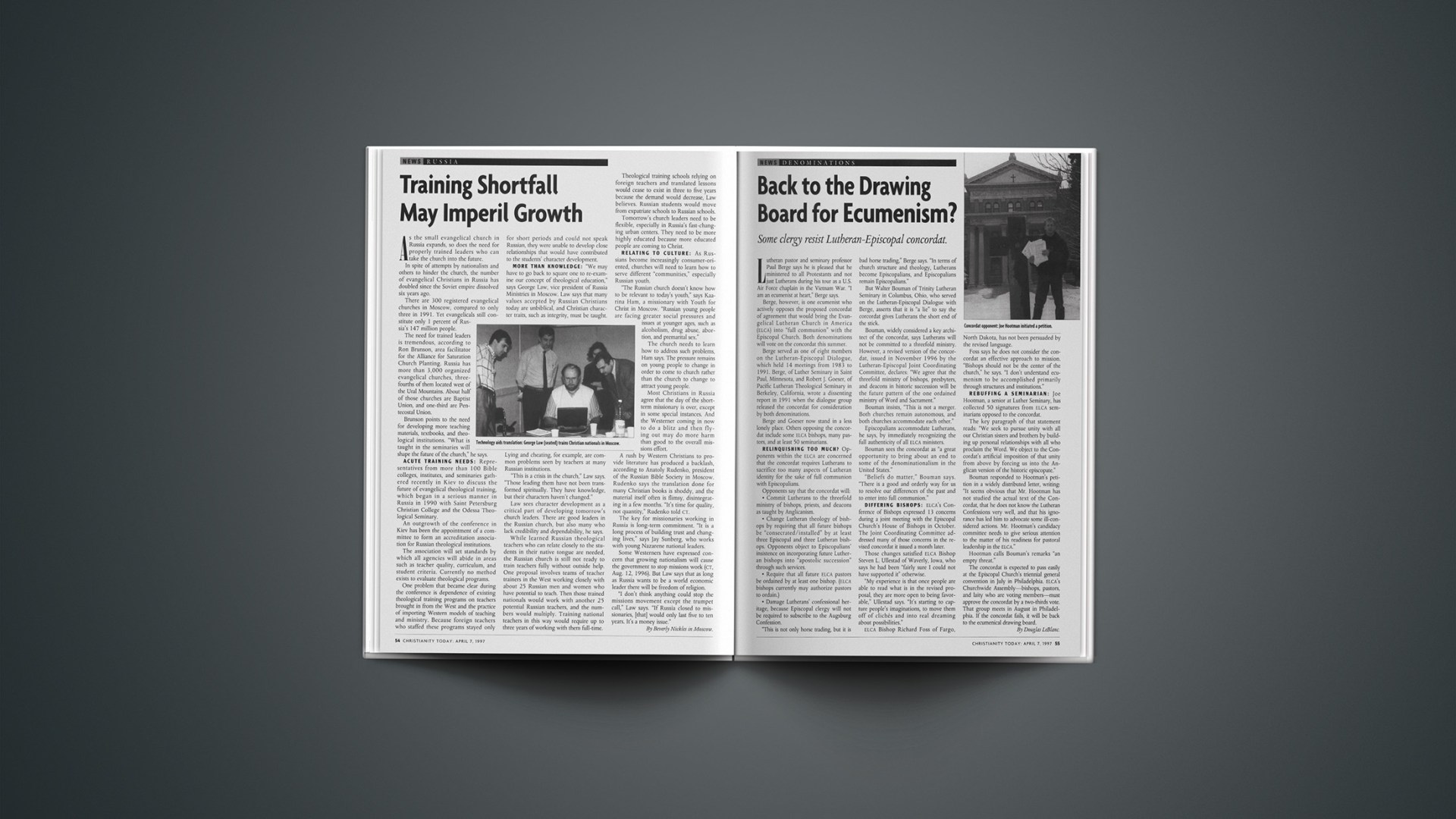
REBUFFING A SEMINARIAN: Joe Hootman, a senior at Luther Seminary, has collected 50 signatures ELCA elca seminarians opposed to the concordat.
The key paragraph of that statement reads: “We seek to pursue unity with all our Christian sisters and brothers by building up personal relationships with all who proclaim the Word. We object to the Concordat’s artificial imposition of that unity from above by forcing us into the Anglican version of the historic episcopate.”
Bouman responded to Hootman’s petition in a widely distributed letter, writing: “It seems obvious that Mr. Hootman has not studied the actual text of the Concordat, that he does not know the Lutheran Confessions very well, and that his ignorance has led him to advocate some ill-considered actions. Mr. Hootman’s candidacy committee needs to give serious attention to the matter of his readiness for pastoral leadership in the ELCA.”
Hootman calls Bouman’s remarks “an empty threat.”
The concordat is expected to pass easily at the Episcopal Church’s triennial general convention in July in Philadelphia. ELCA’s Churchwide Assembly—bishops, pastors, and laity who are voting members—must approve the concordat by a two-thirds vote. That group meets in August in Philadelphia. If the concordat fails, it will be back to the ecumenical drawing board.
Copyright © 1997 Christianity Today. Click for reprint information.