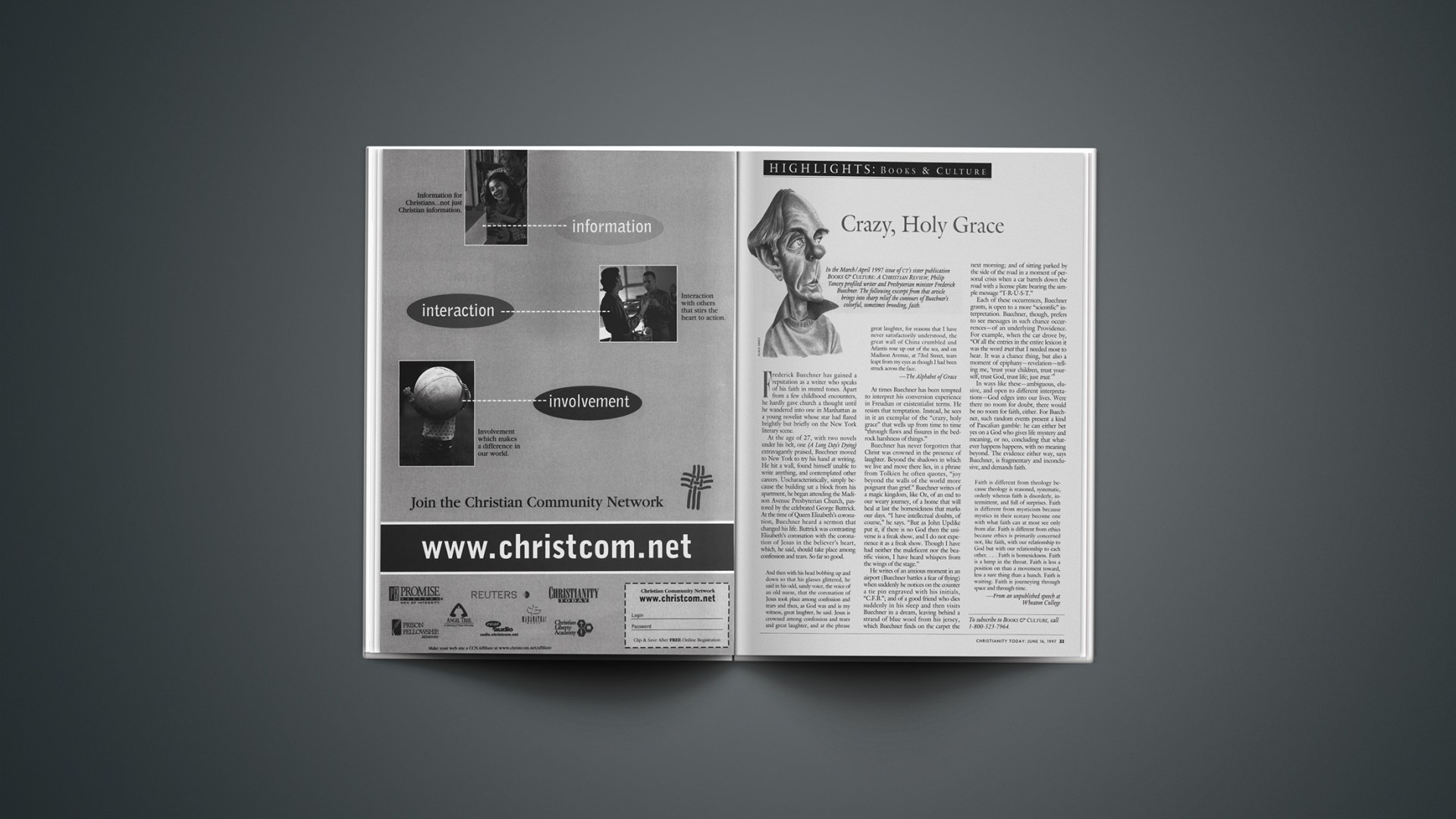

In the March/April 1997 issue of CT's sister publication BOOKS & CULTURE: A Christian Review, Philip Yancey profiled writer and Presbyterian minister Frederick Buechner [print only]. The following excerpt from that article brings into sharp relief the contours of Buechner's colorful, sometimes brooding, faith.
Frederick Buechner has gained a reputation as a writer who speaks of his faith in muted tones. Apart from a few childhood encounters, he hardly gave church a thought until he wandered into one in Manhattan as a young novelist whose star had flared brightly but briefly on the New York literary scene.
At the age of 27, with two novels under his belt, one (A Long Day's Dying) extravagantly praised, Buechner moved to New York to try his hand at writing. He hit a wall, found himself unable to write anything, and contemplated other careers. Uncharacteristically, simply because the building sat a block from his apartment, he began attending the Madison Avenue Presbyterian Church, pastored by the celebrated George Buttrick. At the time of Queen Elizabeth's coronation, Buechner heard a sermon that changed his life. Buttrick was contrasting Elizabeth's coronation with the coronation of Jesus in the believer's heart, which, he said, should take place among confession and tears. So far so good.
And then with his head bobbing up and down so that his glasses glittered, he said in his odd, sandy voice, the voice of an old nurse, that the coronation of Jesus took place among confession and tears and then, as God was and is my witness, great laughter, he said. Jesus is crowned among confession and tears and great laughter, and at the phrase great laughter, for reasons that I have never satisfactorily understood, the great wall of China crumbled and Atlantis rose up out of the sea, and on Madison Avenue, at 73rd Street, tears leapt from my eyes as though I had been struck across the face.
—The Alphabet of Grace
At times Buechner has been tempted to interpret his conversion experience in Freudian or existentialist terms. He resists that temptation. Instead, he sees in it an exemplar of the "crazy, holy grace" that wells up from time to time "through flaws and fissures in the bedrock harshness of things."
Buechner has never forgotten that Christ was crowned in the presence of laughter. Beyond the shadows in which we live and move there lies, in a phrase from Tolkien he often quotes, "joy beyond the walls of the world more poignant than grief." Buechner writes of a magic kingdom, like Oz, of an end to our weary journey, of a home that will heal at last the homesickness that marks our days. "I have intellectual doubts, of course," he says. "But as John Updike put it, if there is no God then the universe is a freak show, and I do not experience it as a freak show. Though I have had neither the maleficent nor the beatific vision, I have heard whispers from the wings of the stage."
He writes of an anxious moment in an airport (Buechner battles a fear of flying) when suddenly he notices on the counter a tie pin engraved with his initials, "C.F.B."; and of a good friend who dies suddenly in his sleep and then visits Buechner in a dream, leaving behind a strand of blue wool from his jersey, which Buechner finds on the carpet the next morning; and of sitting parked by the side of the road in a moment of personal crisis when a car barrels down the road with a license plate bearing the simple message "T-R-U-S-T."
Each of these occurrences, Buechner grants, is open to a more "scientific" interpretation. Buechner, though, prefers to see messages in such chance occurrences—of an underlying Providence. For example, when the car drove by, "Of all the entries in the entire lexicon it was the word trust that I needed most to hear. It was a chance thing, but also a moment of epiphany—revelation—telling me, 'trust your children, trust yourself, trust God, trust life; just trust.' "
In ways like these—ambiguous, elusive, and open to different interpretations—God edges into our lives. Were there no room for doubt, there would be no room for faith, either. For Buechner, such random events present a kind of Pascalian gamble: he can either bet yes on a God who gives life mystery and meaning, or no, concluding that whatever happens happens, with no meaning beyond. The evidence either way, says Buechner, is fragmentary and inconclusive, and demands faith.
Faith is different from theology because theology is reasoned, systematic, orderly whereas faith is disorderly, intermittent, and full of surprises. Faith is different from mysticism because mystics in their ecstasy become one with what faith can at most see only from afar. Faith is different from ethics because ethics is primarily concerned not, like faith, with our relationship to God but with our relationship to each other. … Faith is homesickness. Faith is a lump in the throat. Faith is less a position on than a movement toward, less a sure thing than a hunch. Faith is waiting. Faith is journeying through space and through time.
—From an unpublished speech at Wheaton College
To subscribe to BOOKS & CULTURE, call 1-800-523-7964.
Copyright © 1997 Christianity Today. Click for reprint information.