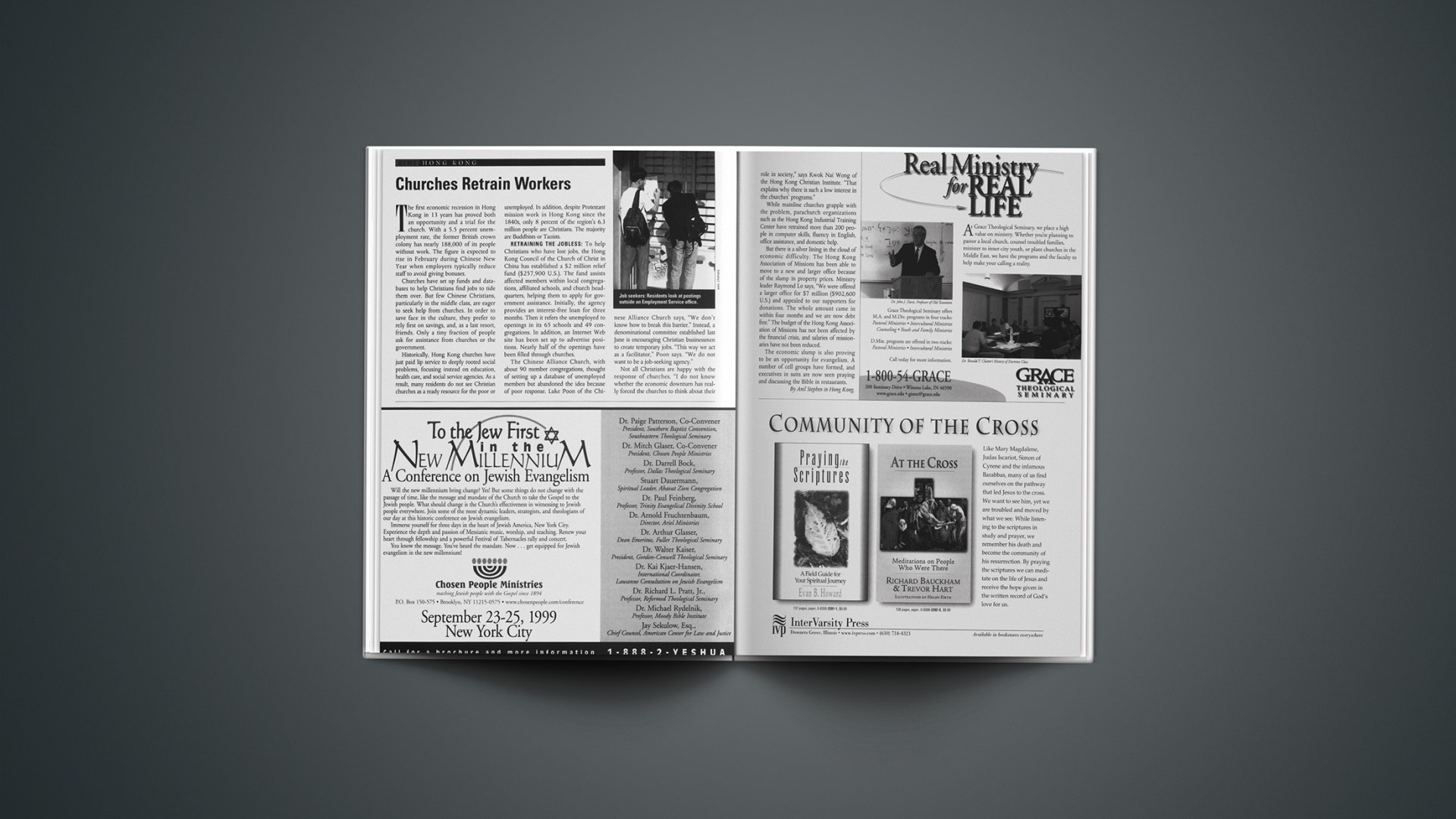
Churches Retrain Workers

The first economic recession in Hong Kong in 13 years has proved both an opportunity and a trial for the church. With a 5.5 percent unemployment rate, the former British crown colony has nearly 188,000 of its people without work. The figure is expected to rise in February during Chinese New Year when employers typically reduce staff to avoid giving bonuses.

Churches have set up funds and databases to help Christians find jobs to tide them over. But few Chinese Christians, particularly in the middle class, are eager to seek help from churches. In order to save face in the culture, they prefer to rely first on savings, and, as a last resort, friends. Only a tiny fraction of people ask for assistance from churches or the government.

Historically, Hong Kong churches have just paid lip service to deeply rooted social problems, focusing instead on education, health care, and social service agencies. As a result, many residents do not see Christian churches as a ready resource for the poor or unemployed. In addition, despite Protestant mission work in Hong Kong since the 1840s, only 8 percent of the region’s 6.3 million people are Christians. The majority are Buddhists or Taoists.

RETRAINING THE JOBLESS: To help Christians who have lost jobs, the Hong Kong Council of the Church of Christ in China has established a $2 million relief fund ($257,900 U.S.). The fund assists affected members within local congregations, affiliated schools, and church headquarters, helping them to apply for government assistance. Initially, the agency provides an interest-free loan for three months. Then it refers the unemployed to openings in its 65 schools and 49 congregations. In addition, an Internet Web site has been set up to advertise positions. Nearly half of the openings have been filled through churches.

The Chinese Alliance Church, with about 90 member congregations, thought of setting up a database of unemployed members but abandoned the idea because of poor response. Luke Poon of the Chinese Alliance Church says, “We don’t know how to break this barrier.” Instead, a denominational committee established last June is encouraging Christian businessmen to create temporary jobs. “This way we act as a facilitator,” Poon says. “We do not want to be a job-seeking agency.”

Not all Christians are happy with the response of churches. “I do not know whether the economic downturn has really forced the churches to think about their role in society,” says Kwok Nai Wong of the Hong Kong Christian Institute. “That explains why there is such a low interest in the churches’ programs.”

While mainline churches grapple with the problem, parachurch organizations such as the Hong Kong Industrial Training Center have retrained more than 200 people in computer skills, fluency in English, office assistance, and domestic help.

But there is a silver lining in the cloud of economic difficulty. The Hong Kong Association of Missions has been able to move to a new and larger office because of the slump in property prices. Ministry leader Raymond Lo says, “We were offered a larger office for $7 million ($902,600 U.S.) and appealed to our supporters for donations. The whole amount came in within four months and we are now debt free.” The budget of the Hong Kong Associ-ation of Missions has not been affected by the financial crisis, and salaries of missionaries have not been reduced.

The economic slump is also proving to be an opportunity for evangelism. A number of cell groups have formed, and executives in suits are now seen praying and discussing the Bible in restaurants.

Copyright © 1999 Christianity Today. Click for reprint information.

Also in this issue

The New Theologians: In a realm once dominated by theological liberals, many of today's top scholars are orthodox believers.

Cover Story

Ellen Charry: Reclaiming spiritual nurture.

Cover Story

N.T. Wright: Making Scholarship a Tool for the Church

Tim Stafford

Cover Story

Kevin Vanhoozer: Creating a theological symphony.

Cover Story

Miroslav Volf: Speaking truth to the world.

Cover Story

Richard Hays: Recovering the Bible for the church.

Cover Story

New Theologians

Tim Stafford

Napalm Victim Now Agent for Peace

Debra Fieguth.

Why I Love Small Churches

Loren Seibold

Max Lucado’s Maxims

Baroness Caroline Cox: The Price of a Slave

Was the Revolutionary War Justified?

Classic & Contemporary Excerpts from February 08, 1999

Muddy Murals

Karen L. Mulder

Tales of a Reluctant Convert and more

Lauren Winner

Is Orlando New Promised Land?

Mark I. Pinsky in Orlando

Churches Accused of Electioneering

Chaplains Reach River Mariners

Christine J. Gardner.

Bridging Kosovo's Deep Divisions

Tomas Dixon in Kosovo, Yugoslavia

Neighbors Fight Cell Tower 'Cross'

Verla Wallace.

In Brief: February 08, 1999

Why I Can Feel Your Pain

World Vision Boots Austrian Affiliate

Christians Recreate Jesus' Home

In Brief: February 08, 1999

New Unreached Group Targeted

Holy Land Archaeology Imperiled

Gordon Govier.

Ethiopia Focus on Evangelism

In Print-Does God Live in Your Brain

Ray Kurzweil, The Age of Spiritual Machines: When Computers Exceed Human Intelligence (Viking, 1999).

Key Year for Lewisian Thespians

KLM

On the Back Flap—Lewis Smedes

A Six-Pack of Strobel's

Michael Maudlin, Managing Editor

Letters

Revival: Pensacola Outpouring Eyes Global Goals

Steve Rabey in Pensacola

$12 Million Fraud Scheme Parallels Greater Ministries

Chuck Fager in Orlando and Tampa, Florida

Cuba: Did the Papal visit Change Anything?

McBride Landers in Havana

Group Helps Communities Curb Smut

Verla Wallace

Congo: Missionaries Flee Amid Latest Fighting

Richard Nyberg

Hypertext-Spirituality Sightings

John Wilson

Editorial

A Silent Holocaust in Iraq

The Gypsy Reformation

Wendy Murray Zoba

Trying Patience on for Size

Cornelius Plantinga, Jr.

View issue

Our Latest

The Bulletin

Pete Hegseth’s Future, Farmers on Tariffs, and Religious Decline Stalls

Mike Cosper, Clarissa Moll

Hegseth scrutinized for drug boat strikes, farmers react to Trump’s tariffs, and a Pew report says religious decline has slowed.

The Debate over Government Overreach Started in 1776

Three books to read this month on politics and public life.

The Call to Art, Africa, and Politics

In 1964, CT urged Christians to “be what they really are—new men and women in Christ.”

Turn Toward Each Other and Away from the Screen

Perhaps technology has changed everything. But God is still here, still wiring humans for connection and presence.

Devil and the Deep Blue Sea

BONUS: Amanda Knox on the Satanic Panic and Wrongful Convictions

How elements of the satanic panic and conspiratorial thinking shaped a wrongful conviction.

Death by a Thousand Error Messages

Classroom tech was supposed to solve besetting education problems. The reality is frustrating for students and costly for taxpayers.

The Chinese Christian Behind 2,000 Hymns

X. Yang

Lü Xiaomin never received formal music training. But her worship songs have made her a household name in China’s churches.

The Surprising Joys of a Gift-Free Christmas

Ahrum Yoo

Amid peak consumerism season, I prayed for ways to teach my children about selfless giving.

Apple PodcastsDown ArrowDown ArrowDown Arrowarrow_left_altLeft ArrowLeft ArrowRight ArrowRight ArrowRight Arrowarrow_up_altUp ArrowUp ArrowAvailable at Amazoncaret-downCloseCloseEmailEmailExpandExpandExternalExternalFacebookfacebook-squareGiftGiftGooglegoogleGoogle KeephamburgerInstagraminstagram-squareLinkLinklinkedin-squareListenListenListenChristianity TodayCT Creative Studio Logologo_orgMegaphoneMenuMenupausePinterestPlayPlayPocketPodcastRSSRSSSaveSaveSaveSearchSearchsearchSpotifyStitcherTelegramTable of ContentsTable of Contentstwitter-squareWhatsAppXYouTubeYouTube