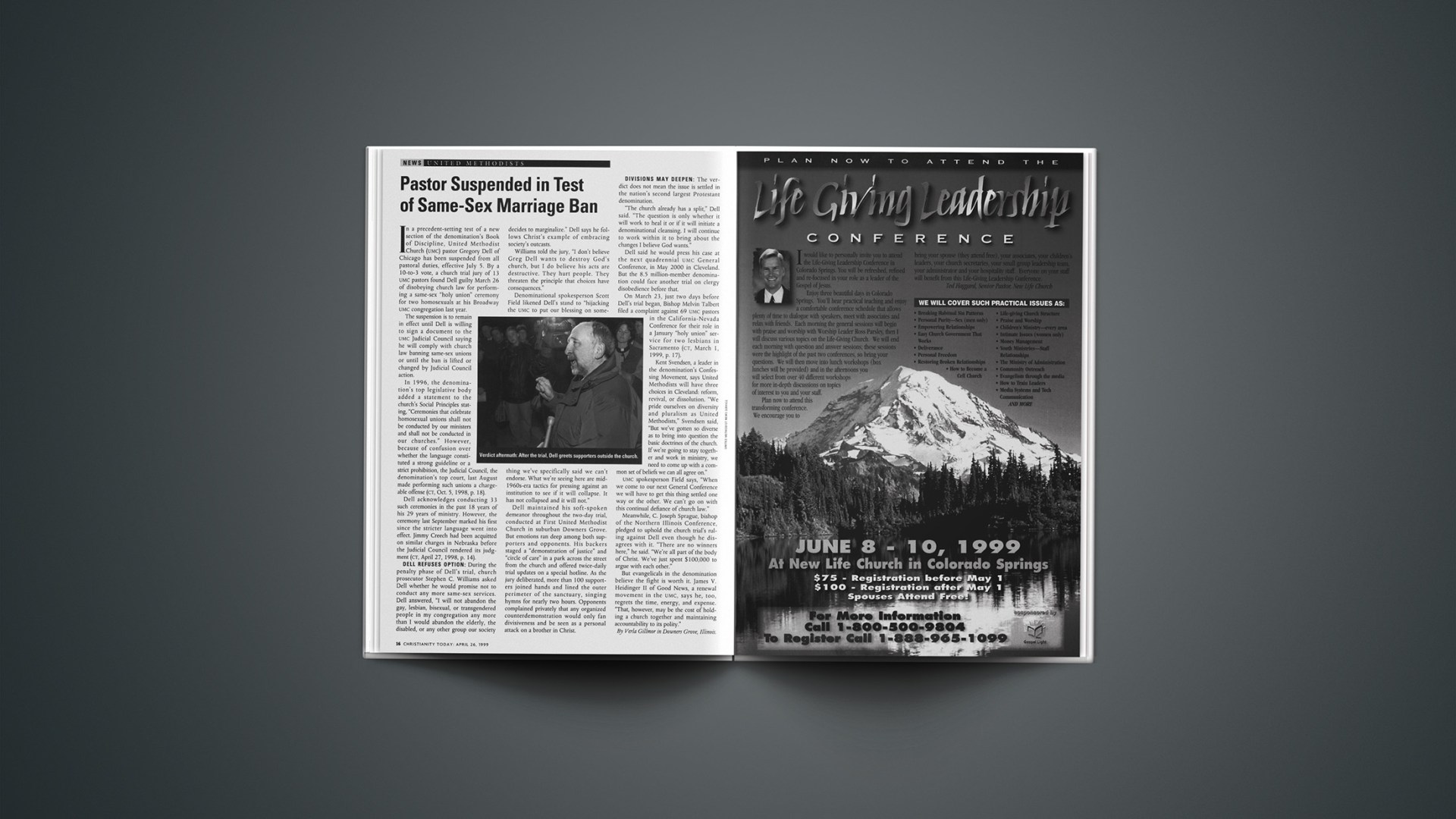

In a precedent-setting test of a new section of the denomination’s Book of Discipline, United Methodist Church (UMC) pastor Gregory Dell of Chicago has been suspended from all pastoral duties, effective July 5. By a 10-to-3 vote, a church trial jury of 13 UMC pastors found Dell guilty March 26 of disobeying church law for performing a same-sex “holy union” ceremony for two homosexuals at his Broadway UMC congregation last year.
The suspension is to remain in effect until Dell is willing to sign a document to the UMC Judicial Council saying he will comply with church law banning same-sex unions or until the ban is lifted or changed by Judicial Council action.
In 1996, the denomination’s top legislative body added a statement to the church’s Social Principles stating, “Ceremonies that celebrate homosexual unions shall not be conducted by our ministers and shall not be conducted in our churches.” However, because of confusion over whether the language constituted a strong guideline or a strict prohibition, the Judicial Council, the denomination’s top court, last August made performing such unions a chargeable offense (CT, Oct. 5, 1998, p. 18).
Dell acknowledges conducting 33 such ceremonies in the past 18 years of his 29 years of ministry. However, the ceremony last September marked his first since the stricter language went into effect. Jimmy Creech had been acquitted on similar charges in Nebraska before the Judicial Council rendered its judgment (CT, April 27, 1998, p. 14).
DELL REFUSES OPTION: During the penalty phase of Dell’s trial, church prosecutor Stephen C. Williams asked Dell whether he would promise not to conduct any more same-sex services. Dell answered, “I will not abandon the gay, lesbian, bisexual, or transgendered people in my congregation any more than I would abandon the elderly, the disabled, or any other group our society decides to marginalize.” Dell says he follows Christ’s example of embracing society’s outcasts.
Williams told the jury, “I don’t believe Greg Dell wants to destroy God’s church, but I do believe his acts are destructive. They hurt people. They threaten the principle that choices have consequences.”
Denominational spokesperson Scott Field likened Dell’s stand to “hijacking the UMC to put our blessing on something we’ve specifically said we can’t endorse. What we’re seeing here are mid-1960s-era tactics for pressing against an institution to see if it will collapse. It has not collapsed and it will not.”
Dell maintained his soft-spoken demeanor throughout the two-day trial, conducted at First United Methodist Church in suburban Downers Grove. But emotions ran deep among both supporters and opponents. His backers staged a “demonstration of justice” and “circle of care” in a park across the street from the church and offered twice-daily trial updates on a special hotline. As the jury deliberated, more than 100 supporters joined hands and lined the outer perimeter of the sanctuary, singing hymns for nearly two hours. Opponents complained privately that any organized counterdemonstration would only fan divisiveness and be seen as a personal attack on a brother in Christ.
DIVISIONS MAY DEEPEN: The verdict does not mean the issue is settled in the nation’s second largest Protestant denomination.
“The church already has a split,” Dell said. “The question is only whether it will work to heal it or if it will initiate a denominational cleansing. I will continue to work within it to bring about the changes I believe God wants.”
Dell said he would press his case at the next quadrennial UMC General Conference, in May 2000 in Cleveland. But the 8.5 million-member denomination could face another trial on clergy disobedience before that.
On March 23, just two days before Dell’s trial began, Bishop Melvin Talbert filed a complaint against 69 UMC pastors in the California-Nevada Conference for their role in a January “holy union” service for two lesbians in Sacramento (CT, March 1, 1999, p. 17).
Kent Svendsen, a leader in the denomination’s Confes sing Movement, says United Methodists will have three choices in Cleveland: reform, revival, or dissolution. “We pride ourselves on diversity and pluralism as United Methodists,” Svend sen said, “But we’ve gotten so diverse as to bring into question the basic doctrines of the church. If we’re going to stay together and work in ministry, we need to come up with a common set of beliefs we can all agree on.”
UMC spokesperson Field says, “When we come to our next General Conference we will have to get this thing settled one way or the other. We can’t go on with this continual defiance of church law.”
Meanwhile, C. Joseph Sprague, bishop of the Northern Illinois Conference, pledged to uphold the church trial’s ruling against Dell even though he disagrees with it. “There are no winners here,” he said. “We’re all part of the body of Christ. We’ve just spent $100,000 to argue with each other.”
But evangelicals in the denomination believe the fight is worth it. James V. Heidinger II of Good News, a renewal movement in the UMC, says he, too, regrets the time, energy, and expense. “That, however, may be the cost of holding a church together and maintaining accountability to its polity.”
Copyright © 1999 Christianity Today. Click for reprint information.