
David Sumrall, a third generation pastor at the Cathedral of Praise in Manila, says the Philippines is experiencing a historic spiritual revival. “It’s harvest time,” Sumrall says. “Each night we take our service to different parts of Manila, and hundreds are getting saved. Come back in a year’s time and you will see our new sanctuary with 8,000 seats full.”
But even as Christian leaders embrace optimism for the church’s future, they face a complex set of problems and challenges, from societal poverty to interchurch rivalry, all of which threaten to derail revival within one of Asia’s most important enclaves of Christianity.
In spite of the difficulties, 25-year missionary Ken Keihlbauch says, “The church is growing through the day-to-day faithfulness of countless local believers. Over the years I’ve seen a tremendous excitement in the evangelical church as people come to Christ.”
The Philippines, an archipelago of 7,000 islands, has 72 million people in a unique mixture of Malay, Chinese, Spanish, and North American cultures. During three hundred years of Spanish rule, not only was the population Christianized, but the economic system was Westernized, creating an elite class of wealthy landowners and an underclass of tenant farmers.
As Christian faith and practice developed in later generations, many churches became a potpourri of myth, folklore, and Roman Catholicism that prevails even today.
SALT AND LIGHT? The Christian gospel has more deeply penetrated the Philippines than any other Asian nation. Neighboring countries are mostly Buddhist, Communist, or Muslim.
Although the Roman Catholic church has been well established for centuries, the growth of the Catholic church is very close to the 2.3 percent annual growth rate of the overall population. But Protestant groups, especially evangelicals, have been growing at about twice the population rate. “We now have 32,000 churches in the Philippines, and 27,000 of these were planted in the last 25 years,” says Bishop Efraim Tendero of the Philippine Council for Evan gelical Churches. “Our target is to plant 50,000 churches by the end of December 2000.” There are about 1,400 American Protestant missions personnel based in the Philippines.
Yet few evangelicals are gloating over their rapid growth. Isabelo Magalit, president of the Asian Theological Seminary in the Philippines, says, “We have not taught our people to be salt and light in the marketplace where they spend most of their day. We need to penetrate all these places by accepting that the mission of the church is broader than simply to evangelize.”
Perhaps ministry to poor Filipinos presents one of the greatest challenges to expanding the evangelical church’s mission. The government says 32 percent of the population live below the poverty line, but some experts say it is really twice that number.
Land reform, which would put arable property into the hands of tenant farmers, has long been advocated by political progressives. Joseph Estrada, inaugurated as president a year ago, has pledged to distribute 618,000 acres of private agricultural land under the decades-old land-reform program. Church leaders believe the land-reform program is essential for reducing poverty in rural areas, where almost 70 percent of Filipinos live. But today, seven out of ten Filipino farmers remain landless. Habitat for Humanity, the Georgia-based housing ministry, has been active in the Filipino land-reform movement. Two months ago, some 8,000 Filipino Christians worked jointly to build 250 dwellings for Filipino poor people, many living in shantytowns, on land donated to Habitat.
CHARISMATIC COMMON GROUND: Service-minded ministries, such as Habitat for Humanity, have been a significant unifying influence among Christians. But greater potential for Christian unity is found within the charismatic movement, both Protestant and Catholic.
Since Vatican II reforms, some active Catholics in the Philippines have been drawn into the Catholic charismatic movement, creating a place of common ground between Protestants and Catholics. “There is a real born-again experience in the Catholic charismatic renewal,” observes Tendero. “I believe God is using that to bring openness in the country to the gospel.” Couples for Christ has become one of the largest Catholic renewal groups.
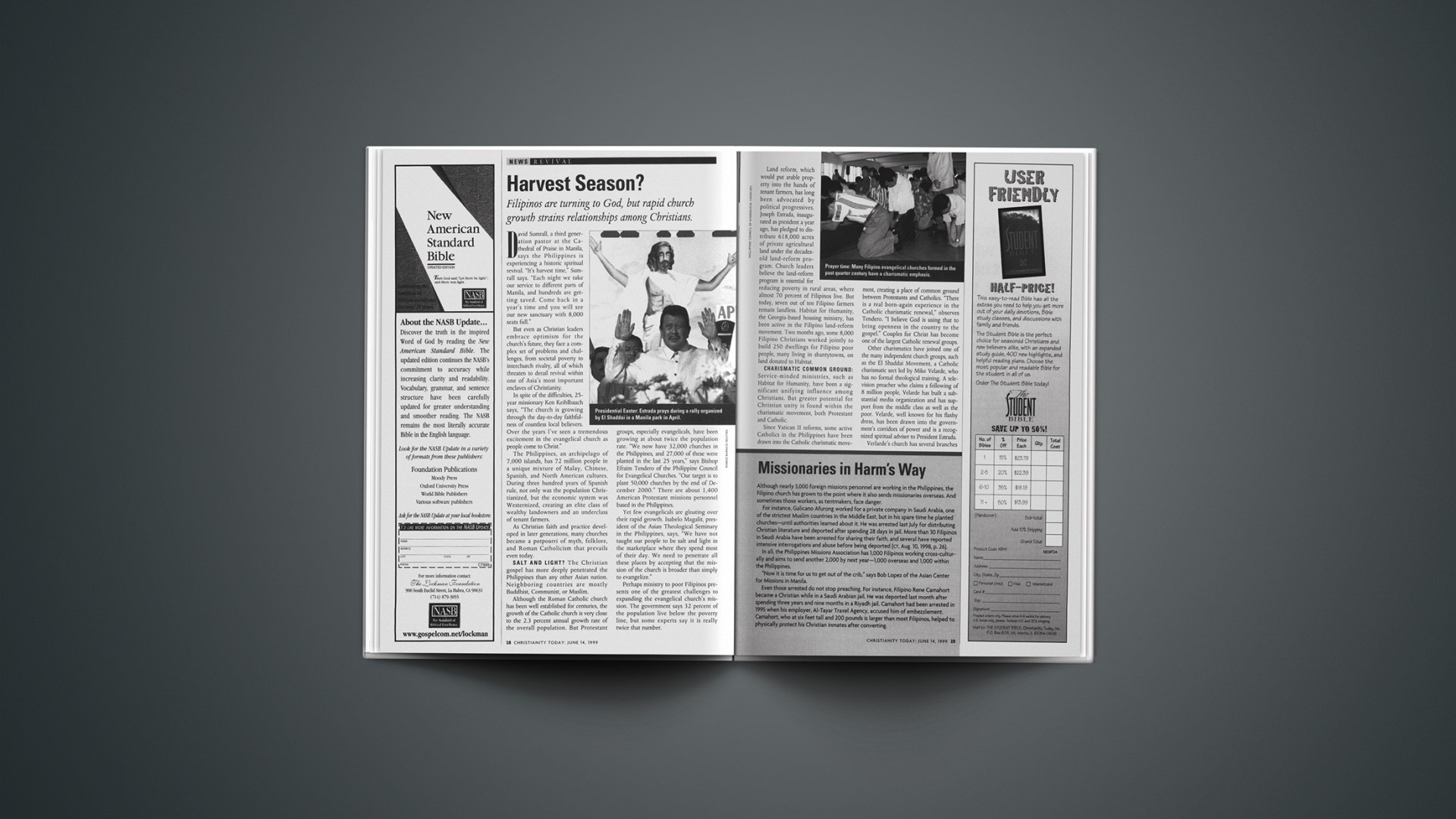
Other charismatics have joined one of the many independent church groups, such as the El Shaddai Movement, a Catholic charismatic sect led by Mike Velarde, who has no formal theological training. A television preacher who claims a following of 8 million people, Velarde has built a substantial media organization and has support from the middle class as well as the poor. Velarde, well known for his flashy dress, has been drawn into the government’s corridors of power and is a recognized spiritual adviser to President Estrada.
Verlarde’s church has several branches around the country, and members regularly gather for large meetings at the biggest facility in Manila. “With his simplistic hermeneutics he preaches somewhat of a prosperity gospel,” Magalit says. “But it is obvious that he reads his Bible a lot.”
LEADERSHIP SHORTCOMINGS: Other than intense Bible study, formal theological training is a work in progress for many churches, leading to a familiar self-criticism that pastors and lay leaders are ill equipped to do their jobs.
For Steve Mirpuri, pastor of the Living Body of Christ, the shortcomings among leaders has been a sobering realization. Mirpuri says, “We need to trust in the Lord more and to be more biblical in the model that we adopt for church structure and leadership. It has made us re-examine ourselves and hopefully protect ourselves.”
One of the fallouts of the leadership problem has been splits among the top megachurches in the Philippines: Word for the World, Bread of Life, and Jesus Is Lord each has experienced a congregational split.
Because many Filipino churches have grown strong in number and outreach without seminary-trained clergy, formal training is seen by many as unnecessary to church growth and development. Magalit says, “Seminaries are considered passe.”
Despite their shortcomings, most Christian leaders in the Philippines endorse the same goal: To fulfill God’s destiny for the nation. Rey Corpuz of the Philippine Missions Association says, “I want the Philippine church to be a beacon of light in this nation, a bastion of justice and peace, order and love. I want to see the Philippine church blessing other nations, including Buddhists, Muslims, and Hindus.”
Copyright © 1999 Christianity Today. Click for reprint information.