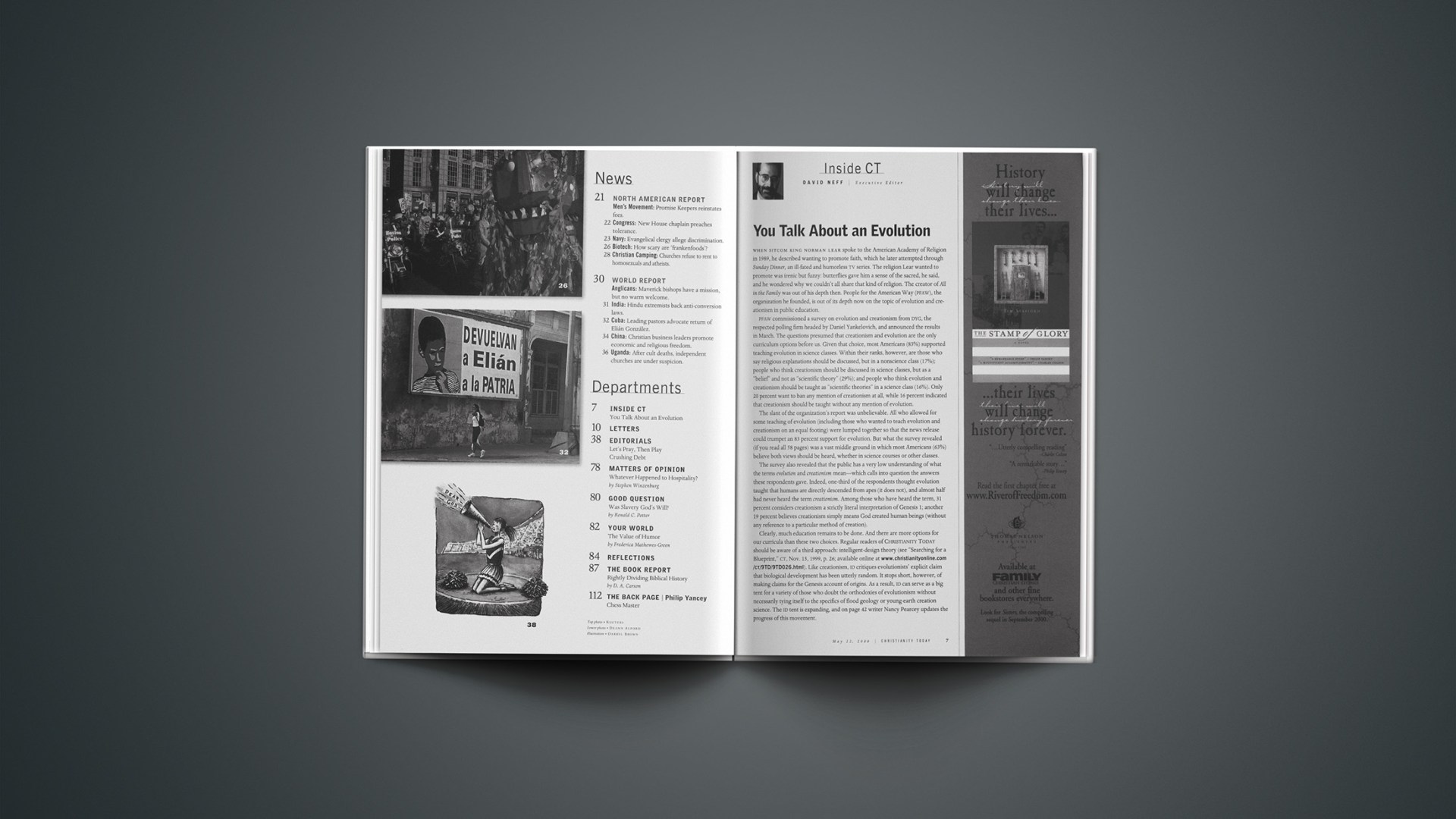
You Talk About an Evolution

When sitcom king Norman Lear spoke to the American Academy of Religion in 1989, he described wanting to promote faith, which he later attempted through Sunday Dinner, an ill-fated and humorless TV series. The religion Lear wanted to promote was irenic but fuzzy: butterflies gave him a sense of the sacred, he said, and he wondered why we couldn’t all share that kind of religion. The creator of All in the Family was out of his depth then. People for the American Way (PFAW), the organization he founded, is out of its depth now on the topic of evolution and creationism in public education.PFAW commissioned a survey on evolution and creationism from DYG, the respected polling firm headed by Daniel Yankelovich, and announced the results in March. The questions presumed that creationism and evolution are the only curriculum options before us. Given that choice, most Americans (83%) supported teaching evolution in science classes. Within their ranks, however, are those who say religious explanations should be discussed, but in a nonscience class (17%); people who think creationism should be discussed in science classes, but as a “belief” and not as “scientific theory” (29%); and people who think evolution and creationism should be taught as “scientific theories” in a science class (16%). Only 20 percent want to ban any mention of creationism at all, while 16 percent indicated that creationism should be taught without any mention of evolution.The slant of the organization’s report was unbelievable. All who allowed for some teaching of evolution (including those who wanted to teach evolution and creationism on an equal footing) were lumped together so that the news release could trumpet an 83 percent support for evolution. But what the survey revealed (if you read all 58 pages) was a vast middle ground in which most Americans (63%) believe both views should be heard, whether in science courses or other classes.The survey also revealed that the public has a very low understanding of what the terms evolution and creationism mean—which calls into question the answers these respondents gave. Indeed, one-third of the respondents thought evolution taught that humans are directly descended from apes (it does not), and almost half had never heard the term creationism. Among those who have heard the term, 31 percent considers creationism a strictly literal interpretation of Genesis 1; another 19 percent believes creationism simply means God created human beings (without any reference to a particular method of creation). Clearly, much education remains to be done. And there are more options for our curricula than these two choices. Regular readers of Christianity Today should be aware of a third approach: intelligent-design theory (see “Searching for a Blueprint,” CT, Nov. 15, 1999, p. 26; available online at www.ChristianityToday.com/ct/9td/9td026.html). Like creationism, ID critiques evolutionists’ explicit claim that biological development has been utterly random. It stops short, however, of making claims for the Genesis account of origins. As a result, id can serve as a big tent for a variety of those who doubt the orthodoxies of evolutionism without necessarily tying itself to the specifics of flood geology or young-earth creation science. The ID tent is expanding, and on page 42 writer Nancy Pearcey updates the progress of this movement.

Copyright © 2000 Christianity Today. Click for reprint information.

Also in this issue

The CT archives are a rich treasure of biblical wisdom and insight from our past. Some things we would say differently today, and some stances we've changed. But overall, we're amazed at how relevant so much of this content is. We trust that you'll find it a helpful resource.

Cover Story

We're Not in Kansas Anymore

Nancy Pearcey

Biotech: Unholy Harvest?

Denyse O'Leary

In Print:The Joy of Judging Judgers

In Summary:Christianity and Politics

The Back Page | Philip Yancey:Chess Master

Men's Movement: Keeping Their Promises

Mark A. Kellner

Catholics, Baptists, Methodists Remain Tops

Congress: First Catholic Chaplain Emphasizes House Unity

Sheryl Henderson Blunt in Washington

Updates

Briefs: North America

Rightly Dividing Biblical History

D. A. Carson

Christian Camping: The Right to Rent

Verla Wallace

Anglicans: Intercontinental Ballistic Bishops?

Douglas LeBlanc

India: Christians Resist Move to Register Conversions

Manpreet Singh in New Delhi

Briefs: The World

Cuba: Family Over Freedom

Mackie Landers in Havana

How to Change China

Tony Carnes

Uganda: Under Suspicion

Greg Taylor in Kanungu

One Musician, Two Gigs

Lauren F. Winner

Wire Story

United Kingdom: Hell Isn't Obsolete, Brits Say

Religion News Service

Inherit the Monkey Trial

Karl Giberson & Donald Yerxa

Your Darwin Is Too Large

John Wilson

Lights, Camera, Jesus

Roy M. Anker

Desperately Seeking Jesus: A review of The Epic Miniseries

Roy Anker

A Good Death

Margaret Kim Peterson

Redeemed Bad Boys of the WWF

John W. Kennedy

Wire Story

Navy: Evangelicals File Bias Suit Against Navy

Religion News Service

Let’s Pray, Then Play

A Christianity Today Editorial

Crushing Debt

A Christianity Today Editorial

Whatever Happened to Hospitality?

Stephen Winzenburg

Was Slavery God's Will?

'Casey Mercer, Columbus, Ohio' By Ronald C. Potter

Your World:The Value of Humor?

Classic & Contemporary Excerpts from May 22, 2000

View issue

Our Latest

The Bulletin

Sunday Afternoon Reads: Lord of the Night

Finding God in the darkness and isolation of Antarctica.

The Russell Moore Show

Why Do Faithful Christians Defend Harmful Things?

Russell answers a listener question about how we should perceive seemingly harmful political beliefs in our church congregations.

The Complicated Legacy of Jesse Jackson

Six Christian leaders reflect on the civil rights giant’s triumphs and tragedies.

News

The Churches That Fought for Due Process

An Ecuadorian immigrant with legal status fell into a detention “black hole.” Church leaders across the country tried to pull him out.

The Bulletin

AI Predictions, Climate Policy Rollback, and Obama’s Belief in Aliens

Mike Cosper, Clarissa Moll, Russell Moore

The future of artificial intelligence, Trump repeals landmark climate finding, and the existence of aliens.

Troubling Moral Issues in 1973

CT condemned the Supreme Court ruling in Roe v. Wade and questioned the seriousness of Watergate.

Ben Sasse and a Dying Breed of Politician

The former senator is battling cancer. Losing him would be one more sign that a certain kind of conservatism—and a certain kind of politics—is disappearing.

Apple PodcastsDown ArrowDown ArrowDown Arrowarrow_left_altLeft ArrowLeft ArrowRight ArrowRight ArrowRight Arrowarrow_up_altUp ArrowUp ArrowAvailable at Amazoncaret-downCloseCloseEmailEmailExpandExpandExternalExternalFacebookfacebook-squareGiftGiftGooglegoogleGoogle KeephamburgerInstagraminstagram-squareLinkLinklinkedin-squareListenListenListenChristianity TodayCT Creative Studio Logologo_orgMegaphoneMenuMenupausePinterestPlayPlayPocketPodcastprintRSSRSSSaveSaveSaveSearchSearchsearchSpotifyStitcherTelegramTable of ContentsTable of Contentstwitter-squareWhatsAppXYouTubeYouTube