Though Augustine’s earthly existence was confined to the fourth and fifth centuries, his influence cannot be confined to any era, church, region, or subject. Consequently, authors (or editors) wishing to publish books about him generally have to choose between detailing his life or exploring his legacy.
Fortunately for those of us working on this issue, Augustine through the Ages: An Encyclopedia (Eerdmans, 1999), dares to do both—and succeeds. Of course, the endeavor required 900 pages and a host of talented contributors, edited by Allan D. Fitzgerald, O.S.A. (who also edits Villanova University’s Augustinian Studies). The encyclopedia’s entries cover a wide range of topics, making it a terrific starting place for tracing Augustine’s thoughts from their origins to some fascinating conclusions.
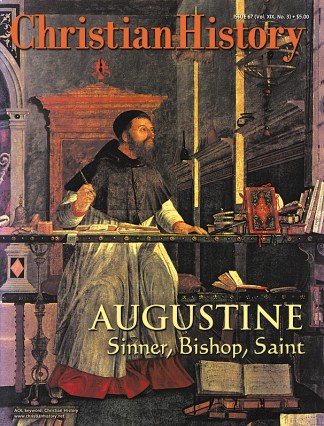
Also in the broad, life-and-legacy vein is the Collectanea Augustiniana series (New York: Peter Lang), begun in 1990. The first three volumes focus on Augustine’s conversion and baptism, his priestly ordination, and his relationship to Christian mysticism, respectively. The fourth volume, Augustine in Iconography, was particularly useful for this issue, as it gives the history behind famous images of the saint and, in so doing, helps illuminate the details of his life.
Who he was
Obviously, any study of Augustine’s life begins with his own Confessions. Next in line is the Life of Augustine written a few years after the saint’s death by his longtime friend Possidius. In trying not to duplicate the autobiography, Possidius summarizes Augustine’s early life, then gives a more detailed description of his actions and attitudes as a bishop.
Moving closer to the present, Peter Brown’s Augustine of Hippo (University of California, 1967) stands out as a classic work by an expert historian. A lesser-known book from the same era, Frederik van der Meer’s Augustine the Bishop (Sheed and Ward, 1961), also stands out for its engaging picture of Augustine’s daily pastoral routine.
Even more recently, prize-winning historian Garry Wills dug into Augustine’s thought life for an intellectual biography titled simply Saint Augustine (Viking, 1999). Wills describes Augustine as “a tireless seeker, never satisfied” yet also a man who knew his mind could never fully penetrate the mysteries of God.
What he means
Again, a good place to start is Augustine’s own words—notably City of God, in which he articulates many foundational ideas of Western society.
Of course, Augustine wasn’t forging these ideas in isolation. For setting him in the flow of his tradition, two “oldies” are still golden: J. N. D. Kelly’s Early Christian Doctrines (Harper & Row, 1960) and Jaroslav Pelikan’s The Emergence of the Catholic Tradition, 100-600 (volume 1 of The Christian Tradition, University of Chicago, 1971).
Exploring the intersections between Augustine and figures further removed from him in time and space has proven fruitful as well. The Augustinian Tradition, edited by Gareth B. Matthews (University of California, 1999), brings thinkers from Dante to Descartes to Wittgenstein into the dialogue. In Christian Doctrine, Christian Identity (University Press of America, 1999), Christopher J. Thompson looks to Alasdair MacIntyre, Stanley Hauerwas, and others as he investigates Augustine’s influence on ideas of narrative and character.
Additional resources
Online, the Christian Classics Ethereal Library (www.ccel.org) includes many letters of Augustine and other source documents in its Ante-Nicene Fathers collection. Some good information on the Augustinian order and its role in education is available at www.augustinian.villanova.edu.
Another useful multi-media resource is Augustine: Philosopher and Saint, part of the Great Courses on Tape series from The Teaching Company (www.teach12.com). Taught by Eastern College’s Phillip Cary, the course is available in audio or video format.
Copyright © 2000 by the author or Christianity Today/Christian History magazine. Click here for reprint information on Christian History.