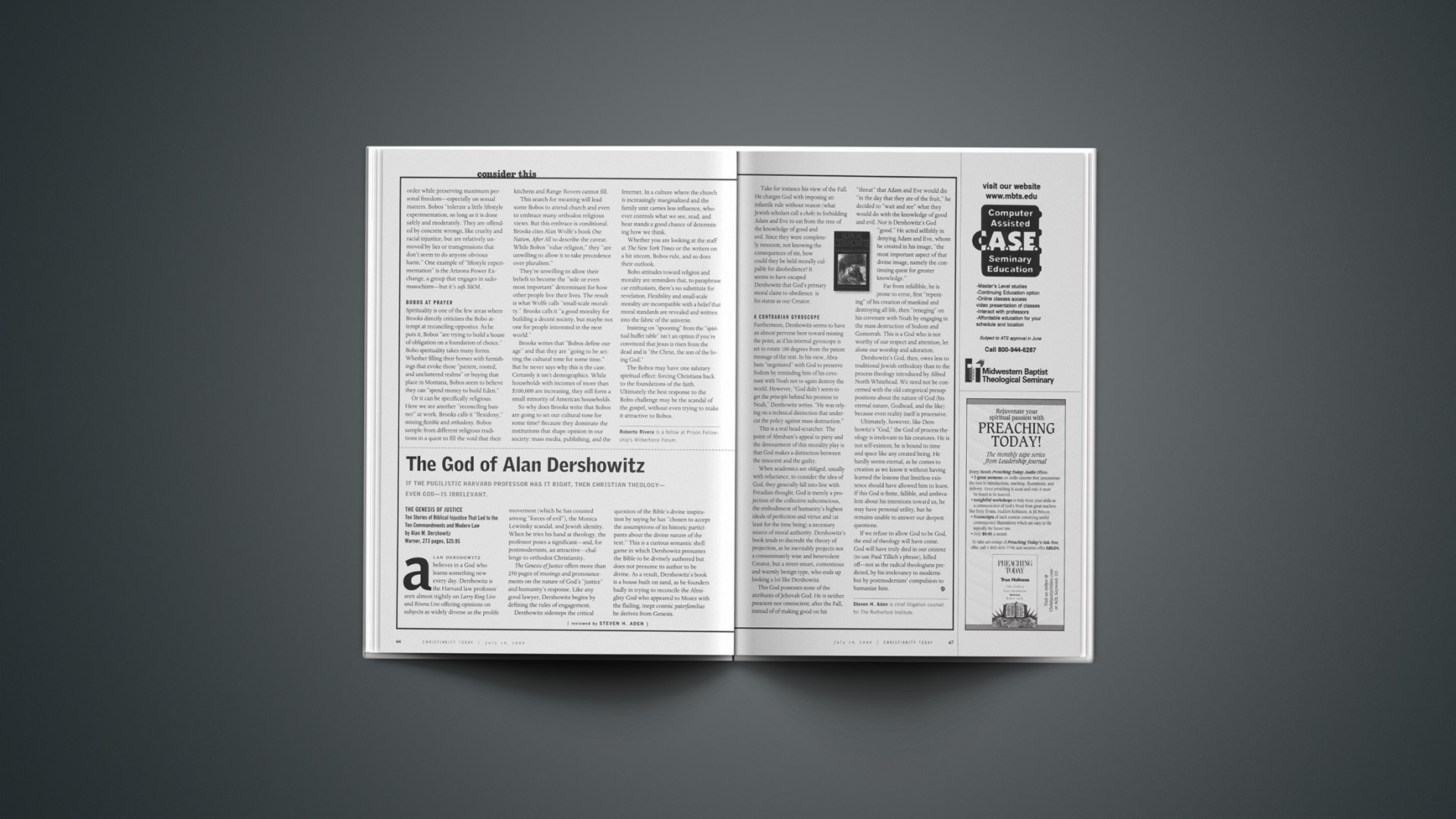

THE GENESIS OF JUSTICE
Ten Stories of Biblical Injustice That Led to the Ten Commandments and Modern Law
by Alan M. Dershowitz Warner, 273 pages, $25.95
Alan Dershowitz believes in a God who learns something new every day. Dershowitz is the Harvard law professor seen almost nightly on Larry King Live and Rivera Live offering opinions on subjects as widely diverse as the prolife movement (which he has counted among “forces of evil”), the Monica Lewinsky scandal, and Jewish identity. When he tries his hand at theology, the professor poses a significant–and, for postmodernists, an attractive–challenge to orthodox Christianity.The Genesis of Justice offers more than 250 pages of musings and pronouncements on the nature of God’s “justice” and humanity’s response. Like any good lawyer, Dershowitz begins by defining the rules of engagement.Dershowitz sidesteps the critical question of the Bible’s divine inspiration by saying he has “chosen to accept the assumptions of its historic participants about the divine nature of the text.” This is a curious semantic shell game in which Dershowitz presumes the Bible to be divinely authored but does not presume its author to be divine. As a result, Dershowitz’s book is a house built on sand, as he founders badly in trying to reconcile the Almighty God who appeared to Moses with the flailing, inept cosmic paterfamilias he derives from Genesis.Take for instance his view of the Fall. He charges God with imposing an infantile rule without reason (what Jewish scholars call a chok) in forbidding Adam and Eve to eat from the tree of the knowledge of good and evil. Since they were completely innocent, not knowing the consequences of sin, how could they be held morally culpable for disobedience? It seems to have escaped Dershowitz that God’s primary moral claim to obedience is his status as our Creator.
A Contrarian Gyroscope
Furthermore, Dershowitz seems to have an almost perverse bent toward missing the point, as if his internal gyroscope is set to rotate 180 degrees from the patent message of the text. In his view, Abraham “negotiated” with God to preserve Sodom by reminding him of his covenant with Noah not to again destroy the world. However, “God didn’t seem to get the principle behind his promise to Noah,” Dershowitz writes. “He was relying on a technical distinction that undercut the policy against mass destruction.”This is a real head-scratcher. The point of Abraham’s appeal to piety and the denouement of this morality play is that God makes a distinction between the innocent and the guilty.When academics are obliged, usually with reluctance, to consider the idea of God, they generally fall into line with Freudian thought. God is merely a projection of the collective subconscious, the embodiment of humanity’s highest ideals of perfection and virtue and (at least for the time being) a necessary source of moral authority. Dershowitz’s book tends to discredit the theory of projection, as he inevitably projects not a consummately wise and benevolent Creator, but a street-smart, contentious and warmly benign type, who ends up looking a lot like Dershowitz.This God possesses none of the attributes of Jehovah God. He is neither prescient nor omniscient; after the Fall, instead of making good on his “threat” that Adam and Eve would die “in the day that they ate of the fruit,” he decided to “wait and see” what they would do with the knowledge of good and evil. Nor is Dershowitz’s God “good.” He acted selfishly in denying Adam and Eve, whom he created in his image, “the most important aspect of that divine image, namely the continuing quest for greater knowledge.”Far from infallible, he is prone to error, first “repenting” of his creation of mankind and destroying all life, then “reneging” on his covenant with Noah by engaging in the mass destruction of Sodom and Gomorrah. This is a God who is not worthy of our respect and attention, let alone our worship and adoration.Dershowitz’s God, then, owes less to traditional Jewish orthodoxy than to the process theology introduced by Alfred North Whitehead. We need not be concerned with the old categorical presuppositions about the nature of God (his eternal nature, Godhead, and the like) because even reality itself is processive.Ultimately, however, like Dershowitz’s “God,” the God of process theology is irrelevant to his creatures. He is not self-existent; he is bound to time and space like any created being. He hardly seems eternal, as he comes to creation as we know it without having learned the lessons that limitless existence should have allowed him to learn. If this God is finite, fallible, and ambivalent about his intentions toward us, he may have personal utility, but he remains unable to answer our deepest questions.If we refuse to allow God to be God, the end of theology will have come. God will have truly died in our existenz (to use Paul Tillich’s phrase), killed off–not as the radical theologians predicted, by his irrelevancy to moderns but by postmodernists’ compulsion to humanize him.
Steven H. Aden is chief litigation counsel for The Rutherford Institute.
Related Elsewhere
Read a free chapter of Dershowitz’s Genesis of Justice.In a scathing review, Kenny Brechner writes, “When you have as much in common with a deity as does lawyer, author, and professor Dershowitz, it’s only to be expected that you would have some special insights into the relationship between God and Mortal, particularly regarding the Deity’s role as Judge, Teacher, and Legal Authority.” Click here to read more.For a change of pace, read a classic theologian’s take on Genesis and justice. John Calvin’s commentary on the book of Genesis is available online from the Center for Reformed Theology.This site offers a replete Dershowitz bio, including a list of books he has published and famous cases he’s been involved with.
Copyright © 2000 Christianity Today. Click for reprint information.