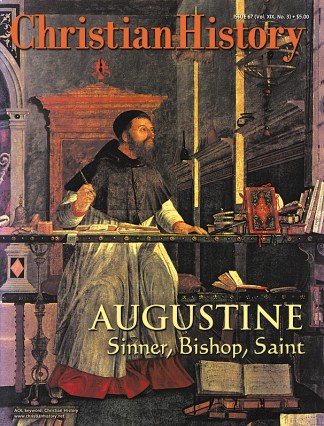
The verbal battle between Augustine and Pelagius raged for a full 25 years before the final condemnation of the latter’s views at the Council of Ephesus in 431. Though Augustine’s views triumphed, not everyone was happy with the outcome.
In Provence, an area of southern France, a group of monks who had all spent time in the important monastery on the Isle of Lérins (opposite the modern resort of Cannes) set about correcting what they saw as the extremism of both Pelagius and Augustine.
John Cassian (360-433), while visiting Egypt to learn spiritual secrets from its famed monks and hermits, heard this from a wizened monk named Chaeremon: “The grace of God always cooperates with our will for its advantage … and sometimes requires and looks for some effort of good will from it that it may not appear to confer its gifts on the sluggish.”
This is the earliest expression of what came to be known as Semi-Pelagianism—a view that Cassian embraced and later began to propagate. The key word is cooperation: no one can save himself but, by cooperating with the grace of God, salvation can be appropriated by anyone.
Cassian clearly felt that Augustine’s stress on predestination ruled out any need for human cooperation or consent. Cassian also disagreed with Augustine on the capabilities of the human will, especially after salvation. “When God for any wise reason—discipline, for example—withdraws grace,” Cassian wrote, “the will is able to hold on for some time awaiting its restoration.”
Cassian’s misgivings were shared by Vincent of Lérins (died 450). In his Commonitorium, Vincent catalogued heresies and dangerous theological innovations, and he also listed an “honor roll” of theologians, teachers, and bishops who had, in Vincent’s opinion, made significant contributions to the defense and spreading of the Gospel. Augustine’s name does not appear on that list.
Furthermore, Vincent makes the point that even “eminent men are sometimes permitted by God to become authors of novelties in the Church.” Many scholars interpret the omission of Augustine’s name and the reference to “eminent men” as an indication that Vincent disapproved of Augustine’s distinctive teaching.
Arguably the greatest of the so-called Semi-Pelagians was Faustus of Riez (died 495), also from Provence. Faustus, a theologian and popular preacher, felt strongly that Pelagius and Augustine had both gotten it wrong. Pelagius stressed human effort and responsibility to the exclusion of God’s grace, but Augustine’s idea of predestination “jeopardizes God’s justice and mercy.”
Faustus, in his De Gratia Dei (“Concerning the Grace of God”), argues that though the Fall made all of us weak and sickly of will, we still possess the ability—and responsibility—to turn to God. Once we turn to God, then he steps in and adds the vital and crucial gift of grace. Faustus is thus close to Augustine in regard to the effects of the Fall but nearer to Pelagius in terms of human ability and responsibility.
The views of these Semi-Pelagians—they could just as easily have been labeled Semi-Augustinians—were not appreciated by Augustine’s many friends and supporters.
Caesarius of Arles (c. 470-542), a forceful Augustinian who believed all good works begin with God, “no merit of ours preceding,” presided over the Synod of Orange (529), which condemned Semi-Pelagianism. However, even the synod backed away from some of Augustine’s more extreme views: his belief that God’s grace cannot be resisted and his severe interpretation of predestination were quietly dropped.
David Allen is a senior lecturer at Mattersey Hall, an Assemblies of God Bible College in Mattersey, England.
Copyright © 2000 by the author or Christianity Today/Christian History magazine. Click here for reprint information on Christian History.