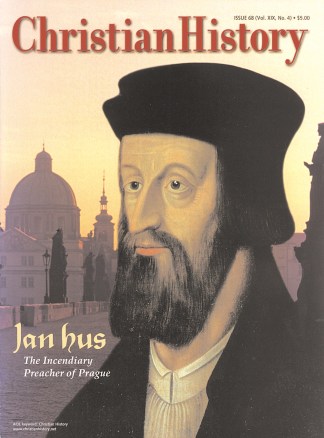
Jan Hus has a tendency to get lost. Following Peter Waldo and John Wyclif but preceding Martin Luther, John Calvin, and Ulrich Zwingli, he occupies nebulous and seldom discussed territory. Even Christian History has scarcely mentioned him since a prototype (developed to accompany Gateway Films’ Jan Hus video) with only a handful of photocopied issues still in circulation. In our magazine as in his era, Hus appeared before the world was ready for him.
That Hus is so largely forgotten outside his native Czech Republic is perhaps as great an injustice as his execution 585 years ago. For though he was solidly a man of his time and place, his ideas merit broad recognition. In fact, most of them ring so true that it seems amazing they were ever considered revolutionary.
Hus believed pastors should model godly lives and preach vivid, accessible sermons. They should not make fortunes off their ministries but should think of themselves as servants (see “A Pastor’s Heart“). Sounds like basic seminary wisdom so far.
Hus was also uneasy with the church hierarchy claiming final authority over worldly—and other-worldly—affairs. Now he begins to sound more specifically Protestant, but considering that at one point during his life three men claimed to be pope (see “A Plethora of Pontiffs“), his uneasiness is understandable.
Unfortunately for Hus, organizations in severe crisis have little use for fresh ideas. At such a time, “different” means “radical,” and “radical” means “dangerous.” Embattled institutions fire first and ask questions later.
Now it’s much, much later, but the Roman Catholic Church is asking questions. As a Polish pope took special interest in Eastern European unity, Catholic and Protestant scholars started working together to reevaluate Hus. They decided he wasn’t such a bad guy after all. Maybe he was even great.
On December 17, 1999, Pope John Paul II told an international symposium, “Today, on the eve of the Great Jubilee, I feel the need to express deep regret for the cruel death inflicted on Jan Hus.” He commended Hus’s “moral courage in the face of adversity and death” and proclaimed that through the scholars’ work, “Hus, who has been such a point of contention in the past, has now become a subject of dialogue, of comparison and shared investigation.”
So long neglected outside his home country and so long contested within, Hus is finally being seen the way he saw himself: as a passionate reformer with sound ideas and fierce integrity. The heirs of both his closest allies and harshest enemies agree on that much, and so do we.
Copyright © 2000 by the author or Christianity Today/Christian History magazine. Click here for reprint information on Christian History.