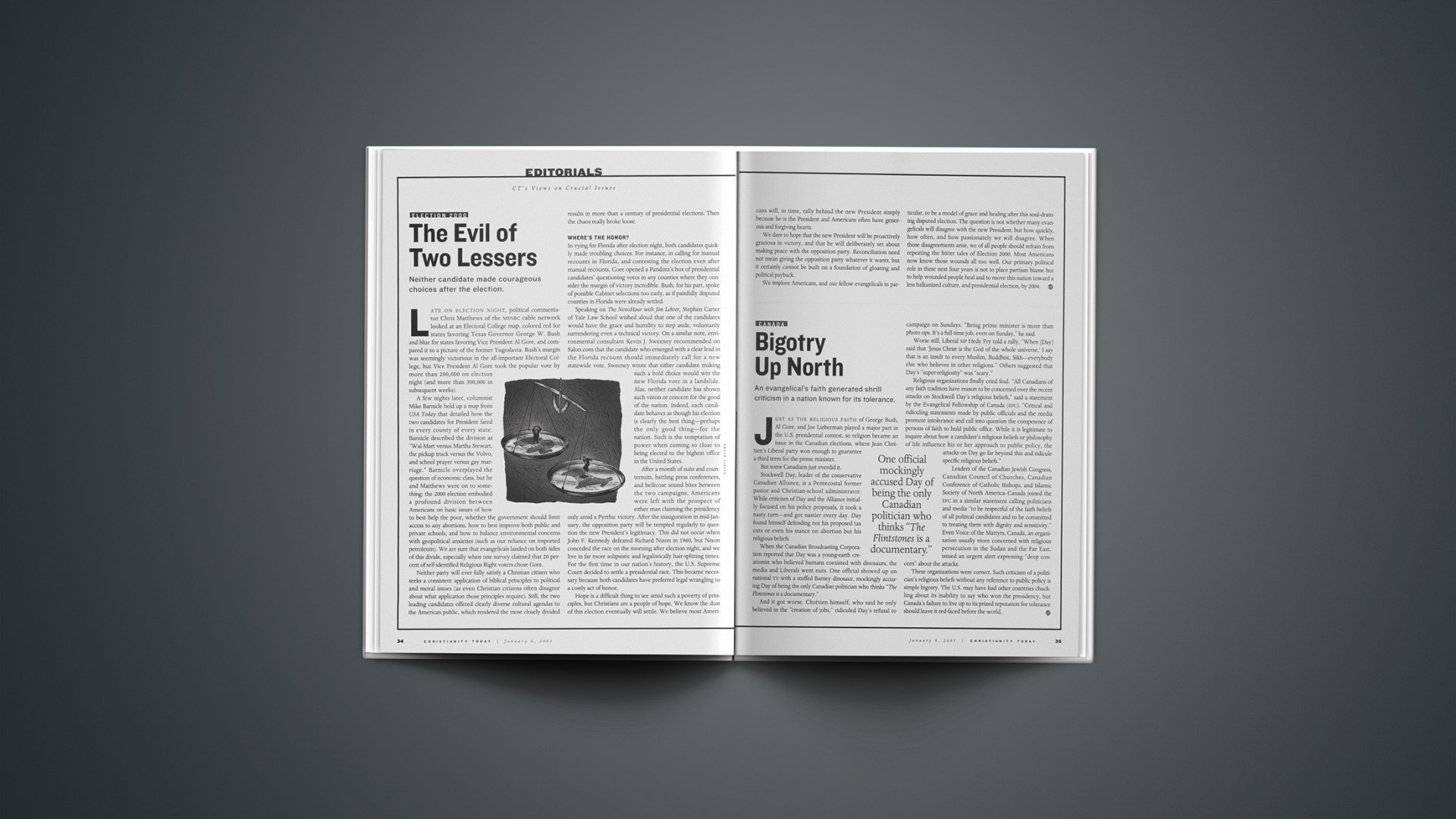

Late on election night, political commentator Chris Matthews of the MSNBC cable network looked at an Electoral College map, colored red for states favoring Texas Governor George W. Bush and blue for states favoring Vice President Al Gore, and compared it to a picture of the former Yugoslavia. Bush's margin was seemingly victorious in the all-important Electoral College, but Vice President Al Gore took the popular vote by more than 200,000 on election night (and more than 300,000 in subsequent weeks).
A few nights later, columnist Mike Barnicle held up a map from USA Today that detailed how the two candidates for President fared in every county of every state. Barnicle described the division as "Wal-Mart versus Martha Stewart, the pickup truck versus the Volvo, and school prayer versus gay marriage." Barnicle overplayed the question of economic class, but he and Matthews were on to something: the 2000 election embodied a profound division between Americans on basic issues of how to best help the poor, whether the government should limit access to any abortions, how to best improve both public and private schools, and how to balance environmental concerns with geopolitical anxieties (such as our reliance on imported petroleum). We are sure that evangelicals landed on both sides of this divide, especially when one survey claimed that 20 percent of self-identified Religious Right voters chose Gore.
Neither party will ever fully satisfy a Christian citizen who seeks a consistent application of biblical principles to political and moral issues (as even Christian citizens often disagree about what application those principles require). Still, the two leading candidates offered clearly diverse cultural agendas to the American public, which rendered the most closely divided results in more than a century of presidential elections. Then the chaos really broke loose.
Where's the honor?
In vying for Florida after election night, both candidates quickly made troubling choices. For instance, in calling for manual recounts in Florida, and contesting the election even after manual recounts, Gore opened a Pandora's box of presidential candidates' questioning votes in any counties where they consider the margin of victory incredible. Bush, for his part, spoke of possible Cabinet selections too early, as if painfully disputed counties in Florida were already settled.
Speaking on The NewsHour with Jim Lehrer, Stephen Carter of Yale Law School wished aloud that one of the candidates would have the grace and humility to step aside, voluntarily surrendering even a technical victory. On a similar note, environmental consultant Kevin J. Sweeney recommended on Salon.com that the candidate who emerged with a clear lead in the Florida recount should immediately call for a new statewide vote. Sweeney wrote that either candidate making such a bold choice would win the new Florida vote in a landslide. Alas, neither candidate has shown such vision or concern for the good of the nation. Indeed, each candidate behaves as though his election is clearly the best thing—perhaps the only good thing—for the nation. Such is the temptation of power when coming so close to being elected to the highest office in the United States.
After a month of suits and countersuits, battling press conferences, and bellicose sound bites between the two campaigns, Americans were left with the prospect of either man claiming the presidency only amid a Pyrrhic victory. After the inauguration in mid-January, the opposition party will be tempted regularly to question the new President's legitimacy. This did not occur when John F. Kennedy defeated Richard Nixon in 1960, but Nixon conceded the race on the morning after election night, and we live in far more solipsistic and legalistically hair-splitting times. For the first time in our nation's history, the U.S. Supreme Court decided to settle a presidential race. This became necessary because both candidates have preferred legal wrangling to a costly act of honor.
Hope is a difficult thing to see amid such a poverty of principles, but Christians are a people of hope. We know the dust of this election eventually will settle. We believe most Americans will, in time, rally behind the new President simply because he is the President and Americans often have generous and forgiving hearts.
We dare to hope that the new President will be proactively gracious in victory, and that he will deliberately set about making peace with the opposition party. Reconciliation need not mean giving the opposition party whatever it wants, but it certainly cannot be built on a foundation of gloating and political payback.
We implore Americans, and our fellow evangelicals in particular, to be a model of grace and healing after this soul-draining disputed election. The question is not whether many evangelicals will disagree with the new President, but how quickly, how often, and how passionately we will disagree. When those disagreements arise, we of all people should refrain from repeating the bitter tales of Election 2000. Most Americans now know those wounds all too well. Our primary political role in these next four years is not to place partisan blame but to help wounded people heal and to move this nation toward a less balkanized culture, and presidential election, by 2004.