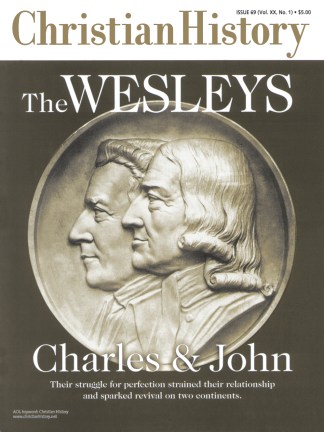
This issue begins with the childhood years of John and Charles Wesley, but in many ways we are picking up the story mid-stream. For though the Wesleys are rightly known as evangelical pioneers, the momentum for the movement they founded had been building long before they arrived.
In the seventeenth century, frustration with the German state church led to the rise of Pietism, a renewal movement within Lutheranism led by figures like Philipp Spener and August Francke. The revived Moravian Brethren, centered at Count Nikolaus von Zinzendorf’s estate in Saxony, grew out of this movement. As the map below illustrates, Pietism and Moravianism exerted a huge influence on Europe and beyond, partially through connections with the Wesleys.
Meanwhile in England, Dissenters (including the Wesleys’ grandparents on both sides) offered their own alternative to the state church model. Their gatherings, or “conventicles,” could meet anywhere and be led by nearly anyone, as long as the format was simple and the focus was on Scripture. Dissenters who eventually joined Methodist society meetings heard many familiar echoes.
The Wesleys consciously drew from all of these traditions in developing their movement. Both brothers experienced spiritual awakening among Moravians. John read and published Pietist classics. He also translated German hymns, while Charles wrote his own Moravian-inspired poetry. Methodist preachers often targeted enclaves of European immigrants, knowing their road would be smoothed by the influence of Continental traditions. And the first Methodist chapels were built in accordance with laws written for Dissenters.
Yet the Wesleys, and Methodists after them, were not merely Pietists, Moravians, or Dissenters. In fact, the Wesleys developed grave concerns about each of these groups. They wanted Methodism to avoid the other movements’ errors and excesses—all while sparking revival and staying within the Church of England.
Not surprisingly, the convergence of these multiple movements and motivations created some tension. Early Methodist leaders, and even the Wesley brothers, found themselves on different sides of numerous debates. But instead of halting Methodism or throwing it off track, these disagreements constituted dynamic tension, the chaos that breeds clarity.
The Wesleys did not boldly go where no one had gone before—they boldly harnessed the best impulses surrounding them and forged a new method of Christian living. They were precisely the pioneers eighteenth-century England was waiting for.
Copyright © 2001 by the author or Christianity Today/Christian History magazine. Click here for reprint information on Christian History.