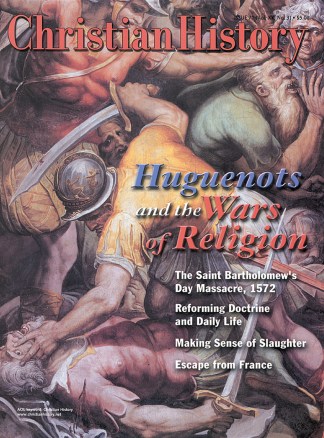
Because of our journalistic focus, Christian History always zooms in on part of a topic, exploring some stories while leaving others untouched. But rather than use this space give a nod to all we didn’t mention, I’m going to zoom in even further on a phrase that appears only once: The War of the Three Henris. It’s a microcosm of the battles waged on these pages.
To begin with the smallest controversy, there was the question of name spellings. We tried to use French spellings (Henri instead of Henry, for example), though often our sources disagreed with one another. Minor inconsistencies were pretty much unavoidable.
Even when we got names spelled “right,” it wasn’t always clear to whom they referred. The issue features five Henris, two kings named Louis, two dukes of Guise, two princes of Condé, and two Médicis women who became queen regent of France. A name and a title found in separate references could designate the same person.
Furthermore, when discussing wars, it’s usually helpful to start with who was fighting whom over what. That wasn’t always clear, either.
The three Henris who fought each other between 1587 and 1589 represent the three factions involved in the French Wars of Religion. Henri I de Lorraine, who was also a duke of Guise, led the ultra-Roman Catholic faction. Henri of Navarre led the Protestant party. Henri III, king of France and head of the royalist camp, played politics between them.
This war followed the pattern of the preceding seven religious conflicts: parties won and lost key cities, foreign nations meddled, a few nobles got killed, one disputant (Henri III) had another one (Henri, duke of Guise) assassinated, and the agreements that were supposed to end the conflict dissatisfied everyone.
What made the War of the Three Henris different from the earlier wars was its finality (although Henri of Navarre kept fighting to succeed Henri III, who was murdered in 1589, until 1593). This peace lasted because, for good or ill, the sole surviving Henri straddled all of the factions: he converted to Catholicism, became king, and gave the Huguenots legal protection.
No church memberships or crowns were swapped in the production of this issue, but Henri’s attempt to see all sides of a complicated struggle proved instructive. Though the Huguenots were more sinned against than sinning, that’s neither the whole story nor the end of it. The jump from microcosm to wide-angle picture only proves John Calvin’s words, “Nothing belongs more peculiarly to God than the office of judging the world.”
Copyright © 2001 by the author or Christianity Today/Christian History magazine. Click here for reprint information on Christian History.