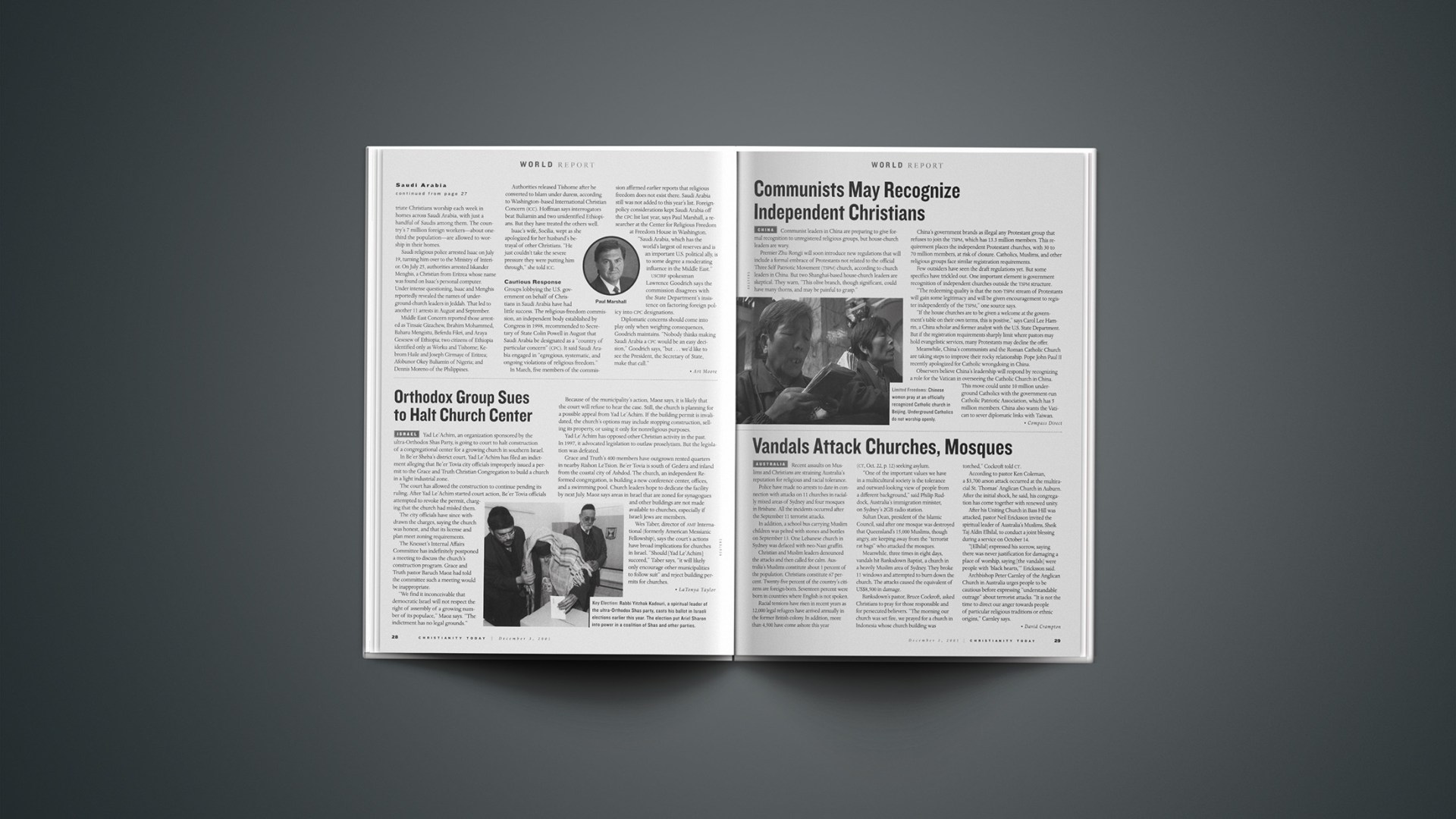

China’s government brands as illegal any Protestant group that refuses to join the TSPM, which has 13.3 million members. This requirement places the independent Protestant churches, with 30 to 70 million members, at risk of closure. Catholics, Muslims, and other religious groups face similar registration requirements.
Few outsiders have seen the draft regulations yet. But some specifics have trickled out. One important element is government recognition of independent churches outside the TSPM structure.
“The redeeming quality is that the non-TSPM stream of Protestants will gain some legitimacy and will be given encouragement to register independently of the TSPM,” one source says.
“If the house churches are to be given a welcome at the government’s table on their own terms, this is positive,” says Carol Lee Hamrin, a China scholar and former analyst with the U.S. State Department. But if the registration requirements sharply limit where pastors may hold evangelistic services, many Protestants may decline the offer.
Meanwhile, China’s communists and the Roman Catholic Church are taking steps to improve their rocky relationship. Pope John Paul II recently apologized for Catholic wrongdoing in China.
Observers believe China’s leadership will respond by recognizing a role for the Vatican in overseeing the Catholic Church in China. This move could unite 10 million underground Catholics with the government-run Catholic Patriotic Association, which has 5 million members. China also wants the Vatican to sever diplomatic links with Taiwan.
Copyright © 2001 Christianity Today. Click for reprint information.
Related Elsewhere
Also appearing on our site recently:Changes in China’s Religious Policy Imminent? | Several respected house-church leaders consulted about official registration.
See Christianity Today’sBearing the Cross article on persecution in China.
This summer, when Beijing was selected to host the 2008 Olympic Games, Christianity Today reported on demands from international human rights groups for China to improve human rights before and during the Games.
The State Department’s 2001 International Religious Freedom Report said the Chinese “Government seeks to restrict religious practice to government-sanctioned organizations and registered places of worship and to control the growth and scope of the activity of religious groups.”
Previous Christianity Today articles on China include:
Hong Kong Church Leaders Fear Anti-Sect Bill | French legislation may have worldwide consequences. (July 3, 2001)
Calling Out the Name of Jesus | What you can do to help persecuted Christians in China. (March 15, 2001)
Digging in China | Christianity in the world’s most populous country may be a lot older than anybody imagined. (March 3, 2001)
The Woman Who Invented China | Pearl S. Buck’s tireless work for the weak belied her own disappointment with mainline Christianity. (Feb. 13, 2001)
House Churches May Be ‘Harmful to Society’ | But China’s unofficial congregations resist “evil cult” label. (January 25, 2001)
China’s Religious Freedom Crackdown Extends to Foreigners | It is against the law for visitors to teach the Bible in China’s house churches. (Nov. 16, 2001)
China’s Smack Down | 53 Christian professors, students, and church-planters detained. (Sept. 11, 2000)