About a year and a half ago, we listed a number of potential issue topics on a survey and asked you, our readers, to choose your favorites. We figured that you would be most interested in American personalities, ministry pioneers, or maybe worship music—familiar, approachable topics that hit close to home.
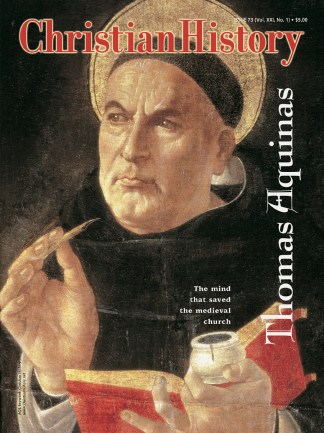
You wanted Thomas Aquinas.
Now, Thomas is not exactly familiar. His name is familiar, certainly, but many people know little about him beyond a dictionary definition: thirteenth-century Italian theologian and philosopher, wrote (but never finished) Summa Theologica, developed concepts of natural law and transubstantiation.
None of this rudimentary information makes Thomas seem the least bit approachable. Theologian-philosophers write ponderous, inscrutable books. The Summa is, in fact, a ponderous, inscrutable book. Natural law and transubstantiation are ponderous, inscrutable ideas.
In portraits, Thomas even looks ponderous and inscrutable. Plus, he wears a monastic robe and a halo, which aren’t the hippest of accessories.
When I first saw the survey results, I guessed that Thomas’s main draw was the mystery factor, or the guilt factor—people felt they ought to know more about him but knew they would never research him on their own. In working on the issue, though, I found that—whether survey respondents realized it or not—Thomas’s life and ideas do hit close to home.
Thomas prayed, read the Bible, and preached with a devotion we would all aspire to. He asked, and answered, questions that Christians across time and space have wondered about: Who is God, how does he operate, how can we know him, and what does he want us to do? And while Thomas never addressed such modern conundrums as genetic engineering, Open Theism, and neuroscientific explanations for the soul, his arguments still inform Christian responses to these and many other debates.
Thomas is not a figure you can grasp and move beyond. No matter how deep you dig, there is always more of him to puzzle out. But it really is important and worthwhile to start somewhere. Try the next page.
By the way, you have probably noticed that we stopped printing letters from readers in the magazine. The volume of mail did not warrant a full page, so we decided to use that editorial space differently. Online, however, we frequently post letters, answer questions, and offer other opportunities for interaction. To join in, you can visit our Web site, http://www.christianhistory.net, and click on Free CH Newsletter, Letters, Ask Christian History, or whatever strikes your fancy.
Copyright © 2002 by the author or Christianity Today/Christian History magazine. Click here for reprint information on Christian History.