“Inside CT: Using a Knife, Fork, and Spoon”

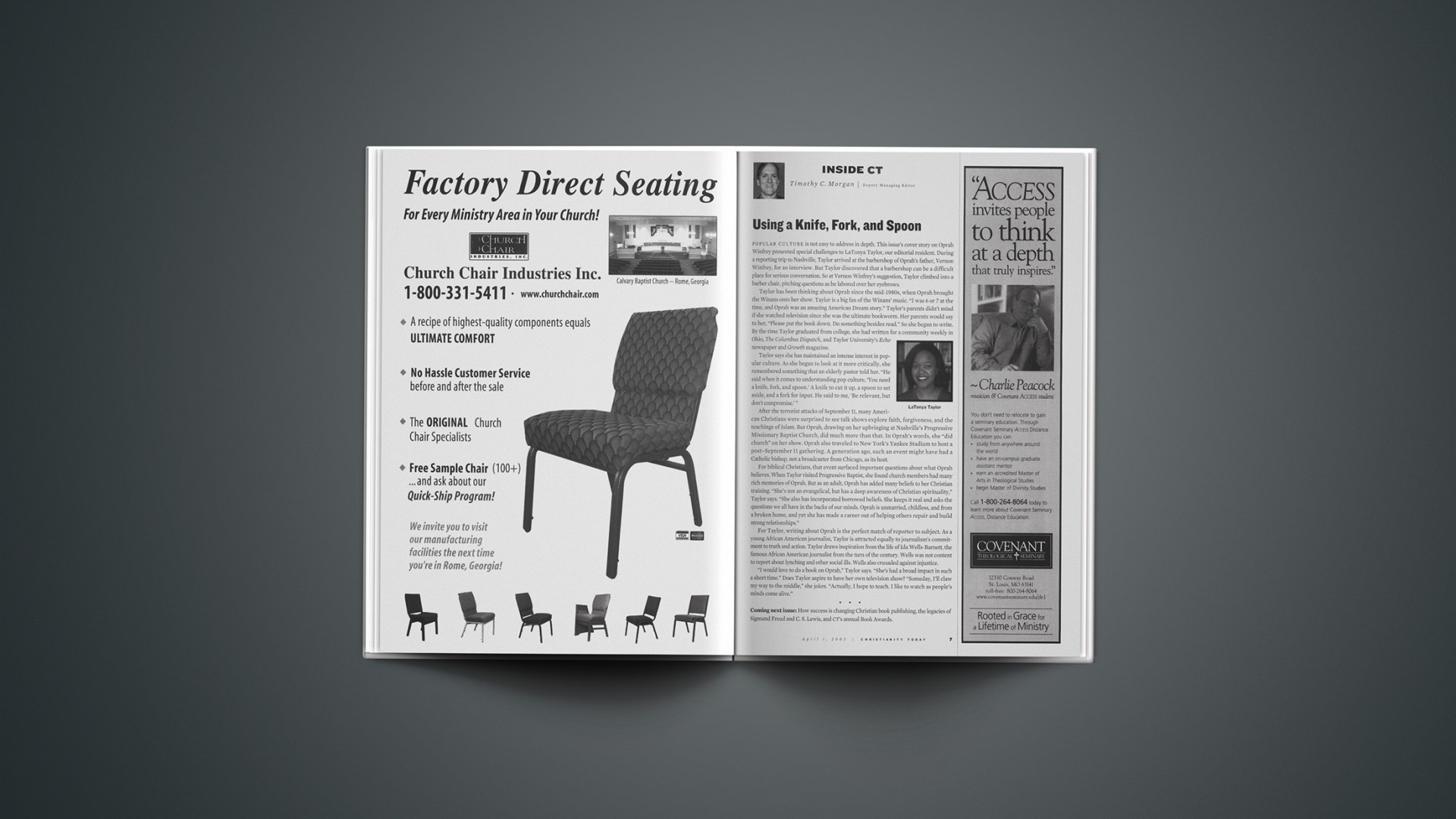
Popular culture is not easy to address in depth. This issue’s cover story on Oprah Winfrey presented special challenges to LaTonya Taylor, our editorial resident. During a reporting trip to Nashville, Taylor arrived at the barbershop of Oprah’s father, Vernon Winfrey, for an interview. But Taylor discovered that a barbershop can be a difficult place for serious conversation. So at Vernon Winfrey’s suggestion, Taylor climbed into a barber chair, pitching questions as he labored over her eyebrows.

Taylor has been thinking about Oprah since the mid-1980s, when Oprah brought the Winans onto her show. Taylor is a big fan of the Winans’ music. “I was 6 or 7 at the time, and Oprah was an amazing American Dream story.” Taylor’s parents didn’t mind if she watched television since she was the ultimate bookworm. Her parents would say to her, “Please put the book down. Do something besides read.” So she began to write. By the time Taylor graduated from college, she had written for a community weekly in Ohio, The Columbus Dispatch, and Taylor University’s Echo newspaper and Growth magazine.

Taylor says she has maintained an intense interest in popular culture. As she began to look at it more critically, she remembered something that an elderly pastor told her. “He said when it comes to understanding pop culture, ‘You need a knife, fork, and spoon.’ A knife to cut it up, a spoon to set aside, and a fork for input. He said to me, ‘Be relevant, but don’t compromise.’ “

After the terrorist attacks of September 11, many American Christians were surprised to see talk shows explore faith, forgiveness, and the teachings of Islam. But Oprah, drawing on her upbringing at Nashville’s Progressive Missionary Baptist Church, did much more than that. In Oprah’s words, she “did church” on her show. Oprah also traveled to New York’s Yankee Stadium to host a post-September 11 gathering. A generation ago, such an event might have had a Catholic bishop, not a broadcaster from Chicago, as its host.

For biblical Christians, that event surfaced important questions about what Oprah believes. When Taylor visited Progressive Baptist, she found church members had many rich memories of Oprah. But as an adult, Oprah has added many beliefs to her Christian training. “She’s not an evangelical, but has a deep awareness of Christian spirituality,” Taylor says. “She also has incorporated borrowed beliefs. She keeps it real and asks the questions we all have in the backs of our minds. Oprah is unmarried, childless, and from a broken home, and yet she has made a career out of helping others repair and build strong relationships.”

For Taylor, writing about Oprah is the perfect match of reporter to subject. As a young African American journalist, Taylor is attracted equally to journalism’s commitment to truth and action. Taylor draws inspiration from the life of Ida Wells-Barnett, the famous African American journalist from the turn of the century. Wells was not content to report about lynching and other social ills. Wells also crusaded against injustice.

“I would love to do a book on Oprah,” Taylor says. “She’s had a broad impact in such a short time.” Does Taylor aspire to have her own television show? “Someday, I’ll claw my way to the middle,” she jokes. “Actually, I hope to teach. I like to watch as people’s minds come alive.”

Copyright © 2002 Christianity Today. Click for reprint information.

Also in this issue

The Church of O: With a congregation of 22 million viewers, Oprah Winfrey has become one of the most influential spiritual leaders in America.

Cover Story

The Church of O

LaTonya Taylor

Jenkins Gets Left Behind

Letters

Quotation Marks

Holy Health

"Heather, Dayna, and Clark?"

Let's Roll ©®™

For Better or Worse

Bring on the Pentagrams

King Herod Was Troubled

New Zealand: New Zealand Christians Decry Unmarried Couples Law

Dave Crampton

Editorial

Why the TNIV Draws Ire

A Christianity Today Editorial

Enough Bullying

A Christianity Today Editorial

Resurrection

Richard A. Kauffman

'Jesus Only' Isn't Enough

J. Stephen Lang

The Long View: The Virtue of Unoriginality

A Beautiful Reminder

One Pilgrims' Regress

Mark A. Kellner

Why Do They Hate Us?

Faith-based Give-in

John W. Kennedy

Wire Story

"Presbyterians: Presbyterians Reaffirm Fidelity, Chastity Rule"

Religion News Services

Review

Grace Meets the Real World

Eric Miller

Review

What Do Women-Ghosts Want?

Douglas LeBlanc

Oprah's Gurus

LaTonya Taylor

Easter in an Age of Terror

M. Craig Barnes

Farther In and Deeper Down

The Danger Ahead

News

Go Figure

Public Religion: Sidestepping Pluralism

Tony Carnes

Gambling: Fighting Chance

Chuck Fager

Broadcast Bloodletting

LaTonya Taylor

Bible Translation: TNIV Critics Blast Scripture 'Distortions'

Timothy C. Morgan

India: Unwanted Girls Aborted

Manpreet Singh

Turkey: Zoning Laws a Pretext for Harassment

Compass Direct

Holy Land Tourism Plunges

Michael R. Smith

Kenya: U.S. Blacks Preach Abstinence Gospel

Sue Sprenkle

View issue

Our Latest

News

Pew: ‘Christian Nationalism’ Is Becoming a Household Term

Jack Panyard

Perceptions of religious influence in public life hit a 24-year high as Americans see blurring lines between church and state.

Navigating 1984

Evangelicals were optimistic about the global church, afraid of artificial intelligence, and had questions about megachurches.

Building a Platform for God—or Using God to Build Your Platform?

Drew Brown

Pastors can be tempted by the twin enticements of wealth and fame, but praise God for shepherds laboring in faithful obscurity.

Just War Debates Reveal Our Moral Poverty

This tradition still speaks the language of virtue, a tongue our society has largely lost.

Public Theology Project

What I Learned Teaching the Same Book Twice—20 Years Apart

When I first taught through Hebrews, I understood doctrine and discipline but not disappointment and disillusionment.

You Can’t Love the Church in the Abstract

Matthew D. Love

It’s easy to say you love the church universal, the whole bride of Christ. But Scripture unmistakably calls us to love the local congregation too.

Gen Z Isn’t Asking Why Bad Things Happen to Good People

Jared Dodson

Christians have long asked how a good God can let evil happen. My students want to know when the evil will get their due.

How God Helps Me Eat on $33 Per Week

It’s a very faith-stretching way to get by, compared to trusting in a salary and benefits.

addApple PodcastsDown ArrowDown ArrowDown Arrowarrow_left_altLeft ArrowLeft ArrowRight ArrowRight ArrowRight Arrowarrow_up_altUp ArrowUp ArrowAvailable at Amazoncaret-downCloseCloseellipseEmailEmailExpandExpandExternalExternalFacebookfacebook-squarefolderGiftGiftGooglegoogleGoogle KeephamburgerInstagraminstagram-squareLinkLinklinkedin-squareListenListenListenChristianity TodayCT Creative Studio Logologo_orgMegaphoneMenuMenupausePinterestPlayPlayPocketPodcastprintremoveRSSRSSSaveSavesaveSearchSearchsearchSpotifyStitcherTelegramTable of ContentsTable of Contentstwitter-squareWhatsAppXYouTubeYouTube