In this series

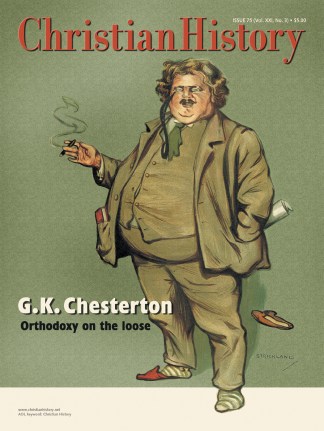
Philip Yancey credits G.K. Chesterton with helping to save his faith from a bitter encounter with fundamentalism. The power of Chesterton’s work also pointed Yancey toward a writing career that has produced such enriching books as Soul Survivor, The Jesus I Never Knew, What’s So Amazing About Grace? and Where Is God When It Hurts? We talked to Yancey about what contemporary Christians—especially evangelicals—can learn from the jolly journalist.
You’ve written that Chesterton helped you recover the joy of faith. How did he do that?
Chesterton believed that a godly way of life is the best way of all ways. It’s the way the world is supposed to work, the way the world is meant to be.
Evangelicals often say that Christianity is a “counter-culture.” I think Chesterton would probably say, “No, Christianity is the culture. Heretics are the counter-culture.”
What we need to do is rediscover the culture. And the culture includes joy and pleasure.
So often, the church is viewed as this finger-wagging, don’t-have-fun institution. Those of us who are in it know that that’s a caricature, but that is the impression a lot of people have. Chesterton would say exactly the opposite. He would say: “To have fun, live the way God intended life to be lived—the Christian way.”
That was very helpful to me, because I came from a fire-and-brimstone, guilt-saturated fundamentalist past. I had never really encountered that positive view of the world. I thought we were supposed to go through life afraid, with our heads down, fleeing anything that smacked of pleasure. And here was a person saying exactly the opposite. So that was an important step in my spiritual journey.
Is Chesterton’s positive view of culture related to his Catholicism?
One of Chesterton’s major contributions to me is his sacramental view of life. I’m not talking about baptism and the Eucharist and those things, but about the layers of meaning that are built into the world. In this view, sex and marriage, for example, are not just physical acts—they are also spiritual acts and, in a sense, theological acts. That’s scriptural, and I think the Catholic church has done a much better job of exploring the sacramental meaning of ordinary acts than, say, Protestant evangelicals have.
In what other ways does Chesterton’s upbeat attitude toward life play out?
When I was writing The Jesus I Never Knew, one of the things that struck me about Jesus was that the people we would most expect to be repelled by him—prostitutes, tax collectors, the poor, outcast lepers—were actually very attracted to him. I’m sure none of them thought, If I go to Jesus, he’ll approve of my behavior. Jesus had very high moral standards; no one would question those. But somehow, he was able to convey a respect for them, a compassion, and a love, even though he disagreed with choices they made.
I think Chesterton conveys much the same spirit. He carried on public debates and even wrote a book called Heretics, but he always truly engaged people who disagreed with him.
For most of us, “heretics” conjures up the Inquisition and these scowling Inquisitors turning the screws of the rack. Well, Chesterton was the exact opposite of that. His theology was just as strong as theirs, and he believed it just as fervently, but his attitude toward people he disagreed with was one of compassion and respect and good humor. If we as a church could just master that skill, we’d go a long way toward rehabilitating what is often viewed as the soiled reputation of the church.
Chesterton’s humor seems to be especially lacking in much Christian writing today.
The folks at the old Wittenburg Door could tell you all sorts of war stories about how evangelicals completely misunderstand satire and other attempts at humor. I’ve experienced this, too. I answer letters probably every week from people who are very uptight over something I said.
For example, I recently responded to a woman who was upset about a quote I used from Frederick Buechner. He had visited my church, and the person leading worship was a woman who happened to be grossly overweight. He made the comment, “How can anyone let herself get that fat?” Many of us in the audience were wondering the same thing. I reproduced that comment.
Well, I got this stinging, four-page letter about how obesity is a disease, and what am I going to do next, line up people with AIDS and make fun of them? I tried to answer her sensitively and compassionately, but I felt like just saying, “Lighten up.”
Chesterton would be a good example there, because he was grossly overweight, over 300 pounds sometimes, and he joked about it as much as anybody. He just had that disarming approach of levity towards the world. He didn’t take things too seriously. And I think we evangelicals do.
We’re not particularly good at humor. We’re susceptible to our own form of political correctness—it’s different from what you’ll find in academia, but it’s there.
People joke about my gray “Afro” hairstyle. This is just a fact of my life, so I laugh with them. I think Chesterton’s approach, making himself the main butt of his jokes, is a good model for all of us.
Even with all of his humor, can’t Chesterton be tough to read?
I would recommend drinking very strong coffee before reading Chesterton. He is not bedtime reading, at least for me, because his sentences are so compact and compressed, and he leaps from thought to thought.
Chesterton was a chaotic person, and he had a chaotic style. He throws ideas and phrases up in the air, but they become seeds. The seeds fall to the ground and take root, because they sound true. They reflect reality.
There have been people to whom I have strongly recommended the book Orthodoxy who come back and say, “I wasn’t able to get into it at all.” It takes some work, but it’s definitely worth it. I would say Orthodoxy had as much influence on my spiritual direction as any single book, and it’s one of the few books that I go back and reread. It was a revolutionary book for me.
Copyright © 2002 by the author or Christianity Today/Christian History magazine. Click here for reprint information on Christian History.