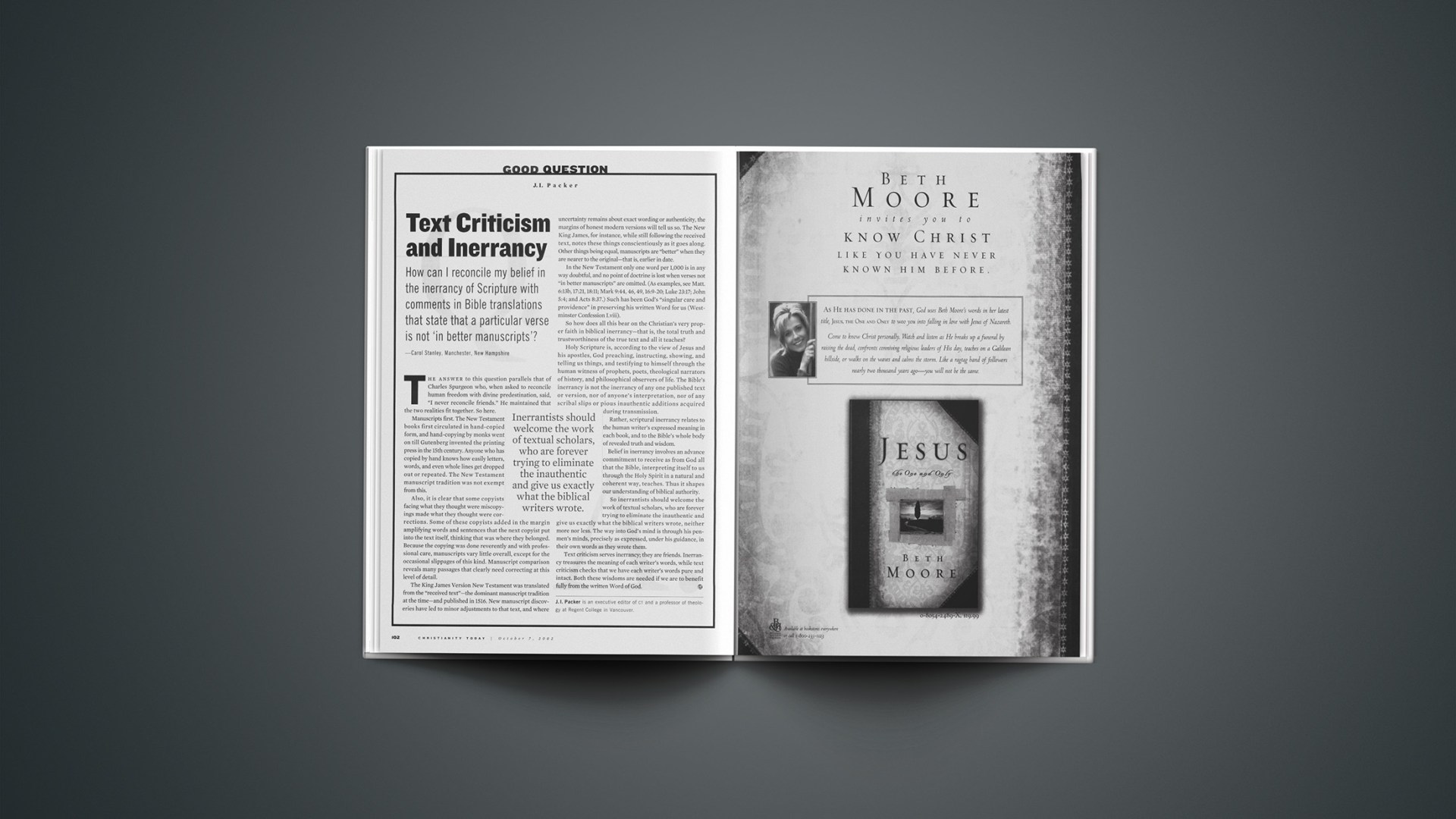

How can I reconcile my belief in the inerrancy of Scripture with comments in Bible translations that state that a particular verse is not ‘in better manuscripts’?
—Carol Stanley, Manchester, New Hampshire
The answer to this question parallels that of Charles Spurgeon who, when asked to reconcile human freedom with divine predestination, said, "I never reconcile friends." He maintained that the two realities fit together. So here.
Manuscripts first. The New Testament books first circulated in hand-copied form, and hand-copying by monks went on till Gutenberg invented the printing press in the 15th century. Anyone who has copied by hand knows how easily letters, words, and even whole lines get dropped out or repeated. The New Testament manuscript tradition was not exempt from this.
Also, it is clear that some copyists facing what they thought were miscopyings made what they thought were corrections. Some of these copyists added in the margin amplifying words and sentences that the next copyist put into the text itself, thinking that was where they belonged. Because the copying was done reverently and with professional care, manuscripts vary little overall, except for the occasional slippages of this kind. Manuscript comparison reveals many passages that clearly need correcting at this level of detail.
The King James Version New Testament was translated from the "received text"—the dominant manuscript tradition at the time—and published in 1611. New manuscript discoveries have led to minor adjustments to that text, and where uncertainty remains about exact wording or authenticity, the margins of honest modern versions will tell us so. The New King James, for instance, while still following the received text, notes these things conscientiously as it goes along.
Other things being equal, manuscripts are "better" when they are nearer to the original—that is, earlier in date.
In the New Testament only one word per 1,000 is in any way doubtful, and no point of doctrine is lost when verses not "in better manuscripts" are omitted. (As examples, see Matt. 6:13b, 17:21, 18:11; Mark 9:44, 46, 49, 16:9-20; Luke 23:17; John 5:4; and Acts 8:37.) Such has been God's "singular care and providence" in preserving his written Word for us (Westminster Confession I.viii).
So how does all this bear on the Christian's very proper faith in biblical inerrancy—that is, the total truth and trustworthiness of the true text and all it teaches?
Holy Scripture is, according to the view of Jesus and his apostles, God preaching, instructing, showing, and telling us things, and testifying to himself through the human witness of prophets, poets, theological narrators of history, and philosophical observers of life. The Bible's inerrancy is not the inerrancy of any one published text or version, nor of anyone's interpretation, nor of any scribal slips or pious inauthentic additions acquired during transmission.
Rather, scriptural inerrancy relates to the human writer's expressed meaning in each book, and to the Bible's whole body of revealed truth and wisdom.
Belief in inerrancy involves an advance commitment to receive as from God all that the Bible, interpreting itself to us through the Holy Spirit in a natural and coherent way, teaches. Thus it shapes our understanding of biblical authority.
So inerrantists should welcome the work of textual scholars, who are forever trying to eliminate the inauthentic and give us exactly what the biblical writers wrote, neither more nor less. The way into God's mind is through his penmen's minds, precisely as expressed, under his guidance, in their own words as they wrote them.
Text criticism serves inerrancy; they are friends. Inerrancy treasures the meaning of each writer's words, while text criticism checks that we have each writer's words pure and intact. Both these wisdoms are needed if we are to benefit fully from the written Word of God.
J.I. Packer is an executive editor of CT and a professor of theology at Regent College in Vancouver.