
Note: This article is a sidebar to our cover story, “The Positive Prophet.”
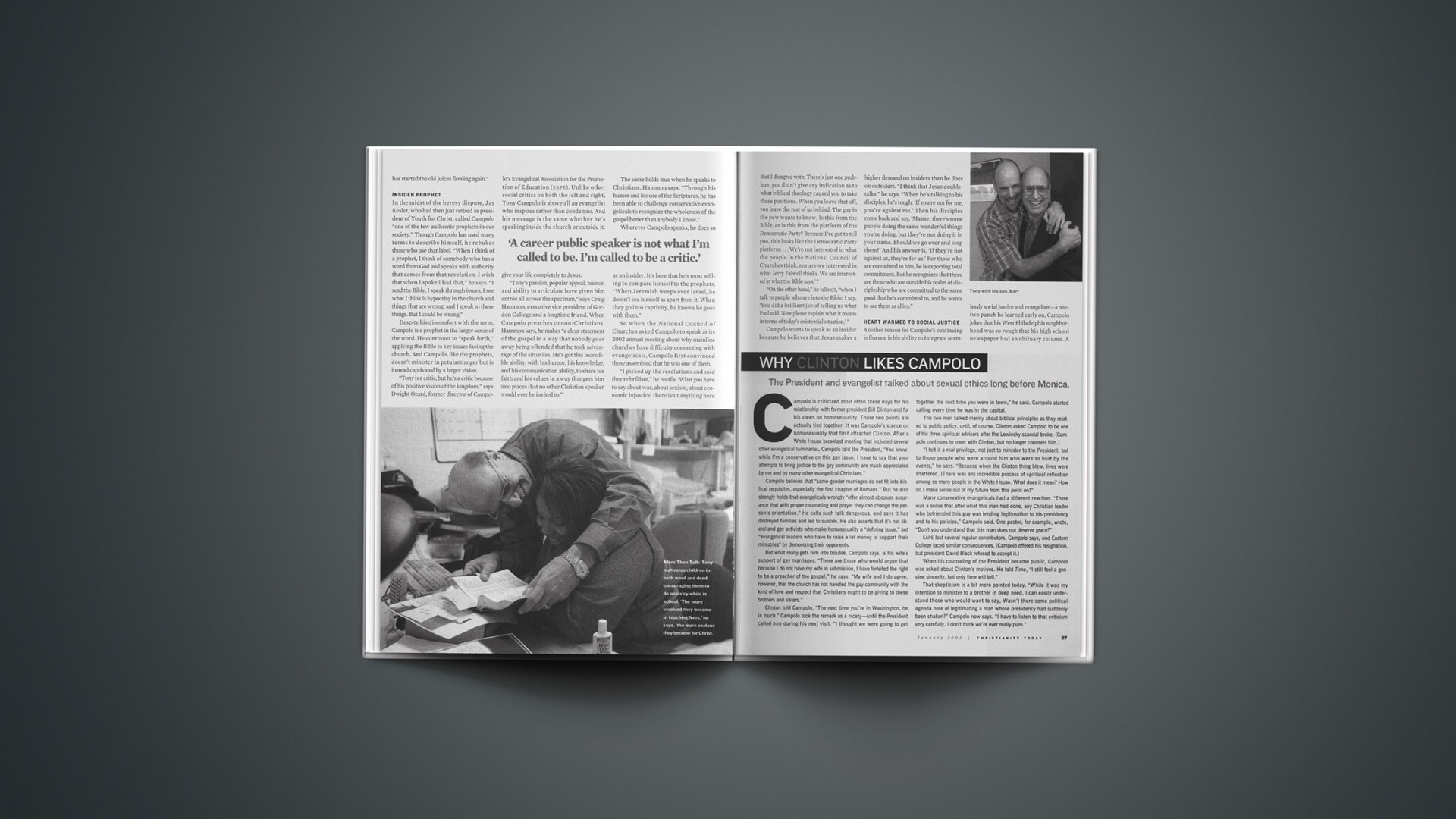
Campolo is criticized most often these days for his relationship with former president Bill Clinton and for his views on homosexuality. Those two points are actually tied together. It was Campolo’s stance on homosexuality that first attracted Clinton. After a White House breakfast meeting that included several other evangelical luminaries, Campolo told the President, “You know, while I’m a conservative on this gay issue, I have to say that your attempts to bring justice to the gay community are much appreciated by me and by many other evangelical Christians.”
Campolo believes that “same-gender marriages do not fit into biblical requisites, especially the first chapter of Romans.” But he also strongly holds that evangelicals wrongly “offer almost absolute assurance that with proper counseling and prayer they can change the person’s orientation.” He calls such talk dangerous, and says it has destroyed families and led to suicide. He also asserts that it’s not liberal and gay activists who make homosexuality a “defining issue,” but “evangelical leaders who have to raise a lot money to support their ministries” by demonizing their opponents.
But what really gets him into trouble, Campolo says, is his wife’s support of gay marriages. “There are those who would argue that because I do not have my wife in submission, I have forfeited the right to be a preacher of the gospel,” he says. “My wife and I do agree, however, that the church has not handled the gay community with the kind of love and respect that Christians ought to be giving to these brothers and sisters.”
Clinton told Campolo, “The next time you’re in Washington, be in touch.” Campolo took the remark as a nicety—until the President called him during his next visit. “I thought we were going to get together the next time you were in town,” he said. Campolo started calling every time he was in the capital.
The two men talked mainly about biblical principles as they related to public policy, until, of course, Clinton asked Campolo to be one of his three spiritual advisers after the Lewinsky scandal broke. (Campolo continues to meet with Clinton, but no longer counsels him.)
“I felt it a real privilege, not just to minister to the President, but to those people who were around him who were so hurt by the events,” he says. “Because when the Clinton thing blew, lives were shattered. [There was an] incredible process of spiritual reflection among so many people in the White House: What does it mean? How do I make sense out of my future from this point on?”
Many conservative evangelicals had a different reaction. “There was a sense that after what this man had done, any Christian leader who befriended this guy was lending legitimation to his presidency and to his policies,” Campolo said. One pastor, for example, wrote, “Don’t you understand that this man does not deserve grace?”
EAPE lost several regular contributors, Campolo says, and Eastern College faced similar consequences. (Campolo offered his resignation, but president David Black refused to accept it.)
When his counseling of the President became public, Campolo was asked about Clinton’s motives. He told Time, “I still feel a genuine sincerity, but only time will tell.”
That skepticism is a bit more pointed today. “While it was my intention to minister to a brother in deep need, I can easily understand those who would want to say, Wasn’t there some political agenda here of legitimating a man whose presidency had suddenly been shaken?” Campolo now says. “I have to listen to that criticism very carefully. I don’t think we’re ever really pure.”