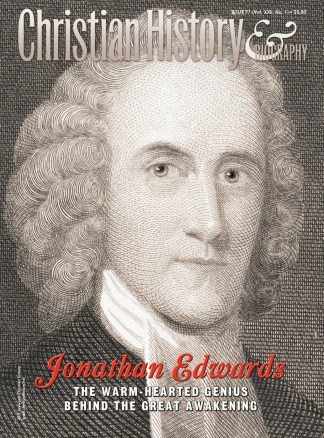
Modern Puritan.” That’s an oxymoron, right? Puritans, with their ultra-serious obsession with getting every detail of the Christian life just right, seem an anachronism in today’s free-and-easy America. In this world, religion has become, for many, an accessory—like the frontier town that supposedly distributed the advertisement for a new minister: “Wanted: A man who takes his religion like his drink—in moderation.”
That’s certainly not Jonathan Edwards.
This is the man who, as a boy, built little forts in the woods to hold—not settlers-and-Indians games, but prayer meetings with his friends. He is the precocious 13-year-old entering Yale University (then called the Collegiate School), who bucked a trend among the students away from the Puritan faith of the college’s founders and towards an elite Anglican rationalism—affirming instead the Reformed orthodoxy of his forebears.
Later, in true Puritan fashion, Edwards made a long list of spiritual and moral “Resolutions,” reminding him to dwell each day on his own death and eternal destiny and to bring his every emotion, thought, and action in line with the Word of God:
48. Resolved, constantly, with the utmost niceness and diligence, and the strictest scrutiny, to be looking into the state of my soul, that I may know whether I have truly an interest in Christ or no; that when I come to die, I may not have any negligence respecting this to repent of.
But at Yale, Edwards also read and interacted with Locke, Newton, and all the “New Learning” of the Enlightenment. Many of his early writings were on scientific topics. He saw the physical world as charged with the glory of God. And he made a lifetime study of the inner mechanics of religious psychology.
As a young man freshly installed in his first pastorate, his college courses behind him, Edwards determined to leave no question unexamined in his quest for a more thorough, “scientific” understanding of God’s Truth:
11. Resolved, when I think of any theorem in divinity to be solved, immediately to do what I can towards solving it, if circumstances don’t hinder.
One modern biographer, Ola Winslow, echoed the assessment of countless others when she said she had met in the pages of Edwards’s books “one of the great original minds of America.”
Yet, as original and, in some senses, “modern” as he clearly was, Edwards never stopped being a Puritan. His interest in the weighty matters of theology and the fine shadings of religious experience was never merely speculative or abstract. A preacher foremost, he studied and communicated the repository of Reformed theology as a living thing.
The distinguished American sociologist Robert Bellah has called Edwards “the last Protestant theologian before the twentieth century to have in his control the entire imaginative resources of the Christian tradition.” A child of the Puritans, a brother of the Enlightenment thinkers, Edwards bestowed the riches of the former on the modern world created by the latter.
Copyright © 2003 by the author or Christianity Today/Christian History magazine. Click here for reprint information on Christian History.