Scholarship Wars

Supreme Court says states can deny public funds to some religious students.

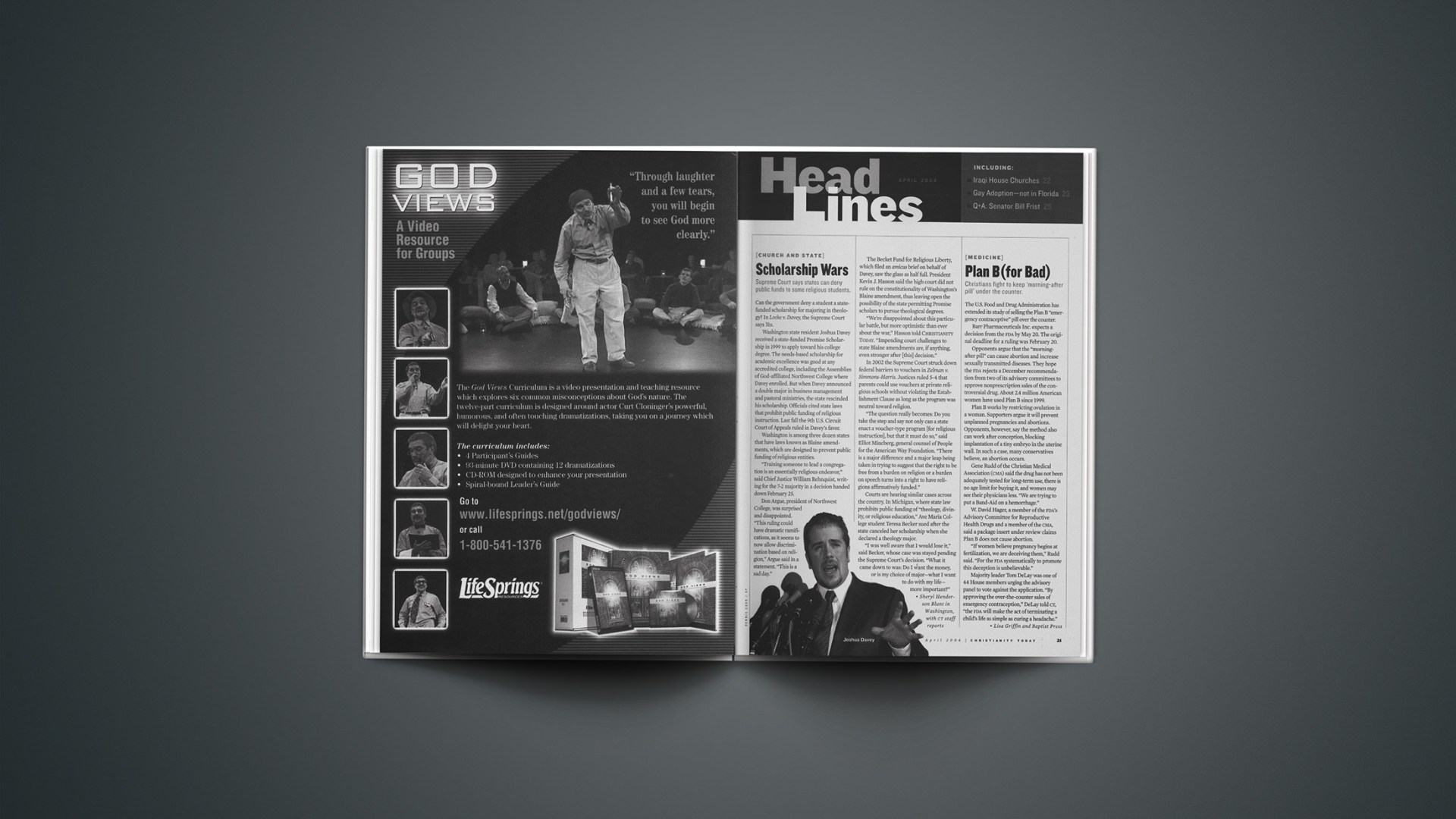
Can the government deny a student a state-funded scholarship for majoring in theology? In Locke v. Davey, the Supreme Court says Yes.

Washington state resident Joshua Davey received a state-funded Promise Scholarship in 1999 to apply toward his college degree. The needs-based scholarship for academic excellence was good at any accredited college, including the Assemblies of God-affiliated Northwest College where Davey enrolled. But when Davey announced a double major in business management and pastoral ministries, the state rescinded his scholarship. Officials cited state laws that prohibit public funding of religious instruction. Last fall the 9th U.S. Circuit Court of Appeals ruled in Davey’s favor.

Washington is among three dozen states that have laws known as Blaine amendments, which are designed to prevent public funding of religious entities.

“Training someone to lead a congregation is an essentially religious endeavor,” said Chief Justice William Rehnquist, writing for the 7-2 majority in a decision handed down February 25.

Don Argue, president of Northwest College, was surprised and disappointed. “This ruling could have dramatic ramifications, as it seems to now allow discrimination based on religion,” Argue said in a statement. “This is a sad day.”

The Becket Fund for Religious Liberty, which filed an amicus brief on behalf of Davey, saw the glass as half full. President Kevin J. Hasson said the high court did not rule on the constitutionality of Washington’s Blaine amendment, thus leaving open the possibility of the state permitting Promise scholars to pursue theological degrees.

“We’re disappointed about this particular battle, but more optimistic than ever about the war,” Hasson told Christianity Today. “Impending court challenges to state Blaine amendments are, if anything, even stronger after [this] decision.”

In 2002 the Supreme Court struck down federal barriers to vouchers in Zelman v. Simmons-Harris. Justices ruled 5-4 that parents could use vouchers at private religious schools without violating the Establishment Clause as long as the program was neutral toward religion.

“The question really becomes: Do you take the step and say not only can a state enact a voucher-type program [for religious instruction], but that it must do so,” said Elliot Mincberg, general counsel of People for the American Way Foundation. “There is a major difference and a major leap being taken in trying to suggest that the right to be free from a burden on religion or a burden on speech turns into a right to have religions affirmatively funded.”

Courts are hearing similar cases across the country. In Michigan, where state law prohibits public funding of “theology, divinity, or religious education,” Ave Maria College student Teresa Becker sued after the state canceled her scholarship when she declared a theology major.

“I was well aware that I would lose it,” said Becker, whose case was stayed pending the Supreme Court’s decision. “What it came down to was: Do I want the money, or is my choice of major—what I want to do with my life—more important?”

Copyright © 2004 Christianity Today. Click for reprint information.
Also in this issue

There's just Something about this Man: But Bill Gaither insists its not about him.

Cover Story

There's Just Something About This Man

Mark Allen Powell

He Is Risen

Compiled by Richard A. Kauffman

Emerging from the Shadows

Runo Samuelson in Baghdad

Evangelical Drift

Faith-based Child Abuse?

Corrie Cutrer

You Are or You Aren't

Answered by Erik Thoennes

Healing Genocide

Timothy C. Morgan

Life Imitates Art

Reviewed by Cindy Crosby

Mixing Religion and Politics

David Karanja in Nairobi

My Two Dads? Not in Florida

John W. Kennedy

News

Quotation Marks

Decalogue Debacle

Shaping Up Flabby Finances

Reviewed by Cindy Crosby

Spotlight on Sexism

Reviewed by Cindy Crosby

State of the Unions

Mark Stricherz in Washington

The <em>Christianity Today</em> News Wrap

CT Staff

The Language of Sin

Reviewed by Cindy Crosby

The Missions of Business

Reviewed by John P. Cragin

Pilgrims to Nowhere

A Justice that Restores

An interview with Howard Zehr

News

An Arts Festival in the Heartland

By Mark Allen Powell

News

Passages

By CT Staff

News

Witnessing with The Passion

Ken Walker

Wire Story

Plan B (for Bad)

Lisa Griffin and Baptist Press

Review

Joan of Arcadia

Douglas Leblanc

A Captivating Vision

An interview with Paul Hattaway

Q & A: Bill Frist

Interview by Tony Carnes

News

Go Figure

Forgiveness 101

Timothy C. Morgan

Border Crackdown

Timothy R. Callahan

A Copt at College

Amending Marriage

Tony Carnes

Lip Service

Jeff M. Sellers

Editorial

'The Longest Hatred'

A Christianity Today Editorial

A Bridge Over Troubled People

Deann Alford

Editorial

Crash-Helmet Christianity

A Christianity Today Editorial

View issue

Our Latest

Analysis

The Many Factors of America’s Math Problem

Ubiquitous screens, classroom chaos, a dearth of qualified teachers: The reasons our children are struggling in math class are multitude.

News

Four Years into the War, Life Goes on for Ukrainians

Even as Moscow weaponizes winter, locals attend church conferences, go sledding, and plan celebrations.

A Russian Drone Killed My Brother. Is the World Tired of Our Suffering?

Taras Dyatlik

On the fourth anniversary of Russia’s invasion of Ukraine, a Ukrainian theologian meditates on self-interested calls for a comfortable peace.

The Bulletin

The Bulletin Goes to Nashville!

Sho Baraka, Mike Cosper, Clarissa Moll, Russell Moore

In Music City, Russell, Mike, Sho, and Clarissa talk about creativity, vocation, and AI.

Review

They May Forget Your Sermons, but They’ll Remember This

Reuben Bredenhof’s new book encourages pastors to focus on small acts of faithfulness.

Excerpt

Parents of Prodigals Can Trust God is Good

Cameron Shaffer

An excerpt from Cameron Shaffer’s Keeping Kids Christian.

Worship, Bible Studies, and Restoration in South Korea’s Nonprofit Prison

Jennifer Park in Yeoju, South Korea

Somang Prison, the only private and Christian-run penitentiary in Asia, seeks to treat inmates with dignity—and it sees results.

Apple PodcastsDown ArrowDown ArrowDown Arrowarrow_left_altLeft ArrowLeft ArrowRight ArrowRight ArrowRight Arrowarrow_up_altUp ArrowUp ArrowAvailable at Amazoncaret-downCloseCloseEmailEmailExpandExpandExternalExternalFacebookfacebook-squareGiftGiftGooglegoogleGoogle KeephamburgerInstagraminstagram-squareLinkLinklinkedin-squareListenListenListenChristianity TodayCT Creative Studio Logologo_orgMegaphoneMenuMenupausePinterestPlayPlayPocketPodcastprintRSSRSSSaveSaveSaveSearchSearchsearchSpotifyStitcherTelegramTable of ContentsTable of Contentstwitter-squareWhatsAppXYouTubeYouTube