Bach in a Shoebox
Bach Archive researcher Michael Maul was looking through a shoebox that had only narrowly escaped a fire in the Anna Amalia Library a few months before. Inside lay more than 100 letters and poems for the 52nd birthday of Johann Sebastian Bach's patron, Duke Wilhelm Ernst of Saxe-Weimar. Maul had hoped to find a greeting from the composer himself, who in 1713 was the court organist. But what he found instead was a two-page hand-written aria for soprano and harpsichord, the first Bach vocal work discovered in 70 years.
The text is a 12-stanza poem by Johann Anton Mylius, beginning, "Alles mit Gott und nichts ohn' ihn" (Everything with God and nothing without him). The music, British conductor John Eliot Gardiner told The Guardian, is "a reflective, meditative, soothing piece, as Bach's church music so often is." The Bach Archive asked Gardiner to record and perform the piece in December, but the aria's first recording can be heard free at NPR.org.
Buried Saxon Treasure
Underneath Herefordshire Council's parking lot in Leominster, England, lies a Saxon rotunda, 56 feet in diameter. The council says the find, discovered by radar, is probably a 10th- or 11th-century baptistry, chapel, or mausoleum. "This is a tremendously important find- an opportunity to rewrite the early history of Christianity," Bruce Watson, a senior archaeologist with the Museum of London Archaeology Service, told the London Times.
Probably a medieval addition to a monastery founded around 660 by King Merewalh (or Merewald), the round structure appears to be well preserved. "It may be like going to a house and seeing the contents left behind," says Watson, who wonders if those contents may include gifts from noted patron Leofric III (d. 1057) and his wife, Godiva (famous for her unclad ride through Coventry). Excavation began in August.
Sounds of Slavery
Some CDs have liner notes. The Sounds of Slavery, which features 18 tracks (mostly 1930s field recordings) of sermons, spirituals, hollers, and other sounds, has a 288-page hardcover book (Beacon Press). "Above all else, slave culture was made to be heard," say authors Shane White and Graham White.
Cracking the Codex Code
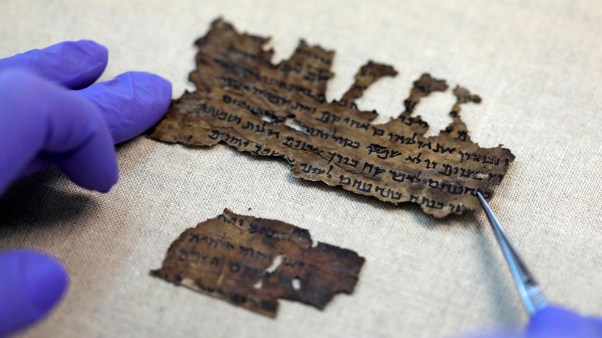
The Codex Sinaiticus, one of the oldest complete Greek New Testament manuscripts, has been off limits to all but the most serious scholars. Only four have been allowed to examine the leaves in the British Library over the last two decades. Soon it will be available to casual browsers. The British Library, the University of Leipzig, Russia's National Library, and Saint Catherine's Monastery in Egypt are uniting for a four-year, $1.3-million project that will result in high-resolution images, transcriptions, translations, and commentary. The "hyperspectral imaging" technique "will allow scholars to see all the layers of the manuscript … and thus perceive the various rewrites it has gone through," reports The Economist.
The manuscript, which has been dated to the mid-fourth century, contains half the Old Testament, much of the Apocrypha, all of the New Testament, the "Epistle of Barnabas" and part of the "Shepherd of Hermas" (a moralistic document used for catechumens, but deemed problematic for its teachings on the Trinity). "The codex is so special as a foundation document and a unique icon to Christianity," John Tuck, head of British Collections at the British Library, told The Dallas Morning News. The joint project is remarkable since Saint Catherine's Monastery has long fought the European institutions over ownership claims.
Saving Sudan's Sites
When it comes to Christian history, Sudan is not at the top of most pilgrimages. But maybe it should be: Edwin Yamauchi, professor of history at Miami University, Ohio, notes in Africa and the Bible (Baker Academic, 2004) that the "Ethiopian eunuch" of Acts 8 was actually from Meroe, Sudan (Moses' "Egyptian" wife was also from what is now Sudan). Eusebius's fourth-century Ecclesiastical History cites a tradition that this "first of the Gentiles to receive from Philip by revelation the mysteries of the divine word … was also the first to return to his native land and preach the gospel."
No hard evidence for this exists, and no patristic-era churches have been found, but The New York Times reports that the ruins of one of the country's oldest monasteries will soon be submerged as Sudan prepares to construct a large dam at the fourth cataract of the Nile. The Ghazali monastery, currently about 12 miles from the river at Wadi Abu Dom, was probably constructed around the turn of the ninth century by Copts from Egypt.
Archaeologists have researched the remains of the monastery's three-aisled church, but outbuildings and numerous graves may keep their secrets when the dam is completed in 2008.
Sprucing Up St. Paul's
Not even architect Christopher Wren saw his own St Paul's Cathedral in London like this, gasped The Guardian as a four-year, £11 million ($19.7 million) renovation project was completed in June. The paper says workers removed about 27,000 cubic feet of dust from the cathedral as they scrubbed clean 167,000 square feet of stonework, paintings, mosaics, tombs, sculptures, and other items.
The mess is partly the fault of Wren himself: during the construction that began in 1675, he ordered the stone coated in linseed oil three times to protect it from the elements. Instead, the oil helped to suck in London's dirt and smoke, darkening it so much that Wren unsuccessfully tried to hose the exterior clean before Queen Anne visited. The church is about to get even better: the cleaning is just part of a £40-million restoration that will be completed in 2007, for the church's 300th birthday.
Copyright © by the author or Christianity Today/Christian History & Biography magazine. Click here for reprint information on Christian History & Biography.