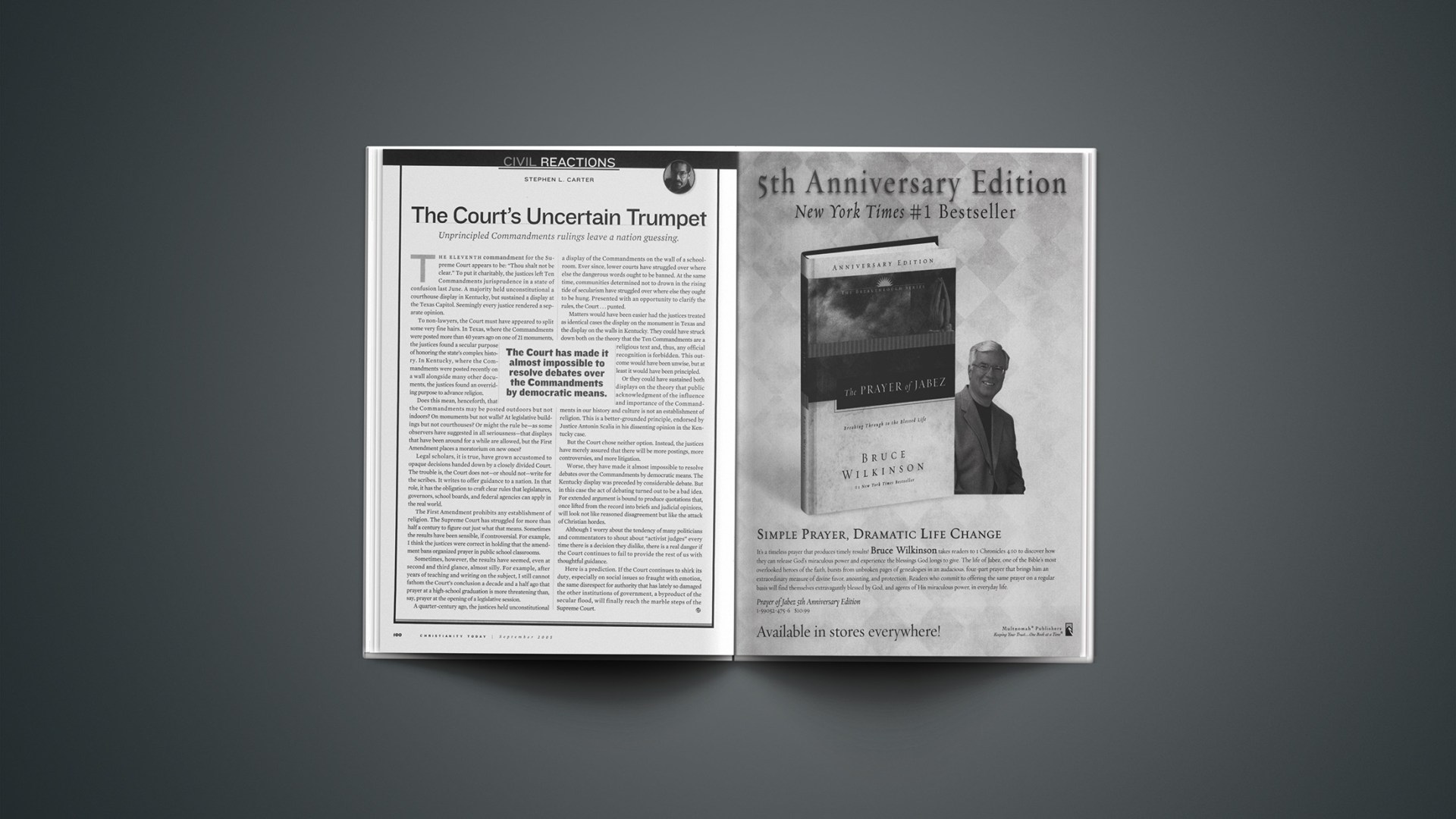
The eleventh commandment for the Supreme Court appears to be: “Thou shalt not be clear.” To put it charitably, the justices left Ten Commandments jurisprudence in a state of confusion last June. A majority held unconstitutional a courthouse display in Kentucky, but sustained a display at the Texas Capitol. Seemingly every justice rendered a separate opinion.
Legal scholars, it is true, have grown accustomed to opaque decisions handed down by a closely divided Court. The trouble is, the Court does not—or should not—write for the scribes. It writes to offer guidance to a nation. In that role, it has the obligation to craft clear rules that legislatures, governors, school boards, and federal agencies can apply in the real world.
The First Amendment prohibits any establishment of religion. The Supreme Court has struggled for more than half a century to figure out just what that means. Sometimes the results have been sensible, if controversial. For example, I think the justices were correct in holding that the amendment bans organized prayer in public school classrooms.
Sometimes, however, the results have seemed, even at second and third glance, almost silly. For example, after years of teaching and writing on the subject, I still cannot fathom the Court’s conclusion a decade and a half ago that prayer at a high-school graduation is more threatening than, say, prayer at the opening of a legislative session.
A quarter-century ago, the justices held unconstitutional a display of the Commandments on the wall of a schoolroom. Ever since, lower courts have struggled over where else the dangerous words ought to be banned. At the same time, communities determined not to drown in the rising tide of secularism have struggled over where else they ought to be hung. Presented with an opportunity to clarify the rules, the Court … punted.
Matters would have been easier had the justices treated as identical cases the display on the monument in Texas and the display on the walls in Kentucky. They could have struck down both on the theory that the Ten Commandments are a religious text and, thus, any official recognition is forbidden. This outcome would have been unwise, but at least it would have been principled.
Or they could have sustained both displays on the theory that public acknowledgment of the influence and importance of the Commandments in our history and culture is not an establishment of religion. This is a better-grounded principle, endorsed by Justice Antonin Scalia in his dissenting opinion in the Kentucky case.
But the Court chose neither option. Instead, the justices have merely assured that there will be more postings, more controversies, and more litigation.
Worse, they have made it almost impossible to resolve debates over the Commandments by democratic means. The Kentucky display was preceded by considerable debate. But in this case the act of debating turned out to be a bad idea. For extended argument is bound to produce quotations that, once lifted from the record into briefs and judicial opinions, will look not like reasoned disagreement but like the attack of Christian hordes.
Although I worry about the tendency of many politicians and commentators to shout about “activist judges” every time there is a decision they dislike, there is a real danger if the Court continues to fail to provide the rest of us with thoughtful guidance.
Here is a prediction. If the Court continues to shirk its duty, especially on social issues so fraught with emotion, the same disrespect for authority that has lately so damaged the other institutions of government, a byproduct of the secular flood, will finally reach the marble steps of the Supreme Court.
Copyright © 2005 Christianity Today. Click for reprint information.