





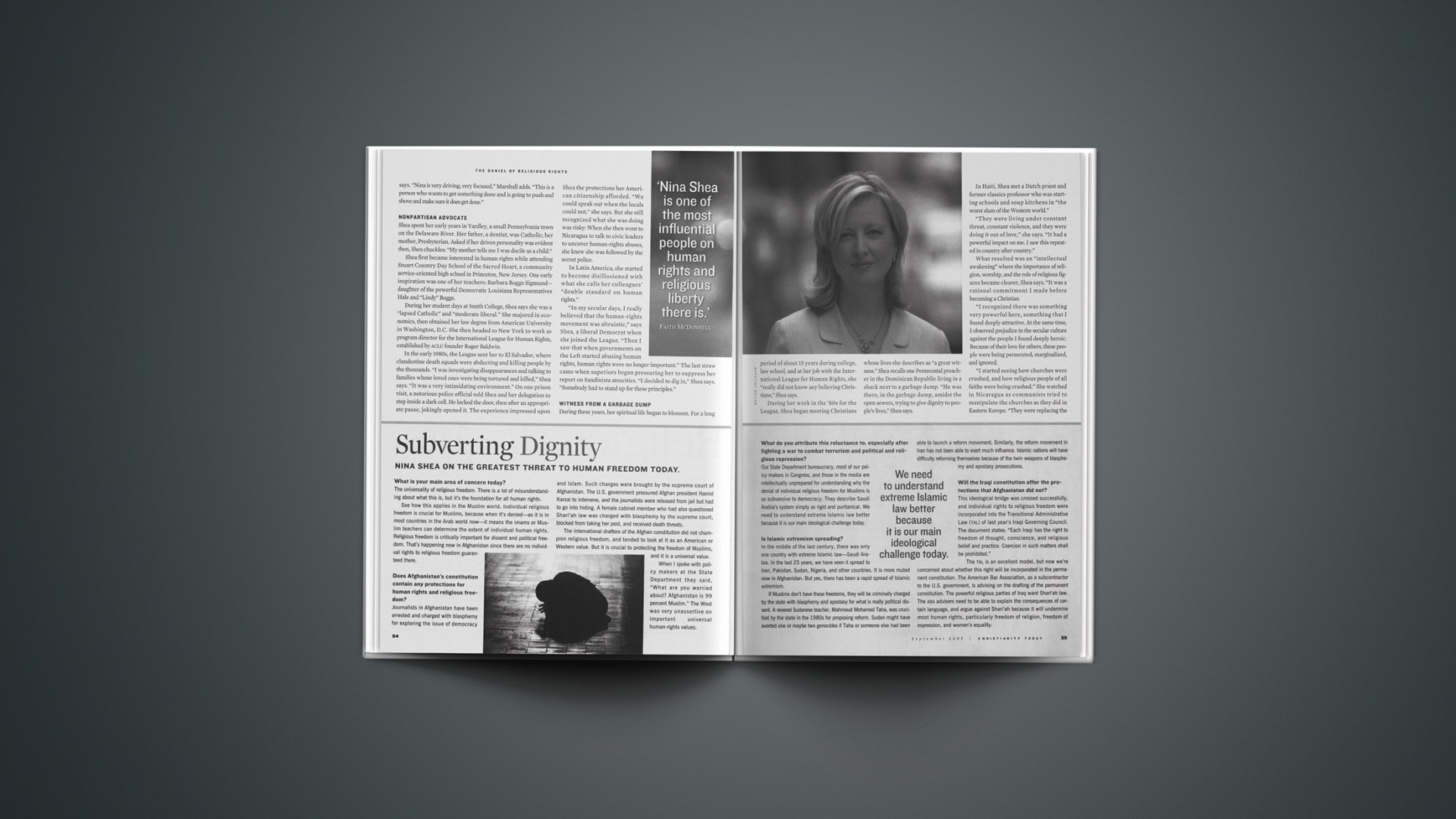
What is your main area of concern today?
The universality of religious freedom. There is a lot of misunderstanding about what this is, but it’s the foundation for all human rights.
See how this applies in the Muslim world. Individual religious freedom is crucial for Muslims, because when it’s denied—as it is in most countries in the Arab world now—it means the imams or Muslim teachers can determine the extent of individual human rights. Religious freedom is critically important for dissent and political freedom. That’s happening now in Afghanistan since there are no individual rights to religious freedom guaranteed there.
Does Afghanistan’s constitution contain any protections for human rights and religious freedom?
Journalists in Afghanistan have been arrested and charged with blasphemy for exploring the issue of democracy and Islam. Such charges were brought by the supreme court of Afghanistan. The U.S. government pressured Afghan president Hamid Karzai to intervene, and the journalists were released from jail but had to go into hiding. A female cabinet member who had also questioned Shari’ah law was charged with blasphemy by the supreme court, blocked from taking her post, and received death threats.
The international drafters of the Afghan constitution did not champion religious freedom, and tended to look at it as an American or Western value. But it is crucial to protecting the freedom of Muslims, and it is a universal value.
When I spoke with policy makers at the State Department they said, “What are you worried about? Afghanistan is 99 percent Muslim.” The West was very unassertive on important universal human-rights values.
What do you attribute this reluctance to, especially after fighting a war to combat terrorism and political and religious repression?
Our State Department bureaucracy, most of our policy makers in Congress, and those in the media are intellectually unprepared for understanding why the denial of individual religious freedom for Muslims is so subversive to democracy. They describe Saudi Arabia’s system simply as rigid and puritanical. We need to understand extreme Islamic law better because it is our main ideological challenge today.
Is Islamic extremism spreading?
In the middle of the last century, there was only one country with extreme Islamic law—Saudi Arabia. In the last 25 years, we have seen it spread to Iran, Pakistan, Sudan, Nigeria, and other countries. It is more muted now in Afghanistan. But yes, there has been a rapid spread of Islamic extremism.
If Muslims don’t have these freedoms, they will be criminally charged by the state with blasphemy and apostasy for what is really political dissent. A revered Sudanese teacher, Mahmoud Mohamed Taha, was crucified by the state in the 1980s for proposing reform. Sudan might have averted one or maybe two genocides if Taha or someone else had been able to launch a reform movement. Similarly, the reform movement in Iran has not been able to exert much influence. Islamic nations will have difficulty reforming themselves because of the twin weapons of blasphemy and apostasy prosecutions.
Will the Iraqi constitution offer the protections that Afghanistan did not?
This ideological bridge was crossed successfully, and individual rights to religious freedom were incorporated into the Transitional Administrative Law (TAL) of last year’s Iraqi Governing Council. The document states: “Each Iraqi has the right to freedom of thought, conscience, and religious belief and practice. Coercion in such matters shall be prohibited.”
The TAL is an excellent model, but now we’re concerned about whether this right will be incorporated in the permanent constitution. The American Bar Association, as a subcontractor to the U.S. government, is advising on the drafting of the permanent constitution. The powerful religious parties of Iraq want Shari’ah law. The aba advisers need to be able to explain the consequences of certain language, and argue against Shari’ah because it will undermine most human rights, particularly freedom of religion, freedom of expression, and women’s equality.
Copyright © 2005 Christianity Today. Click for reprint information.
Related Elsewhere:
This is a sidebar to today’s main article, “The Daniel of Religious Rights: Nina Shea is not someone to tangle with. And the persecuted are mighty glad.”
Freedom House‘s Center for Religious Freedom has more information on the organization and its work.
Brief biographical sketches on Shea are available from National Review (alt.), the U.S. Commission on International Religious Freedom, and Freedom House’s Center for Religious Freedom.
Shea’s In the Lion’s Den: Persecuted Christians and What the Western Church Can Do About It is available at Amazon.com and other book retailers.







