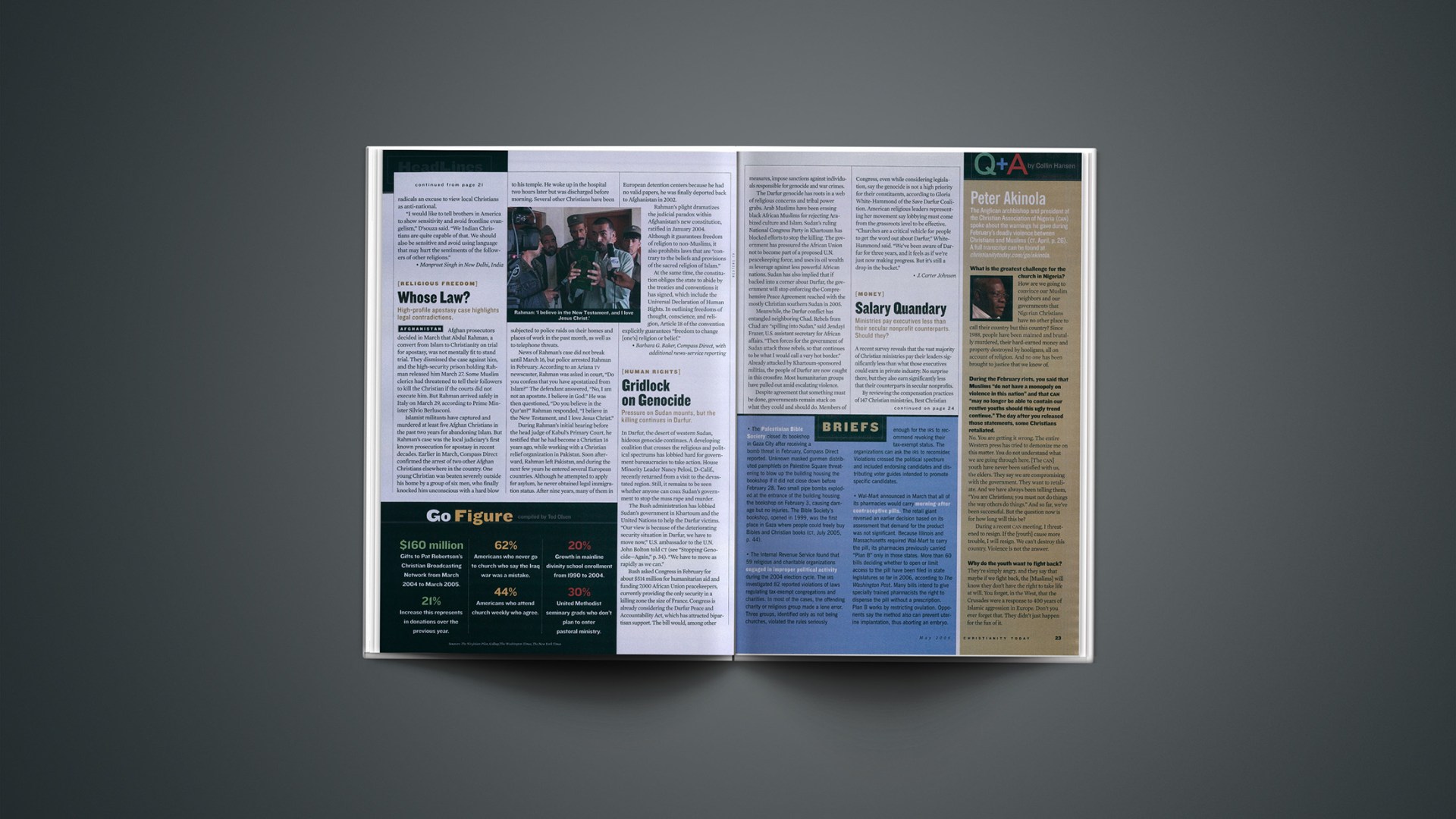

In Darfur, the desert of western Sudan, hideous genocide continues. A developing coalition that crosses the religious and political spectrum has lobbied hard for government bureaucracies to take action. House Minority Leader Nancy Pelosi, D-Calif., recently returned from a visit to the devastated region. Still, it remains to be seen whether anyone can coax Sudan’s government to stop the mass rape and murder.
The Bush administration has lobbied Sudan’s government in Khartoum and the United Nations to help the Darfur victims. “Our view is because of the deteriorating security situation in Darfur, we have to move now,” U.S. ambassador to the U.N. John Bolton told CT (see “Stopping Genocide-Again,” p. 34). “We have to move as rapidly as we can.”
So far, Congress has appropriated $514 million for humanitarian aid and funding 7,000 African Union peacekeepers, currently providing the only security in a killing zone the size of France. President Bush has asked Congress for an aid increase of 20 percent for 2007. Congress is already considering the Darfur Peace and Accountability Act, which has attracted bipartisan support. The bill would, among other measures, impose sanctions against individuals responsible for genocide and war crimes.
The Darfur genocide has roots in a web of religious concerns and tribal power grabs. Black Arab Muslims have been erasing black African Muslims for rejecting Arabized culture and Islam. Sudan’s ruling National Congress Party in Khartoum has blocked efforts to stop the killing. The government has pressured the African Union not to become part of a proposed U.N. peacekeeping force, and uses its oil wealth as leverage against less powerful African nations. Sudan has also implied that if backed into a corner about Darfur, the government will stop enforcing the Comprehensive Peace Agreement reached with the mostly Christian southern Sudan in 2005.
Meanwhile, the Darfur conflict has entangled neighboring Chad. Rebels from Chad are “spilling into Sudan,” said Jendayi Frazer, U.S. assistant secretary for African affairs. “Then forces for the government of Sudan attack those rebels, so that continues to be what I would call a very hot border.” Already attacked by Khartoum-sponsored militias, the people of Darfur are now caught in this crossfire. Most humanitarian groups have pulled out amid escalating violence.
Despite agreement that something must be done, governments remain stuck on what they could and should do. Members of Congress, even while considering legislation, say the genocide is not a high priority for their constituents, according to Gloria White-Hammond of the Save Darfur Coalition. American religious leaders representing her movement say lobbying must come from the grassroots level to be effective. “Churches are a critical vehicle for people to get the word out about Darfur,” White-Hammond said. “We’ve been aware of Darfur for three years, and it feels as if we’re just now making progress. But it’s still a drop in the bucket.”
Copyright © 2006 Christianity Today. Click for reprint information.
Related Elsewhere:
Also posted today is:
Stopping Genocide—Again | Ethnic bloodshed in Sudan’s Darfur region remains the top crisis for U.N. ambassador John Bolton.
Christianity Today’s full coverage of the trouble in Darfur and the end of the civil war in southern Sudan is available on our website.
The Crisis Group has lots of information about Darfur and what to do to help those in need.
Weblog regularly updates news from Sudan.