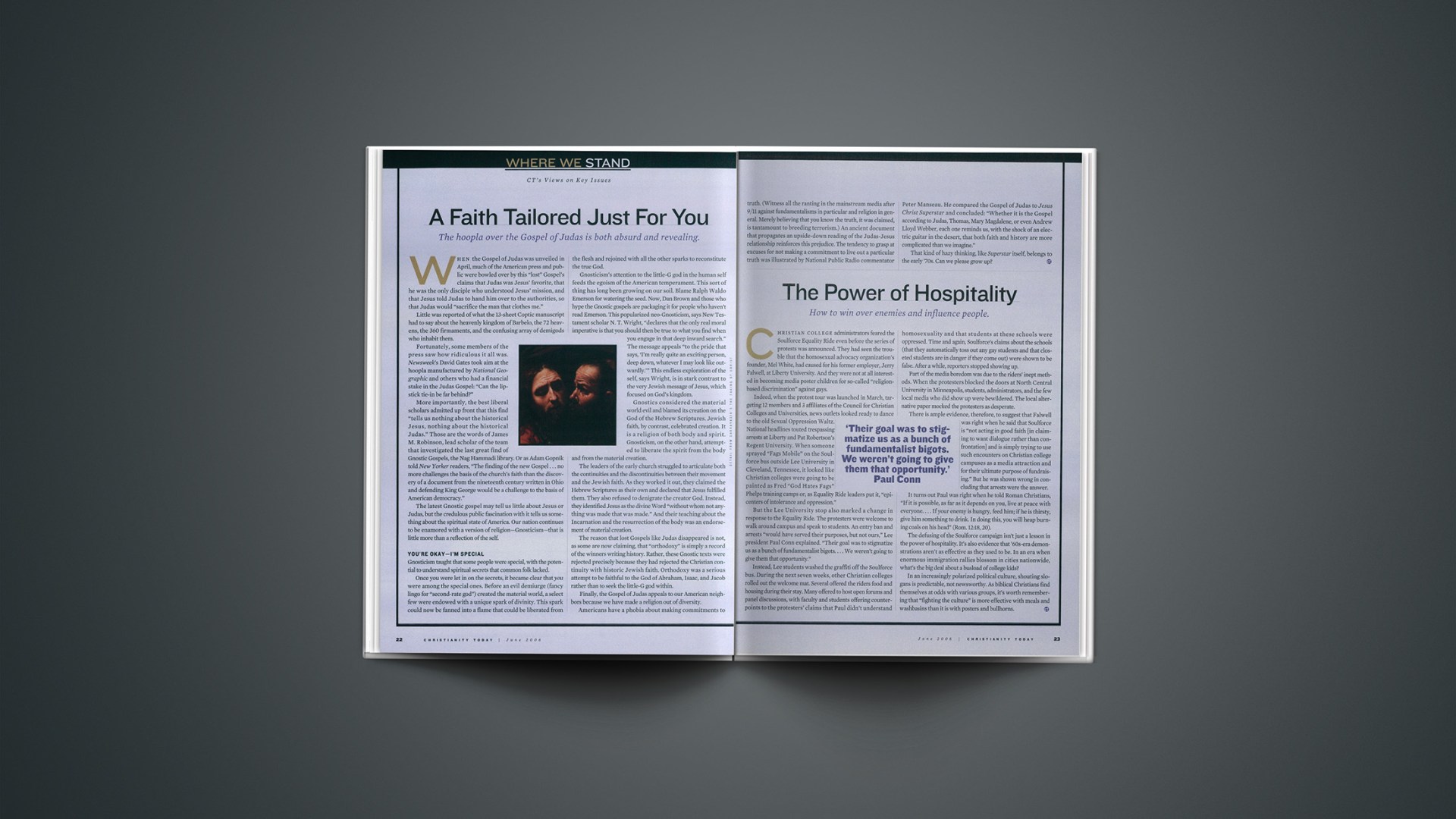

When the Gospel of Judas was unveiled in April, much of the American press and public were bowled over by this “lost” Gospel’s claims that Judas was Jesus’ favorite, that he was the only disciple who understood Jesus’ mission, and that Jesus told Judas to hand him over to the authorities, so that Judas would “sacrifice the man that clothes me.”
Little was reported of what the 13-sheet Coptic manuscript had to say about the heavenly kingdom of Barbelo, the 72 heavens, the 360 firmaments, and the confusing array of demigods who inhabit them.
Fortunately, some members of the press saw how ridiculous it all was. Newsweek‘s David Gates took aim at the hoopla manufactured by National Geographic and others who had a financial stake in the Judas Gospel: “Can the lipstick tie-in be far behind?”
More importantly, the best liberal scholars admitted up front that this find “tells us nothing about the historical Jesus, nothing about the historical Judas.” Those are the words of James M. Robinson, lead scholar of the team that investigated the last great find of Gnostic Gospels, the Nag Hammadi library. Or as Adam Gopnik told New Yorker readers, “The finding of the new Gospel … no more challenges the basis of the church’s faith than the discovery of a document from the nineteenth century written in Ohio and defending King George would be a challenge to the basis of American democracy.”
The latest Gnostic gospel may tell us little about Jesus or Judas, but the credulous public fascination with it tells us something about the spiritual state of America. Our nation continues to be enamored with a version of religion—Gnosticism—that is little more than a reflection of the self.
You’re okay—I’m special
Gnosticism taught that some people were special, with the potential to understand spiritual secrets that common folk lacked.
Once you were let in on the secrets, it became clear that you were among the special ones. Before an evil demiurge (fancy lingo for “second-rate god”) created the material world, a select few were endowed with a unique spark of divinity. This spark could now be fanned into a flame that could be liberated from the flesh and rejoined with all the other sparks to reconstitute the true God.
Gnosticism’s attention to the little-G god in the human self feeds the egoism of the American temperament. This sort of thing has long been growing on our soil. Blame Ralph Waldo Emerson for watering the seed. Now, Dan Brown and those who hype the Gnostic gospels are packaging it for people who haven’t read Emerson. This popularized neo-Gnosticism, says New Testament scholar N. T. Wright, “declares that the only real moral imperative is that you should then be true to what you find when you engage in that deep inward search.” The message appeals “to the pride that says, ‘I’m really quite an exciting person, deep down, whatever I may look like outwardly.'” This endless exploration of the self, says Wright, is in stark contrast to the very Jewish message of Jesus, which focused on God’s kingdom.
Gnostics considered the material world evil and blamed its creation on the God of the Hebrew Scriptures. Jewish faith, by contrast, celebrated creation. It is a religion of both body and spirit. Gnosticism, on the other hand, attempted to liberate the spirit from the body and from the material creation.
The leaders of the early church struggled to articulate both the continuities and the discontinuities between their movement and the Jewish faith. As they worked it out, they claimed the Hebrew Scriptures as their own and declared that Jesus fulfilled them. They also refused to denigrate the creator God. Instead, they identified Jesus as the divine Word “without whom not anything was made that was made.” And their teaching about the Incarnation and the resurrection of the body was an endorsement of material creation.
The reason that lost Gospels like Judas disappeared is not, as some are now claiming, that “orthodoxy” is simply a record of the winners writing history. Rather, these Gnostic texts were rejected precisely because they had rejected the Christian continuity with historic Jewish faith. Orthodoxy was a serious attempt to be faithful to the God of Abraham, Isaac, and Jacob rather than to seek the little-G god within.
Finally, the Gospel of Judas appeals to our American neighbors because we have made a religion out of diversity.
Americans have a phobia about making commitments to truth. (Witness all the ranting in the mainstream media after 9/11 against fundamentalisms in particular and religion in general. Merely believing that you know the truth, it was claimed, is tantamount to breeding terrorism.) An ancient document that propagates an upside-down reading of the Judas-Jesus relationship reinforces this prejudice. The tendency to grasp at excuses for not making a commitment to live out a particular truth was illustrated by National Public Radio commentator Peter Manseau. He compared the Gospel of Judas to Jesus Christ Superstar and concluded: “Whether it is the Gospel according to Judas, Thomas, Mary Magdalene, or even Andrew Lloyd Webber, each one reminds us, with the shock of an electric guitar in the desert, that both faith and history are more complicated than we imagine.”
That kind of hazy thinking, like Superstar itself, belongs to the early ’70s. Can we please grow up?
Copyright © 2006 Christianity Today. Click for reprint information.
Related Elsewhere:
More on the Gospel of Judas includes:
Books & Culture’s Books of the Week
Betrayed Again | The Gospel of Judas Roadshow.
The Jesus and Judas Papers: A Look at Recent Claims about Jesus | Questions about history may be sincere, but make no mistake: There is an agenda at work. (April 13, 2006)
Weblog: Kisses for Judas | The Gospel of Judas beyond the ecstatic headlines (April 11, 2006)
The Judas We Never Knew | Disgraced disciple actually conspired with Jesus, according to newly released Gospel of Judas. Should we believe it? (April 6, 2006)
Weblog: Good News for Judas | Times of London: Vatican to “rehabilitate” Judas’s reputation (Jan. 13, 2006)
See more in our Da Vinci Code, Bible, and Theology pages.