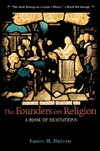
James H. Hutson, chief of the manuscript division of the Library of Congress, edited The Founders on Religion: A Book of Quotations (Princeton, 2005). The book, unlike some earlier, less scholarly collections of Revolution-era sayings, is organized by topic rather than by proper name, allowing easier searches. Stan Guthrie, a CT senior associate editor, spoke with Hutson about the religious beliefs of the Founders and their relevance for today.
|
The Founderson Religion:A Book ofQuotationsby James H. HutsonPrinceton280 pp.; $19.95 |
What are people’s biggest misconceptions about the Founders?
One is that there was a monolithic point of view on certain religious topics. There was a wide variety of opinion on a wide variety of subjects. But the subjects on which there was a kind of consensus emerged very clearly in the book. I have found no one among the Founders who didn’t believe in Providence being actively at work, who didn’t believe that religion was vital for social well-being, who didn’t believe in liberty of conscience.
Some say that the Founders were mostly Deists, others that they were really born again Christians.
“Deism” is a very slippery term. It generally means somebody who does not believe in revealed religion. It’s more correct to say that some of the Founders certainly had liberal views. John Adams talks about being a liberal Christian and admitted to being a Unitarian. Jefferson certainly was [a Unitarian]. Madison was accused of being a Unitarian. Washington’s views were very closely held. He did not take Communion in the Episcopal Church, though he attended regularly and was a vestryman. Franklin would be the closest to being a Deist.
Most of the leading people were not, I suspect, what you would call in today’s terms “evangelical Christians.” Some of them, however, were very deeply orthodox Christians, such as John Jay, the first chief justice. Elias Boudinot, the president of the Continental Congress and the first director of the U.S. Mint, would qualify as an evangelical Christian under any definition of that term. The population at large certainly was preponderantly orthodox or evangelical, but the founding group was substantially more liberal.
What did they teach us about church and state and religion in the public square?
As usual, they were divided. Jefferson and Madison believed that the state should not support a particular church. Others, such as John Adams and Washington, believed it was entirely permissible for the state to financially support churches in a non-preferential way.
Few among the proponents of more religion in the public square today would support taxes going directly to churches, but they might support tax dollars going to social-welfare organizations attached to churches.
What was the Founders’ attitude toward religion in the country?
Public virtue was seen as necessary for a republic, and most believed that virtue was produced by religion. There was a strong view that religion was necessary to turn out good citizens.
Many of the Founders were well versed in religious and theological matters. How did this affect their work as architects of the republic?
They could quote Scripture. Jefferson and others were tutored by ministers. They were an extremely biblically literate generation. This certainly shaped their view of Providence. The extent to which they believed in Providence would be unimaginable today.
Adams and folks like that continually quoted [Jesus’] statement that a swallow cannot fall without God’s knowledge. Washington talks about the invisible hand of Providence. Their biblical knowledge convinced these people that there was an invisible hand of God, and that there was a moral government of the universe.
Copyright © 2006 Christianity Today. Click for reprint information.
Related Elsewhere:
The Founders on Religion is available from Christianbook.com and at other retailers. You can read a sample chapter about addiction from the publisher.
Christianity Today earlier interviewed Hutson before the National Day of Prayer