Ideas

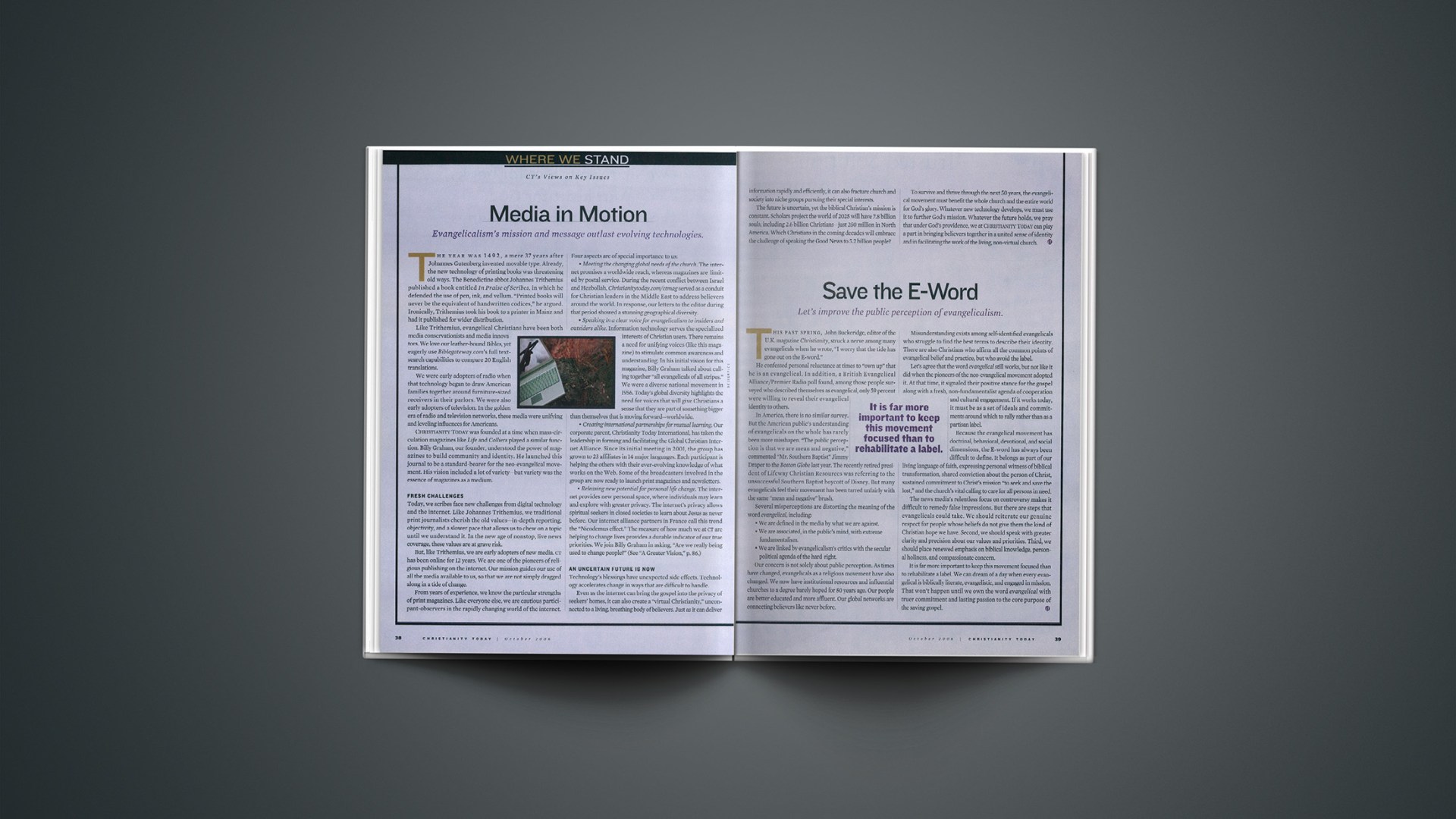
Save the E-Word

Let’s improve the public perception of evangelicalism.

This past spring, John Buckeridge, editor of the U.K. magazine Christianity, struck a nerve among many evangelicals when he wrote, “I worry that the tide has gone out on the E-word.”

He confessed personal reluctance at times to “own up” that he is an evangelical. In addition, a British Evangelical Alliance/Premier Radio poll found, among those people surveyed who described themselves as evangelical, only 59 percent were willing to reveal their evangelical identity to others.

In America, there is no similar survey. But the American public’s understanding of evangelicals on the whole has rarely been more misshapen. “The public perception is that we are mean and negative,” commented “Mr. Southern Baptist” Jimmy Draper to the Boston Globe last year. The recently retired president of Lifeway Christian Resources was referring to the unsuccessful Southern Baptist boycott of Disney. But many evangelicals feel their movement has been tarred unfairly with the same “mean and negative” brush.

Several misperceptions are distorting the meaning of the word evangelical, including:

We are defined in the media by what we are against. We are associated, in the public’s mind, with extreme fundamentalism. We are linked by evangelicalism’s critics with the secular political agenda of the hard-right.

Our concern is not solely about public perception. As times have changed, evangelicals as a religious movement have also changed. We now have institutional resources and influential churches to a degree barely hoped for 50 years ago. Our people are better educated and more affluent. Our global networks are connecting believers like never before.

Misunderstanding exists among self-identified evangelicals who struggle to find the best terms to describe their identity. There are also Christians who affirm all the common points of evangelical belief and practice, but who avoid the label.

Let’s agree that the word evangelical still works, but not like it did when the pioneers of the neo-evangelical movement adopted it. At that time, it signaled their positive stance for the gospel along with a fresh, non-fundamentalist agenda of cooperation and cultural engagement. If it works today, it must be as a set of ideals and commitments around which to rally rather than as a partisan label.

Because the evangelical movement has doctrinal, behavioral, devotional, and social dimensions, the E-word has always been difficult to define. It belongs as part of our living language of faith, expressing personal witness of biblical transformation, shared conviction about the person of Christ, sustained commitment to Christ’s mission “to seek and save the lost,” and the church’s vital calling to care for all persons in need.

The news media’s relentless focus on controversy makes it difficult to remedy false impressions. But there are steps that evangelicals could take. We should reiterate our genuine respect for people whose beliefs do not give them the kind of Christian hope we have. Second, we should speak with greater clarity and precision about our values and priorities. Third, we should place renewed emphasis on biblical knowledge, personal holiness, and compassionate concern.

It is far more important to keep this movement focused than to rehabilitate a label. We can dream of a day when every evangelical is biblically literate, evangelistic, and engaged in mission. That won’t happen until we own the word evangelical with truer commitment and lasting passion to the core purpose of the saving gospel.

Copyright © 2006 Christianity Today. Click for reprint information.

Related Elsewhere:

Christianity Today‘s Weblog earlier commented on Buckeridge’s Christianity editorial on “the e-word.”

The Institute for the Study of American Evangelicals has more on defining evangelicalism.

Also in this issue

The CT archives are a rich treasure of biblical wisdom and insight from our past. Some things we would say differently today, and some stances we've changed. But overall, we're amazed at how relevant so much of this content is. We trust that you'll find it a helpful resource.

Cover Story

Where We Are and How We Got Here

Mark A. Noll

What Married Women Want

The Church's Great Malfunctions

Miroslav Volf

Flea Market Believers

Arthur E. Farnsley II

A Bioethicist on Genesis

Reviewed by John Makujina

Hope for Shalom

Reviewed by LaTonya Taylor

CT Classics

Compiled by Richard A. Kauffman

From Eternity to Here

A Greater Vision

Harold Myra

Grappling with God

A One-China (Church) Policy

'Jesus Never Left China', reviewed by Tony Carnes

Editorial

Media in Motion

A Christianity Today Editorial

Genocide and Grace

Reviewed by Timothy C. Morgan

LBJ and JFK

Mark Noll

News

Q&A: Richard Stearns

What's Next: Relief and Development

Deann Alford

Review

IDing ID's Designer

Denyse O'Leary

What's Next: International Justice

What's Next: Higher Education

Ted Olsen and Jason Bailey

Legacy of a Global Leader

Tim Stafford

Evangelism Plus

Interview by Tim Stafford

Train Wreck Coming

What's Next: Evangelism

Timothy Morgan

What's Next: Culture

Rob Moll

Let Us Reason Together About Life

What's Next: Theology

Collin Hansen

News

To Russia with Fury

What's Next: Publishing & Broadcasting

Madison Trammel

The Top 50 Books That Have Shaped Evangelicals

What's Next: Politics

Tony Carnes

What's Next: Missions

News

Go Figure

What's Next: Youth

LaTonya Taylor

News

Quotation Marks

What's Next: Local Church

Tim Stafford

News

One 'Major Step'

Sarah Eekhoff Zylstra

'Truth from the Evangelical Viewpoint'

Mark A. Noll

News

'Christianity Today' News Briefs

CT staff

Calvary Reunion: Skip Heitzig Returns to N.M.

Rob Moll

News

'They Know We Are Christians'

Dale Gavlak in Beirut, Lebanon, and Amman, Jordan

News

A Hint of Peace

James Jewell in Gulu, Uganda

News

Passages

CT staff

News

Soaking in Blood—Again

Anto Akkara in Sri Lanka

Asylum vs. Assistance

Cool on Climate Change

Sheryl Henderson Blunt

Braves Lose Focus

Jason Bailey

The Earmark Epidemic

News

Axis Denied

Madison Trammel

News

Indonesia's Death Quota

Deann Alford

News

Disputed Dismissal

Sarah Pulliam

News

The Price of Protest

Xu Mei, Compass Direct, with reporting by CT

View issue

Our Latest

News

Amid Fear of Attacks, Many Nigerians Mute Christmas

Emmanuel Nwachukwu

One pastor has canceled celebrations and will only reveal the location of the Christmas service last-minute.

A Time of Moral Indignation

CT reports on civil rights, the “death of God” theology, and an escalating conflict in Vietnam.

The Bulletin

Brown University Shooting and The Last Republican

Mike Cosper, Clarissa Moll

Violence at Brown, and former Rep. Adam Kinzinger talks about Jan 6, courage, and global affairs.

Come, Thou Long-Expected Spirit

W. David O. Taylor

The Holy Spirit is present throughout the Nativity story. So why is the third person of the Trinity often missing from our Christmas carols?

A Heartwarming Book on Sin

Three books on theology to read this month.

Who Writes History When There Is No Winner?

Lebanon’s civil war is a taboo subject. A group of Christians and Muslims is broaching it.

Review

Review: Angel Studios’ ‘David’

Peter T. Chattaway

Artistically, it’s ambitious. Narratively, it works. But it’s no “The Prince of Egypt.”

My Son’s Last Christmas at Home

Christmastime comes with its own losses and longings. God understands them.

Apple PodcastsDown ArrowDown ArrowDown Arrowarrow_left_altLeft ArrowLeft ArrowRight ArrowRight ArrowRight Arrowarrow_up_altUp ArrowUp ArrowAvailable at Amazoncaret-downCloseCloseEmailEmailExpandExpandExternalExternalFacebookfacebook-squareGiftGiftGooglegoogleGoogle KeephamburgerInstagraminstagram-squareLinkLinklinkedin-squareListenListenListenChristianity TodayCT Creative Studio Logologo_orgMegaphoneMenuMenupausePinterestPlayPlayPocketPodcastRSSRSSSaveSaveSaveSearchSearchsearchSpotifyStitcherTelegramTable of ContentsTable of Contentstwitter-squareWhatsAppXYouTubeYouTube