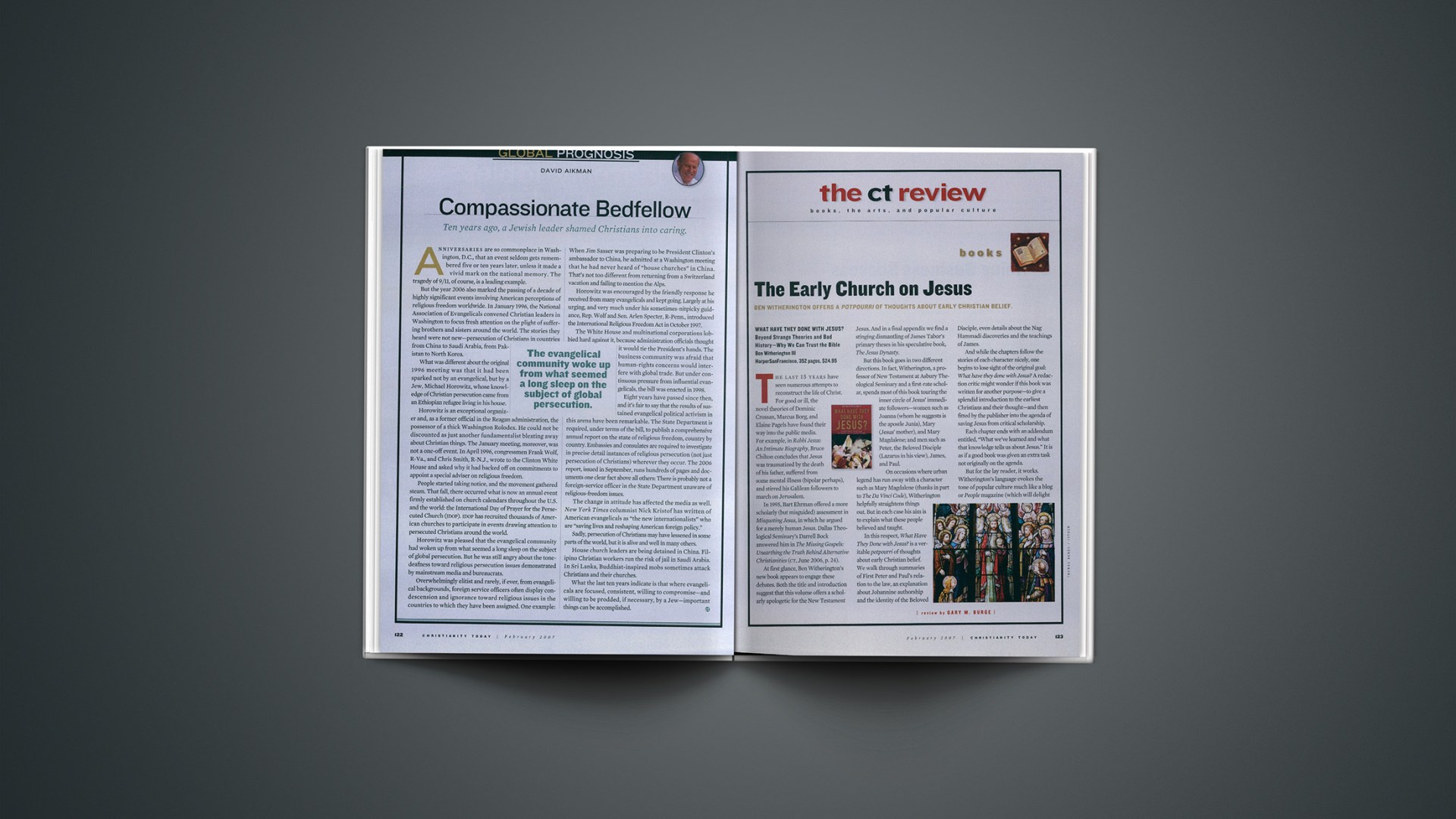

Anniversaries are so commonplace in Washington, D.C., that an event seldom gets remembered five or ten years later, unless it made a vivid mark on the national memory. The tragedy of 9/11, of course, is a leading example.
But the year 2006 also marked the passing of a decade of highly significant events involving American perceptions of religious freedom worldwide. In January 1996, the National Association of Evangelicals convened Christian leaders in Washington to focus fresh attention on the plight of suffering brothers and sisters around the world. The stories they heard were not new—persecution of Christians in countries from China to Saudi Arabia, from Pakistan to North Korea.
What was different about the original 1996 meeting was that it had been sparked not by an evangelical, but by a Jew, Michael Horowitz, whose knowledge of Christian persecution came from an Ethiopian refugee living in his house.
Horowitz is an exceptional organizer and, as a former official in the Reagan administration, the possessor of a thick Washington Rolodex. He could not be discounted as just another fundamentalist bleating away about Christian things. The January meeting, moreover, was not a one-off event. In April 1996, congressmen Frank Wolf, R-Va., and Chris Smith, R-N.J., wrote to the Clinton White House and asked why it had backed off on commitments to appoint a special adviser on religious freedom.
People started taking notice, and the movement gathered steam. That fall, there occurred what is now an annual event firmly established on church calendars throughout the U.S. and the world: the International Day of Prayer for the Persecuted Church (IDOP). IDOP has recruited thousands of American churches to participate in events drawing attention to persecuted Christians around the world.
Horowitz was pleased that the evangelical community had woken up from what seemed a long sleep on the subject of global persecution. But he was still angry about the tone-deafness toward religious persecution issues demonstrated by mainstream media and bureaucrats.
Overwhelmingly elitist and rarely, if ever, from evangelical backgrounds, foreign service officers often display condescension and ignorance toward religious issues in the countries to which they have been assigned. One example: When Jim Sasser was preparing to be President Clinton’s ambassador to China, he admitted at a Washington meeting that he had never heard of “house churches” in China. That’s not too different from returning from a Switzerland vacation and failing to mention the Alps.
Horowitz was encouraged by the friendly response he received from many evangelicals and kept going. Largely at his urging, and very much under his sometimes-nitpicky guidance, Rep. Wolf and Sen. Arlen Specter, R-Penn., introduced the International Religious Freedom Act in October 1997.
The White House and multinational corporations lobbied hard against it, because administration officials thought it would tie the President’s hands. The business community was afraid that human-rights concerns would interfere with global trade. But under continuous pressure from influential evangelicals, the bill was enacted in 1998.
Eight years have passed since then, and it’s fair to say that the results of sustained evangelical political activism in this arena have been remarkable. The State Department is required, under terms of the bill, to publish a comprehensive annual report on the state of religious freedom, country by country. Embassies and consulates are required to investigate in precise detail instances of religious persecution (not just persecution of Christians) wherever they occur. The 2006 report, issued in September, runs hundreds of pages and documents one clear fact above all others: There is probably not a foreign-service officer in the State Department unaware of religious-freedom issues.
The change in attitude has affected the media as well. New York Times columnist Nick Kristof has written of American evangelicals as “the new internationalists” who are “saving lives and reshaping American foreign policy.”
Sadly, persecution of Christians may have lessened in some parts of the world, but it is alive and well in many others.
House church leaders are being detained in China. Filipino Christian workers run the risk of jail in Saudi Arabia. In Sri Lanka, Buddhist-inspired mobs sometimes attack Christians and their churches.
What the last ten years indicate is that where evangelicals are focused, consistent, willing to compromise—and willing to be prodded, if necessary, by a Jew—important things can be accomplished.
Copyright © 2007 Christianity Today. Click for reprint information.
Related Elsewhere:
Christianity Today has a special section on the International Day of Prayer for the Persecuted Church.
PersecutedChurch.org lists organizations support persecuted Christians.
The 2006 United States Committee on International Religious Freedom‘s report is available as a pdf.
Recent Christianity Today articles on the persecuted church include:
Equal-Opportunity Offender | Uzbek government crackdown on Muslims worries evangelicals. (January 18, 2007)
Riding the Pope’s Coattails | Protestants hope to share in the benefits of Turkey trip. (January 11, 2007)
Fleeing Nineveh | Threatened by persistent violence, Assyrian Christians in Iraq want to govern themselves. (December 18, 2006)
Cross Dress | British airline sends employee home for wearing crucifix. (November 20, 2006)
Marginalized Again | Evangelicals protest mandatory Christian curriculum in Israel. (November 17, 2006)