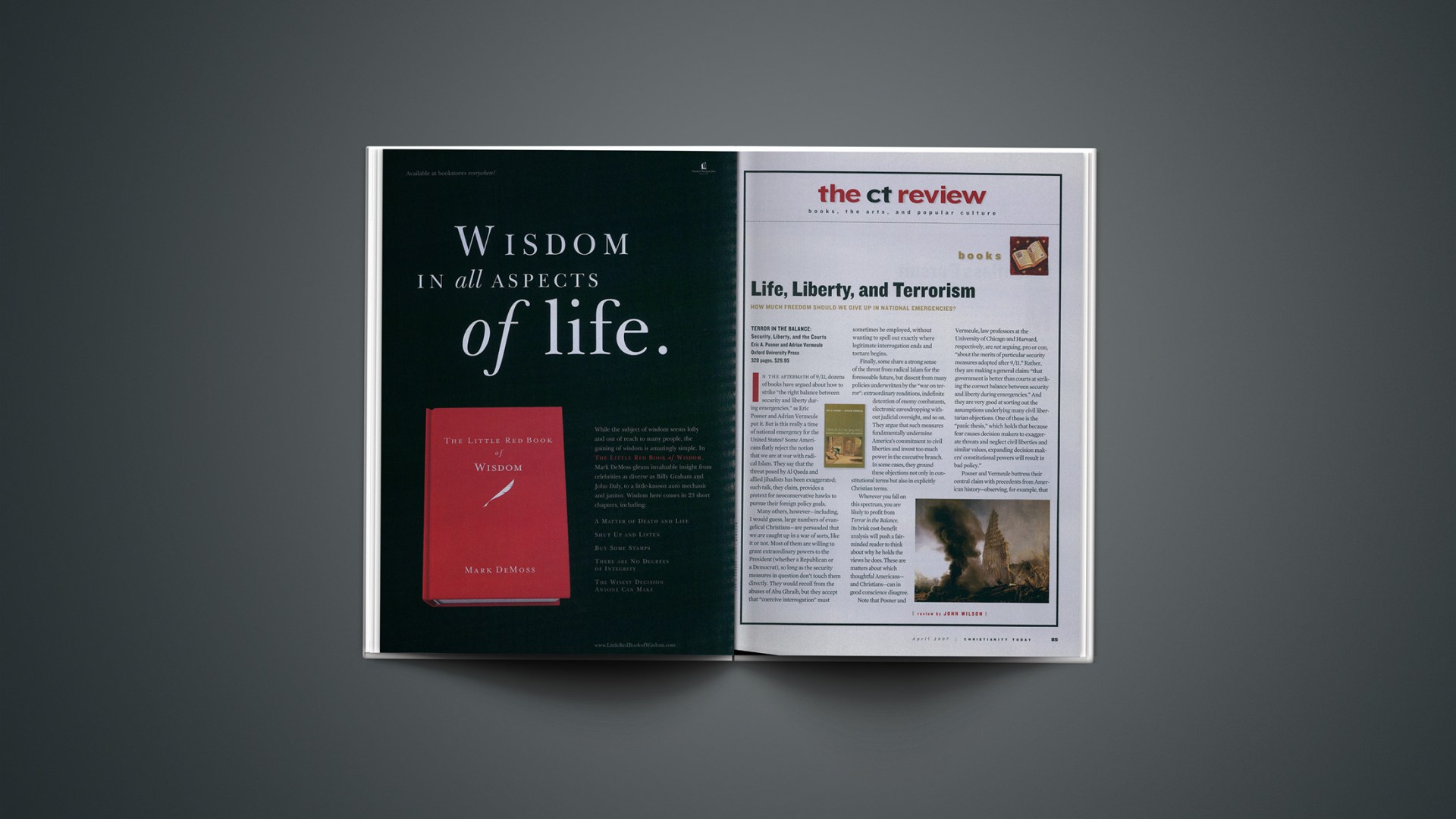

Terror in the Balance: Security, Liberty and the Courts Eric A. Posner and Adrian Vermeule Oxford University Press 328 pages, $29.95
In the aftermath of 9/11, dozens of books have argued about how to strike “the right balance between security and liberty during emergencies,” as Eric Posner and Adrian Vermeule put it. But is this really a time of national emergency for the United States? Some Americans flatly reject the notion that we are at war with radical Islam. They say that the threat posed by Al Qaeda and allied jihadists has been exaggerated; such talk, they claim, provides a pretext for neoconservative hawks to pursue their foreign policy goals.
Many others, however—including, I would guess, large numbers of evangelical Christians—are persuaded that we are caught up in a war of sorts, like it or not. Most of them are willing to grant extraordinary powers to the President (whether a Republican or a Democrat), so long as the security measures in question don’t touch them directly. They would recoil from the abuses of Abu Ghraib, but they accept that “coercive interrogation” must sometimes be employed, without wanting to spell out exactly where legitimate interrogation ends and torture begins.
Finally, some share a strong sense of the threat from radical Islam for the foreseeable future, but dissent from many policies underwritten by the “war on terror”: extraordinary renditions, indefinite detention of enemy combatants, electronic eavesdropping without judicial oversight, and so on. They argue that such measures fundamentally undermine America’s commitment to civil liberties and invest too much power in the executive branch. In some cases, they ground these objections not only in constitutional terms but also in explicitly Christian terms.
Wherever you fall on this spectrum, you are likely to profit from Terror in the Balance. Its brisk cost-benefit analysis will push a fair-minded reader to think about why he holds the views he does. These are matters about which thoughtful Americans—and Christians—can in good conscience disagree.
Note that Posner and Vermeule, law professors at the University of Chicago and Harvard, respectively, are not arguing, pro or con, “about the merits of particular security measures adopted after 9/11.” Rather, they are making a general claim: “that government is better than courts at striking the correct balance between security and liberty during emergencies.” And they are very good at sorting out the assumptions underlying many civil libertarian objections. One of these is the “panic thesis,” which holds that because fear causes decision makers to exaggerate threats and neglect civil liberties and similar values, expanding decision makers’ constitutional powers will result in bad policy.”
Posner and Vermeule buttress their central claim with precedents from American history—observing, for example, that Abraham Lincoln’s suspension of habeas corpus was in effect only until the perceived threat had passed, contrary to today’s dire warnings that civil liberties, once restricted, are irrevocably eroded.
But if, as we’re being told, the conflict with radical Islam could drag on for a very long while—for a generation or more—don’t such fears take on greater weight? Of one thing we can be certain. This elusive war, if war it is, will demand more from most of us than we have so far been asked to give.
John Wilson is the editor of Books & Culture.
Copyright © 2007 Christianity Today. Click for reprint information.
Related Elsewhere:
Terror in the Balance is available from Amazon.com and other retailers.
More information and reviews of the book are at Oxford University Press.
Posner has also written ‘A Threat That Belongs Behind Bars’ for The New York Times.
‘Judicial Cliches On Terrorism,’ by Posner and Vermeule appeared in The Washington Post.
Christianity Today has a special section on the war on terror.