
In the late fourth century, the biblical translator and monk Jerome described the Jews coming to observe the ninth day of the month of Ab, the anniversary of the destruction of the Temple. "Overcome with mourning," he wrote, they "are prohibited from entering Jerusalem. So that they may be allowed to weep over the ruins of their own city they pay a hefty price, and those who shed Christ's blood now shed their own tears."
Once a majority in the land, the Jews became personae non gratae in their own spiritual capital after A.D. 70. Most fled north to cities like Nazareth and Sepphoris in Galilee. Some fled to Europe, Asia, and North Africa. A few moved south of Jerusalem and Bethlehem to a small area called Daroma ("South" in Aramaic). Archaeological discoveries of Jewish ritual baths and stone vessels show that daily Jewish life continued in various places throughout the land—but not in Jerusalem.
The Jews' fortunes depended on who was emperor at the time and what mood he was in. In the fourth century, Constantine gave Count Joseph of Tiberias, a Jewish believer in Christ, permission to build churches in Sepphoris (then known as Diocaesarea), Tiberias, Capernaum, and Nazareth—all in Galilee. But after Constantine died in 337, his sons began to restrain Jewish populations throughout the empire. The emperors Theodosius II and Justinian codified these anti-Jewish sentiments into laws—for example, seizing the property of any Christian who converted to Judaism. But Jews were not stripped of citizenship and were usually allowed to maintain their own customs. At the other extreme was Emperor Julian (362-365), called "the Apostate" because he tried to reestablish pagan worship. Julian raised the Jews' hopes by promising to rebuild the Jewish Temple, but the building project was soon halted by his assassination.
Despite these political uncertainties, the few surviving Jews in Judea after A.D. 70 managed to grow and eventually to thrive.
A new kind of Judaism
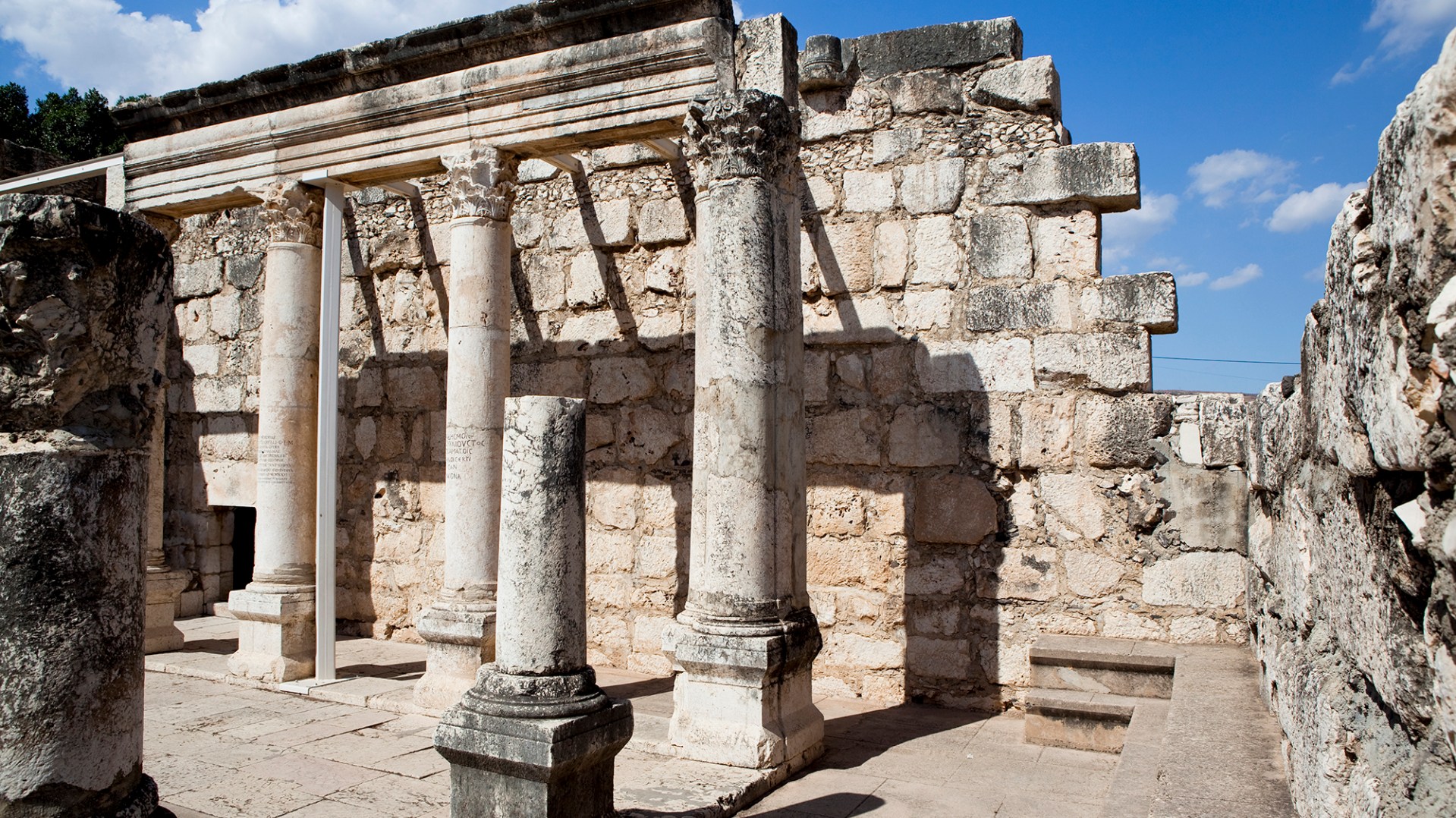
Public Jewish identity had to change in order to survive. A Jewish intellectual elite emerged in Sepphoris that redefined Judaism. Without a Temple, this new Judaism focused on the synagogue (defined as ten men gathered as Israel to declaim Torah) and on family rituals. Synagogues had already existed before Jesus' birth (see Luke 4:14-30). Archaeologists have excavated more than 50 synagogues in Palestine, dating mainly from the third century to the sixth century A.D. These buildings gradually became more and more elaborate, featuring beautiful mosaic artwork and dedications in Greek, Hebrew, and Aramaic.
Jewish literature also blossomed. The third-century rabbis believed that their discussions preserved and applied the Law originally given to Moses on Mt. Sinai in its oral form. The written Law was the Torah. The oral Law, also known as the oral Torah, became the Mishnah. Around 200, Rabbi Judah the Prince and his colleagues recorded the Mishnah in Hebrew. By the fourth century (around the time when Christianity became a legal religion in the empire), the rabbis, possibly in Tiberias, published an Aramaic commentary on the Mishnah, including a series of new applications of its laws, which we call the Jerusalem Talmud. This was followed nearly two centuries later by the Babylonian Talmud, an independent document from the Jewish Diaspora in Mesopotamia (modern Iraq).
Heresies and hopes
Meanwhile, hostility between Jews and Christians was growing. Most Jews knew Christians only as Gentiles, who were condemned as fornicators and idolaters. The Tosefta Hullin 2.24 (a third-century Jewish source) tells the story of a rabbi named Eliezer who encountered a known follower of Jesus and had a brief conversation with him. Because of this, the rabbi was later accused of heresy, but was released by the judge. From the point of view of third-century Judaism, Christianity was a heresy. Christians, after all, saw messianic prophecies in many biblical texts that the rabbis did not understand to be messianic at all, including Isaiah 7:14: "Behold, a virgin shall conceive."
In this time of uneasy coexistence, Jewish Christians were caught in the middle. Though some Jews did convert to Christianity during this period, Gentile Christians often considered them heretics. Origen and Eusebius reported that some Jewish Christians, especially those called Ebionites, observed the Law, did not believe in the virgin birth, practiced circumcision, and celebrated Passover according to the Jewish calendar. Eusebius added that he knew Jewish Christians who observed both the Jewish Sabbath and the Lord's Day. During this period, Christians were working very hard to define their beliefs and practices over against both pagans and Jews. Gentile Christians and Jewish Christians grew farther and farther apart.
If Jews did not accept Christians' messianic beliefs, they held on tightly to their own messianic hopes and looked toward the day when the Temple would be rebuilt and the kingdom restored to Israel. Around A.D. 135, four distinguished rabbis visited the ruins of Jerusalem. The Babylonian Talmud records, "When they reached Mt. Scopus, they tore their garments [in grief]. When they reached the Temple Mount, they saw a fox emerging from the place of the Holy of Holies. The others started weeping, but Rabbi Akiva laughed because, if the prophecy of Micah 3:12 was fulfilled that Jerusalem would be destroyed, then also the prophecy of Zechariah 8:4 would be fulfilled: 'Old men and women shall yet sit in the streets of Jerusalem.'"
James Strange is professor of religious studies at the University of South Florida.
Copyright © 2008 by the author or Christianity Today/Christian History & Biography magazine. Click here for reprint information on Christian History & Biography.