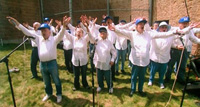
Two dozen seniors are sitting on grey metal folding chairs in a community center gymnatorium in Northampton, Massachusetts. A couple of people are falling asleep, the rest are looking over their large-print lyric sheets trying to follow along as their wiry-haired choir director leads them in a new song for their upcoming concert. Their upcoming rock concert.
It’s just another rehearsal for the Young@Heart Chorus, a group of 70- to 90-somethings who offer older perspectives on new rock songs, such as The Clash’s “Should I Stay or Should I Go?” and Sonic Youth’s “Schizophrenia.” It’s the latter that members are puzzling over today as 53-year-old director Bob Cilman tries to explain his vision for the trippy tune.

The senior singers, most of them fans of classical and opera, don’t get it, but they follow their leader just the same. After all, this is the man who introduced many of them to music CDs and who’s led them on multiple European tours, including a performance for the king and queen of Norway.
Stephen Walker’s documentary follows Bob and his Young@Heart choir for the seven weeks leading up to their Alive and Well concert, a sold-out, one-night-only show in their Massachusetts hometown. We watch these singers, aged 74 to 92, carpool to and from practice, wrestle with health problems, struggle to get in the 71 can‘s in Allen Toussaint’s “Yes We Can Can,” practice at home by singing along to music videos, perform music videos of their own to The Ramones’ “I Want to Be Sedated” and the Bee Gees’ “Stayin’ Alive,” iron their shirts and lace up their orthopedic shoes before a performance, and discuss the eclectic mix of songs in their repertoire.

Along the way, we meet several of the more colorful choir members, including Eileen, a 92-year-old war bride who likes to invert her age and tell people she’s really 29; Lenny, a World War II pilot who’s the only one in his carpool who can see well, a distinction that earns him the role of designated driver; and Fred, a former chorus member who had to quit because of heart failure and who returns for a one-time-only solo accompanied by his oxygen tank.
We also spend a fair amount of time with Bob, the choir director who slowly morphed the group’s song list from vaudeville tunes to modern rock. He seems hard on the members at times, pushing them to tackle tough melodies or memorize lyrics. But then we catch him taking surprise joy at a member’s musical moment. I wish we’d heard more about why he picks the songs he does and how these choir members have shaped his life.
Director Stephen Walker is most effective when he finally disappears about halfway through the film. Unfortunately he’s a frequent distraction in the first half, telling us with his distinctive British accent that he first saw Young@Heart in London and that he then decided to hang out with them for two months while they prepared for an upcoming hometown concert. Why? Who is Walker? Why should we care? Unfortunately, none of these questions are really addressed.
Instead of the audience getting to interact with choir members in their homes, cars, or rehearsals, we watch Stephen interact with them, thus distancing us one step from the action. Several recent documentaries, such as Spellbound, Mad Hot Ballroom, Darfur Now, Wordplay, and War/Dance, have done a much more effective job of introducing us to a new world and its inspiring inhabitants.
There are three music videos interspersed between the conversations, practices, and performances. These are clever, irreverent, and almost disrespectful moments in the film, and they show up in odd moments, mostly interrupting the flow.
Thankfully, Young@Heart also offers some wonderfully poignant moments—when the choir performs at a local prison, when a couple members succumb to health issues, when Fred offers a moving solo of Coldplay’s “Fix You.” Overall the group is a testament to the healing and community-building capabilities of music. The choir itself deserves four stars; if only the film had delivered the same grit and poignancy, it would have too.
Talk About It
Discussion starters- Which of the choir members struck you most or resonates with you most? Why?
- What do you think of the choir’s eclectic song choices? Just as the seniors found joy in performing a few songs they didn’t necessarily like, have you ever found joy from an unlikely source?
- What role do you think the choir plays in these seniors’ lives?
- What can we learn from these seniors about aging well?
- Are there ways you can help build community for the seniors in your neighborhood, church, or family?
The Family Corner
For parents to considerYoung@Heart is rated PG for some mild language and thematic elements. There’s one bad word in the Sonic Youth song, and one choir member has an amusing discussion about having sex with his wife in their golden years. There are also issues of illness and death. You’d probably have a difficult time getting younger kids to sit through this documentary, but savvy teens—especially music lovers—might get a kick out of it.
Photos © Copyright Fox Searchlight
Copyright © 2008 Christianity Today. Click for reprint information.