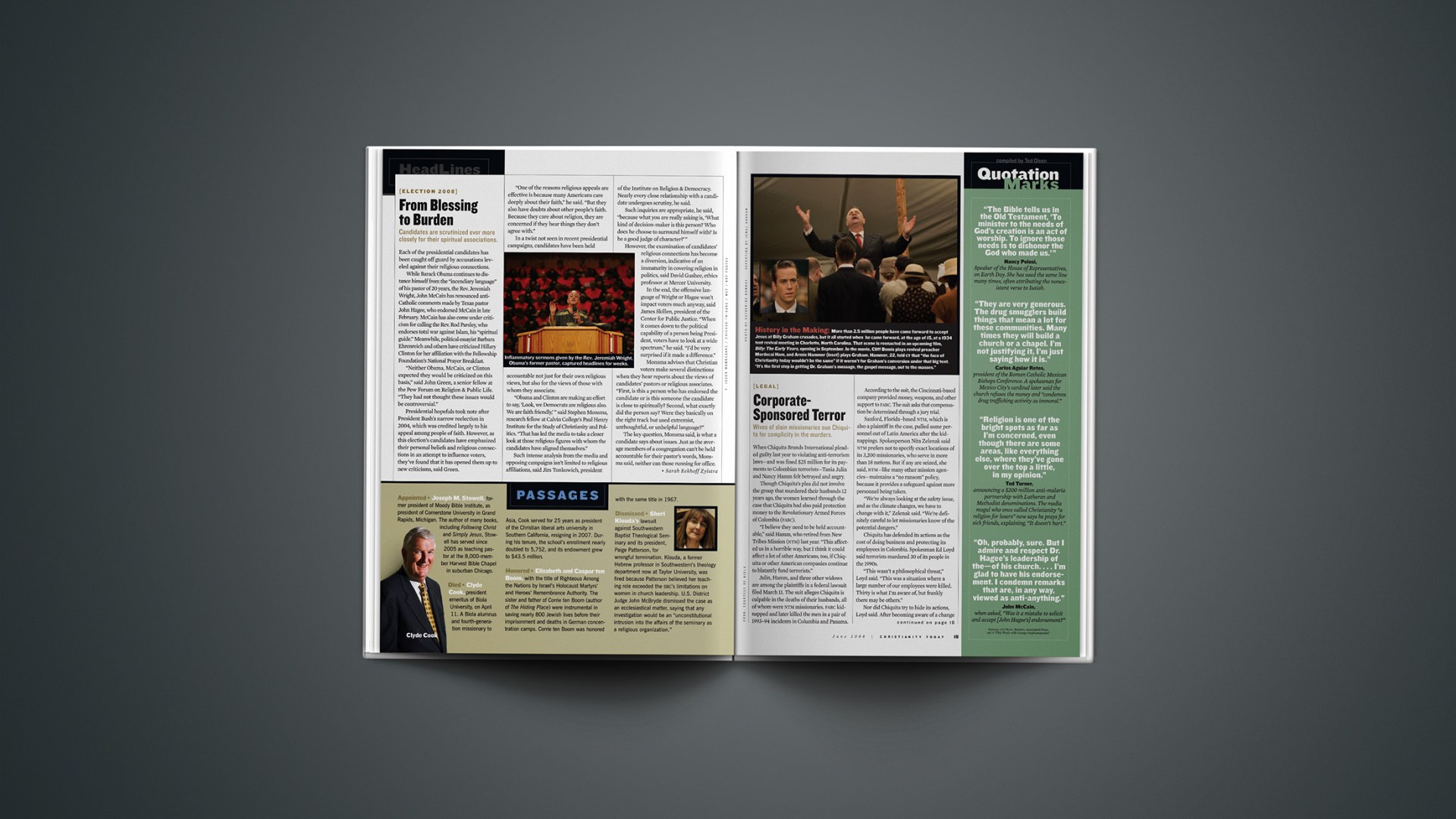

Each of the presidential candidates has been caught off guard by accusations leveled against their religious connections.
While Barack Obama continues to distance himself from the “incendiary language” of his pastor of 20 years, the Rev. Jeremiah Wright, John McCain has renounced anti-Catholic comments made by Texas pastor John Hagee, who endorsed McCain in late February. McCain has also come under criticism for calling the Rev. Rod Parsley, who endorses total war against Islam, his “spiritual guide.” Meanwhile, political essayist Barbara Ehrenreich and others have criticized Hillary Clinton for her affiliation with the Fellowship Foundation’s National Prayer Breakfast.
“Neither Obama, McCain, or Clinton expected they would be criticized on this basis,” said John Green, a senior fellow at the Pew Forum on Religion & Public Life. “They had not thought these issues would be controversial.”
Presidential hopefuls took note after President Bush’s narrow reelection in 2004, which was credited largely to his appeal among people of faith. However, as this election’s candidates have emphasized their personal beliefs and religious connections in an attempt to influence voters, they’ve found that it has opened them up to new criticisms, said Green.
“One of the reasons religious appeals are effective is because many Americans care deeply about their faith,” he said. “But they also have doubts about other people’s faith. Because they care about religion, they are concerned if they hear things they don’t agree with.”
In a twist not seen in recent presidential campaigns, candidates have been held accountable not just for their own religious views, but also for the views of those with whom they associate.
“Obama and Clinton are making an effort to say, ‘Look, we Democrats are religious also. We are faith friendly,’ ” said Stephen Monsma, research fellow at Calvin College’s Paul Henry Institute for the Study of Christianity and Politics. “That has led the media to take a closer look at those religious figures with whom the candidates have aligned themselves.”
Such intense analysis from the media and opposing campaigns isn’t limited to religious affiliations, said Jim Tonkowich, president of the Institute on Religion & Democracy. Nearly every close relationship with a candidate undergoes scrutiny, he said.
Such inquiries are appropriate, he said, “because what you are really asking is, ‘What kind of decision maker is this person? Who does he choose to surround himself with? Is he a good judge of character?’ ”
However, the examination of candidates’ religious connections has become a diversion, indicative of an immaturity in covering religion in politics, said David Gushee, ethics professor at Mercer University.
In the end, the offensive language of Wright or Hagee won’t impact voters much anyway, said James Skillen, president of the Center for Public Justice. “When it comes down to the political capability of a person being President, voters have to look at a wide spectrum,” he said. “I’d be very surprised if it made a difference.”
Monsma advises that Christian voters make several distinctions when they hear reports about the views of candidates’ pastors or religious associates. “First, is this a person who has endorsed the candidate or is this someone the candidate is close to spiritually? Second, what exactly did the person say? Were they basically on the right track but used extremist, unthoughtful, or unhelpful language?”
The key question, Monsma said, is what a candidate says about issues. Just as the average members of a congregation can’t be held accountable for their pastor’s words, Monsma said, neither can those running for office.
Copyright © 2008 Christianity Today. Click for reprint information.
Related elsewhere:
John Hagee recently apologized for his comments about Catholics.
In March, Collin Hansen interviewed Thabiti Anyabwile, author of The Decline of African American Theology, about Wright and the appeal of black liberation theology.
Other Christianity Today coverage of Jeremiah Wright includes “Jeremiah Wright, Evangelicals’ Brother in Christ.”
“Meet the Patriot Pastors” has more about Rod Parsley and the 2006 elections.
Pastors and preachers are discussing Wright over at Leadership Journal’s Out of Ur blog.
Our coverage of the 2008 campaign is available on our site.