John Knox is famous for his preaching: by it he instigated a religious revolution in Scotland, and when the Protestants became dejected in the struggle, his preaching rallied them to victory. Yet of the hundreds of sermons he preached, only two were ever published.
In early 1500s Scotland, the Catholic church owned more than half the real estate and gathered an annual income of almost 18 times that of the crown.
Bishops and priests in pre-Reformation Scotland were often appointed for their political connections, and many displayed horrific morals: the Archbishop of St. Andrews, Cardinal Beaton, openly consorted with concubines and sired ten children.
Knox was once sentenced to slave labor, rowing in a French galley. Knox later spoke of the “torment. in the galleys, which brought forth sobs of my heart.” During those 19 months, he contracted a kidney infection and stomach ulcers, ailments that vexed him the rest of his life.
While in exile in Geneva, Knox worked briefly with Miles Coverdale on the English translation called the Geneva Bible.
Scottish Reformers forbade the celebration of saints’ days and even Christmas. They believed only the Lord’s Day should be observed.
One of the most important ways the Reformation faith spread through Scotland was through “Privy Kirks,” small groups that met for prayer and Bible study.
The First Book of Discipline, an outline of government for the Reformed Scottish church co-authored by Knox, proposed that every Scottish child receive elementary and high school education—an idea centuries ahead of its time.
When a Protestant leader first exhorted Knox to take up preaching, Knox was frightened and wept openly in confusion.
During the stormy year of 1559, when religious revolution swept Scotland, Knox wrote that he could only get about four hours of sleep a night. He also asked a friend to secure a horse for him to use: “For great watch is laid for my apprehension, and large money promised [to] any that shall kill me.”
We don’t know the details of Knox’s conversion to Protestantism. On his deathbed, though, he asked his wife to read him John 18, describing it as the passage “where I first cast my anchor.”
Years after his first wife died, a 50- year-old Knox married again. His bride? Seventeen-year-old Margaret Stewart, a distant relative of Mary Queen of Scots—his chief antagonist.
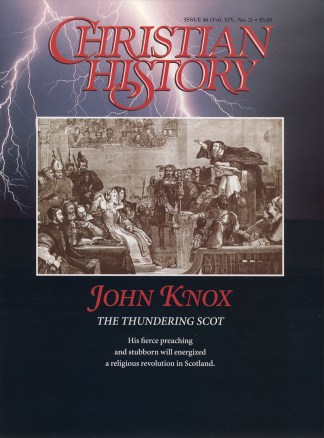
In his sermons, Knox typically spent half an hour calmly exegeting a biblical passage. Then as he applied the text to the Scottish situation, he would become “active and vigorous” and violently pound the pulpit. Said one note taker, “He made me so to grew [quake] and tremble, that I could not hold pen to write.”
Queen Mary once pleaded with Knox to keep Protestants from taking up the sword against Catholic priests. Knox replied, “The sword of justice is God’s, and if princes and rulers fail to use it, others may.”
Until this century, when a statue of Knox was erected in Edinburgh, there was no memorial dedicated to Knox in Scotland. Even today the spot where he is buried is covered by a parking lot.
Attendance in the Scottish Reformed Church was made compulsory for Protestants.
A would-be assassin once fired a shot through a window where Knox usually sat with his back to the street. The bullet passed through the chair and hit a chandelier but not Knox, who on this occasion had chosen to sit in another chair.
Knox sowed the seeds of the Presbyterian system of church government. Today his spiritual progeny includes some 750,000 Presbyterians in Scotland, 3 million in the United States, and many more millions worldwide.
Kevin Dale Miller is assistant editor of The Christian Reader and Your Church magazines.
Copyright © 1995 by the author or Christianity Today/Christian History magazine. Click here for reprint information on Christian History.