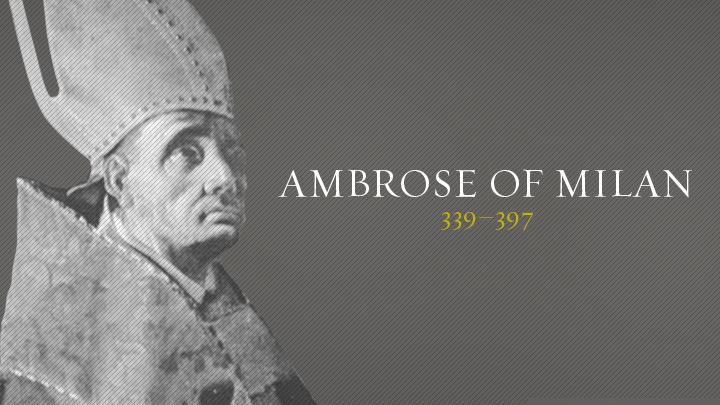
"When we are speaking about truth and life and redemption, we are speaking about Christ."

"When we speak of wisdom, we are speaking about Christ. When we speak about virtue, we are speaking about Christ. When we speak about justice, we are speaking about Christ. When we are speaking about truth and life and redemption, we are speaking about Christ." So wrote Ambrose, bishop of Milan, biblical exegete, political theorist, master of Latin eloquence, musician, and teacher; in all these roles, he was speaking about Christ.
Arrested career
The first Latin church father from a Christian family, Ambrose was also born into power, part of the Roman family of Aurelius. The pope and church dignitaries visited his parent's home when he was a child, and he was a governor in Italy's northern provinces before the age of 30. As he was sent, the prefect gave him a word of prophetic advice: "Go, conduct yourself not as a judge, but as a bishop."
Indeed, even as governor he had ecclesiastical problems to deal with. Orthodox Christians and Arians were practically at war at the time. Ambrose was no friend of the Arians, but he was so well regarded that both sides supported him. When the bishop of Milan (an Arian) died, Ambrose attended the meeting to elect a replacement, hoping that his presence would preempt violence between the parties. Much to his surprise, both sides shouted their wish for him to be their replacement.
Ambrose really didn't want to be an ecclesiastical leader; he was doing quite well as a political one. And he hadn't even been baptized yet! But the people wrote to Emperor Valentian, asking for his seal on their verdict. Ambrose was placed under arrest until he agreed to serve.
Timeline |
|
|
270 |
Antony takes up life of solitude |
|
313 |
"Edict of Milan" |
|
325 |
First Council of Nicea |
|
339 |
Ambrose of Milan born |
|
397 |
Ambrose of Milan dies |
|
398 |
Chrysostom consecrated bishop of Constantinople |
If the Arians had hoped to gain favor by supporting Ambrose as bishop, their hopes were soon dashed. The new bishop was as orthodox as could be, and he soon took the Arians to task. He refused to surrender a church for use by Arians, and he wrote several works against them, including On the Faith, The Mystery of the Lord's Incarnation, and On the Holy Spirit.
Having been trained in rhetoric and law and having studied Greek, Ambrose became known for his knowledge of the latest Greek writings, both Christian and pagan. In addition to Philo, Origen, and Basil of Caesarea, he even quoted Neoplatonist Plotinus in his sermons. He was widely regarded as an excellent preacher.
In many of those sermons, Ambrose expounded upon the virtues of asceticism. He was so persuasive that noble families sometimes forbade their daughters to attend his sermons, fearing they'd trade their marriageable status for a life of austere virginity.
One piece of his pastoral advice is still universally known: "When you are at Rome, live in the Roman style; when you are elsewhere, live as they live elsewhere."
Ambrose also introduced congregational singing, and he was accused of "bewitching" Milan by introducing Eastern melodies into the hymns he wrote. Because of his influence, hymn singing became an important part of the Western liturgy.
The emperor repents
Ambrose's most lasting contribution, though, was in the area of church-state relations. He wrestled with three emperors—and won each time. His relationship with Theodosius, the first emperor to try to make Rome a Christian state, is the most well-known example.
In 390, local authorities imprisoned a charioteer of Thessalonica for homosexuality. Unfortunately, the charioteer was one of the city's favorites, and riots broke out when the governor refused to release him. The governor and a few others were killed in the melee, and the charioteer was freed.
Fuming, Theodosius exacted revenge. He announced another chariot race, but after the crowds arrived, the gates were locked and the townspeople were massacred by the emperor's soldiers. Within three hours, 7,000 were dead.
Ambrose was horrified. He wrote an angry letter to Theodosius demanding his repentance. "I exhort, I beg, I entreat, I admonish you, because it is grief to me that the perishing of so many innocent is no grief to you," he wrote. "And now I call on you to repent." He forbade the emperor to attend worship until he prostrated himself at the altar.
Theodosius obeyed, marking the first time church triumphed over state.
In that event, Ambrose introduced the medieval concept of a Christian emperor as dutiful "son of the church serving under orders from Christ." For the next thousand years, secular and religious rulers struggled to determine who was sovereign in various spheres of life.
Though there is some question about the historicity of Theodosius's famous statement, "I know no bishop worthy of the name, except Ambrose," the emperor continued to hold the bishop in high regard and died in his arms.
"I confess I loved him, and felt the sorrow of his death in the abyss of my heart," Ambrose eulogized.
Two years later, Ambrose himself fell gravely ill. The worries of the country were expressed by one writer: "When Ambrose dies, we shall see the ruin of Italy." On Easter eve, 397, the man who had been bishop of Milan for more than 23 years finally succumbed.
Only one name is more associated with Ambrose than Theodosius's, and only one student outshined this teacher: Augustine. The skeptical professor of rhetoric had gone to Milan in 384 to hear the bishop's famous allegorical preaching. By the time he left four years later, he had been baptized by Ambrose and given a philosophical basis he would use to transform Christian theology.
Corresponding Issue