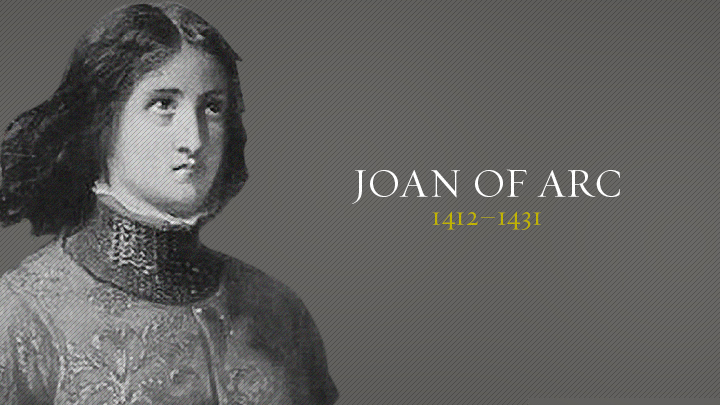
"If I were to say that God sent me, I shall be condemned, but God really did send me."

She has been called a saint, a heretic, and "a diamond among pebbles." But who was this illiterate French peasant girl, who in 15 months changed the history of western Europe and became, according to one historian, "the most widely known of all medieval women"?
Her voices
Joan's father was the most prosperous farmer in the small French village of Domremy. She spun wool and gathered the harvest, a typical life interrupted only by occasional encounters with soldiers from the Hundred Years' War (1337–1453), the lingering conflict between France and England. Once English soldiers burned the village church; two other times Joan herded the livestock to safety from their marauding invasions.
Timeline |
|
|
1373 |
Julian of Norwich receives her revelations |
|
1378 |
Great Papal Schism begins |
|
1380 |
Wycliffe supervises English Bible translation |
|
1412 |
Joan of Arc born |
|
1431 |
Joan of Arc dies |
|
1456 |
Gutenberg produces first printed Bible |
One summer when Joan was about 13, she was working in her father's garden at noon. Suddenly she saw a bright light and heard a voice. The voice called her "Joan the Maid" and told her to live a virtuous life. Voices came more often and gave instructions: Joan was to save France and help the dauphin (France's rightful heir) be crowned. Joan questioned how she could possibly accomplish these astounding feats. The voices said God would be with her.
Joan later identified the voices as belonging to the archangel Michael and the saints Margaret of Antioch and Catherine of Alexandria. At any rate, Joan's voices impelled her to attempt unthinkable tasks; she would rather die than deny them.
With her cousin's help, Joan gained access to Robert de Baudricourt, the local lord. He flatly ordered, "Give her a good slapping and take her back to her father."
Joan would not relent, and nearly nine months later, she convinced her hearers that she was divinely chosen to help France. With knights at her side, she rode over 300 miles—across enemy territory, at night—to tell the dauphin, Charles, of her plans.
Charles was unsure whether to receive her, so when Joan entered the 70-foot-long hall, filled with dozens of courtiers, the dauphin was not on his throne. Instead, dressed like the others, he mingled with the crowd. Somehow, Joan walked directly to him.
"But I am not the dauphin," he protested when she addressed him.
"In God's name, gentle sire, you are," Joan responded.
Charles turned her over to churchmen from the University of Poitiers. Weeks of doubt and indecision followed while she was questioned, but finally her examiners found "only humility, purity, honesty, and simplicity." Soon she was helping 4,000 troops to relieve the besieged city of Orleans.
Though not the commander of the troops, she led troops in taking a number of forts that surrounded Orleans. During the battle for the fort of Les Tourelles, Joan was wounded (an arrow through the shoulder) but quickly returned to the fight, and her fortitude inspired many French commanders to maintain the attack until the English capitulated. The next day the English were seen retreating, but, because it was a Sunday, Joan refused to allow any pursuit. It didn't matter; Orleans was back in French hands.
In a few months, the town of Reims was recaptured, and the dauphin was officially crowned king of France (Reims was the traditional city for coronation). But Charles suddenly lost his nerve. Joan's insistent pleas to drive the English out of Paris went unheeded. On a sortie the next year, the 18-year-old soldier was captured by the English, who put her on ecclesiastical trial in Rouen.
Reverse decision
Joan was imprisoned for nearly five months, repeatedly questioned about her views, and finally charged on 70 counts of heresy. Authorities were troubled that she claimed for her pronouncements the authority of divine revelation, prophesied the future, endorsed her letters with the names of Jesus and Mary (thereby identifying herself with a novel and suspect cult called the Name of Jesus), professed to be assured of salvation, and wore men's clothing. She was finally convicted of being a schismatic (she said she felt accountable first to God and her saints rather than the church). When her sentence was read—execution by the secular authorities—Joan quailed and declared she would do all that the church required of her. Her sentence was changed to life imprisonment.
Three days later, however, she was found wearing men's clothes again, and when asked about it, she said the voices of Catherine and Margaret had censured her for her "treason." She was handed over to secular authorities.
At 9 a.m. on May 30, 1431, 19-year-old Joan walked toward the market square. She knelt and prayed for her enemies, then mounted the prepared pyre. As the flames leapt upward, Joan asked for a cross to be held before her. Gazing upon it, her final word was "Jesus."
It would be 25 years before a church commission overturned the charges against her and declared her innocent. In 1920 Joan—remembered for her heroism and devotion far more than her military and political conquests—was canonized a saint by the Roman Catholic Church.
Corresponding Issue