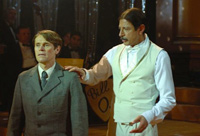
Adam Stein (Jeff Goldblum) was a well-loved circus-style entertainer before he was hauled off to a Nazi concentration camp, along with his beloved wife and daughters. There, he encounters a Nazi commandant (Willem Dafoe) who remembers him from his act years ago and takes him into his home—not as a friend, but as his “dog,” an entertaining, subservient companion who goes around on all fours, barks, and eats raw meat with the other (actual) dog.
Years later, Stein is a patient at an Israeli mental institution for Holocaust survivors, haunted by his past and prone to some kind of mania. Charming, charismatic, and a bit odd, he is loved by patients (who see him as a kind of savior) and staff (a doctor who is fascinated with his case, a nurse who is fascinated with his more sensual side). One day he discovers a patient on the ward—a ragged boy who was kept as a dog for his life and can now only cower, bark, whimper, hide, and crawl on his hands and knees. Adam is strangely drawn to the boy, whom he approaches against the rules and dubs “David, king of the dogs,” after the king of Israel. As their relationship develops, Adam’s humanity begins to crumble, bit by bit. The boy represents a kind of way out to Adam, but his care turns to a twisted jealousy, and it takes a serious encounter with the ghosts of his past to free him from his demons.

Not having read the Yoram Kaniuk novel on which the film is based, I don’t know how faithful it is to the book. But some stories are better left on the page, and I suspect this is one of them. It’s one of those movies with many good elements that, given a little more finesse, could have added up to something important—but instead, it’s a mess.
While the story’s premise is provocative and begins well enough, incessant explanatory flashbacks render the present-day narrative too interrupted to really be effective. It feels like this film is trying to be an epic, and it may even be mistaken for one; after all, it deals with family pain, mental illness, and the Holocaust. The tragedy just keeps coming, punctuated by dark comedy and even a few moments of surrealism. In and of itself, the story is thematically heartbreaking. But the barrage of calamities renders it overwrought, obscuring the emotional connection and leaving the audience gasping for breath.
Additionally, for a film this replete with religious imagery, it’s hard to figure out what Adam is really all about. Is he a con artist? An embattled messiah? An example of some kind? Or just a very sick man with some odd powers? Why would he try to leave the asylum? And how did he evolve from a broken former prisoner to this bizarrely charming patient? That is where the real story lies, and that is precisely what the movie refuses to reveal.
I don’t demand that all movies have a clear-cut moral, story arc, and message; after all, some are intended to be pure entertainment. But because of its weighty, important themes, it’s frustrating that Adam Resurrected isn’t a good film. Adam’s story is a powerful one—it doesn’t shy away from depicting the depths to which a dehumanized human, victimized by his fellow man, can fall, and it portrays the immense healing that comes from recognizing hurt in others and learning to care for them. Like an earlier film that struggled against dehumanization—Amazing Grace—this film could have managed to inspire some outrage against those atrocities in our world.
Jeff Goldblum is obviously being positioned for an Oscar here, and though his performance is unlike anything we’ve ever seen him do, I’m not sure it’s deserved. We’re used to seeing Goldblum as a sort of muttering comic genius, and though he has myriad opportunity to do that here, this is a much deeper character who experiences guilt, fear, rage, and desire. His performance is painfully compelling for much of the movie, but it’s not consistent—or perhaps this is just an uneven character, or an uneven film.
In truth, Adam Resurrected could have been a tour de force for director Paul Schrader and his cast; bits scattered throughout that show what the film could have been. And that glimpse of greatness makes the reality all the more disappointing.
Talk About It
Discussion starters- What do you think prompted Adam to befriend David?
- Read Proverbs 5:22. This is a difficult verse to swallow when you consider the atrocities that many people suffered during the Holocaust, and still suffer around the world today. What does this kind of forgiveness look like in such horrible circumstances?
- What does Adam’s journey toward a life outside the asylum imply about the healing power of forgiveness and unselfishness?
The Family Corner
For parents to considerAdam Resurrected is rated R for some disturbing behavior, sexuality, nudity, and some language. The main theme of the movie is truly disturbing, and it’s coupled with scenes in a Nazi concentration camp, some strange sexual behavior from Adam and others, a handful of obscenities, and some female frontal nudity (in the first scene), which includes groping, and male rear nudity.
Photos © Copyright Bleiberg Entertainment
Copyright © 2008 Christianity Today. Click for reprint information.