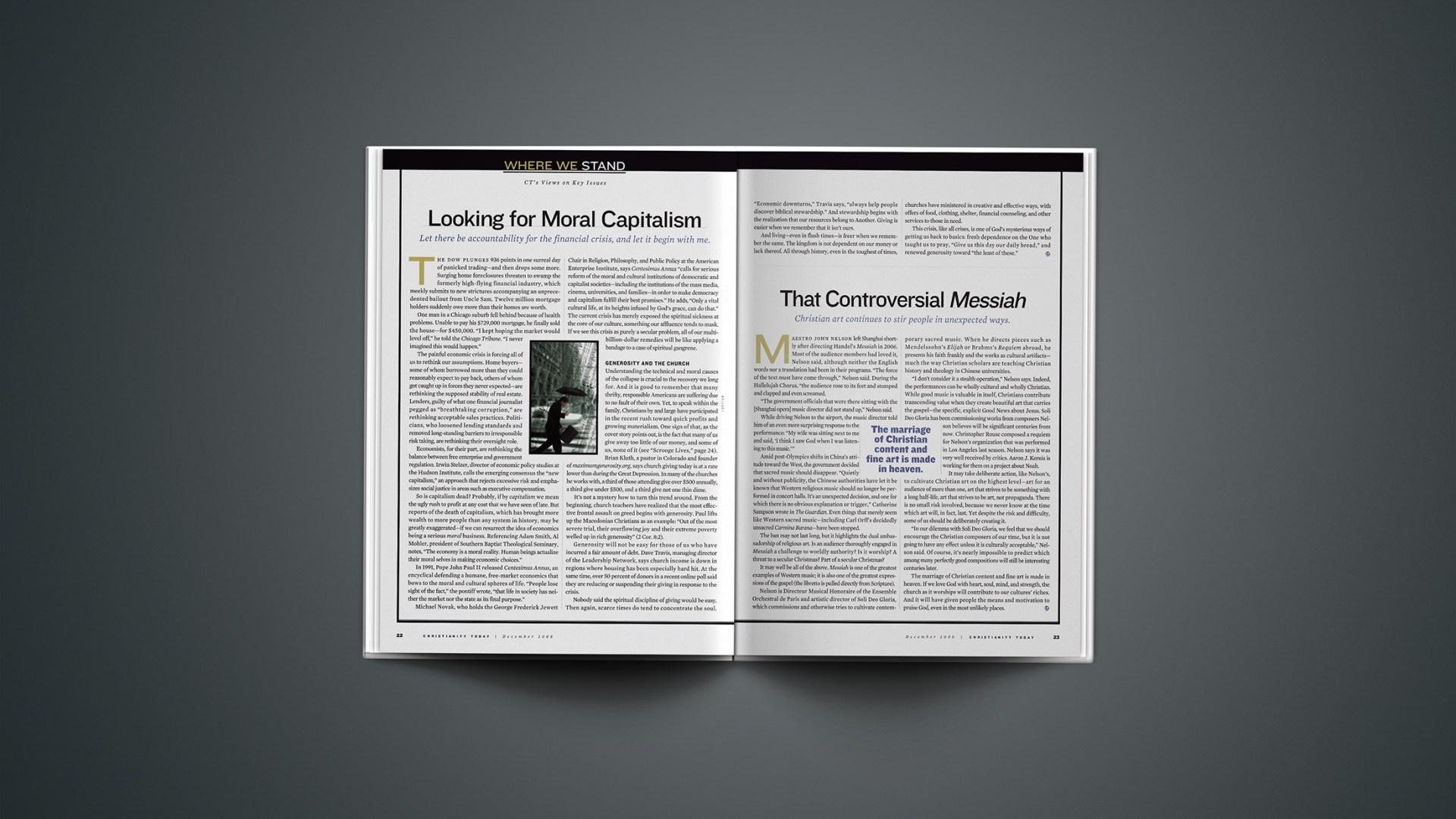

The Dow plunges 936 points in one surreal day of panicked trading—and then drops some more. Surging home foreclosures threaten to swamp the formerly high-flying financial industry, which meekly submits to new strictures accompanying an unprecedented bailout from Uncle Sam. Twelve million mortgage holders suddenly owe more than their homes are worth.
One man in a Chicago suburb fell behind because of health problems. Unable to pay his $729,000 mortgage, he finally sold the house—for $450,000. “I kept hoping the market would level off,” he told the Chicago Tribune. “I never imagined this would happen.”
The painful economic crisis is forcing all of us to rethink our assumptions. Home buyers—some of whom borrowed more than they could reasonably expect to pay back, others of whom got caught up in forces they never expected—are rethinking the supposed stability of real estate. Lenders, guilty of what one financial journalist pegged as “breathtaking corruption,” are rethinking acceptable sales practices. Politicians, who loosened lending standards and removed long-standing barriers to irresponsible risk taking, are rethinking their oversight role.
Economists, for their part, are rethinking the balance between free enterprise and government regulation. Irwin Stelzer, director of economic policy studies at the Hudson Institute, calls the emerging consensus the “new capitalism,” an approach that rejects excessive risk and emphasizes social justice in areas such as executive compensation.
So is capitalism dead? Probably, if by capitalism we mean the ugly rush to profit at any cost that we have seen of late. But reports of the death of capitalism, which has brought more wealth to more people than any system in history, may be greatly exaggerated—if we can resurrect the idea of economics being a serious moral business. Referencing Adam Smith, Al Mohler, president of Southern Baptist Theological Seminary, notes, “The economy is a moral reality. Human beings actualize their moral selves in making economic choices.”
In 1991, Pope John Paul II released Centesimus Annus, an encyclical defending a humane, free-market economics that bows to the moral and cultural spheres of life. “People lose sight of the fact,” the pontiff wrote, “that life in society has neither the market nor the state as its final purpose.”
Michael Novak, who holds the George Frederick Jewett Chair in Religion, Philosophy, and Public Policy at the American Enterprise Institute, says Centesimus Annus “calls for serious reform of the moral and cultural institutions of democratic and capitalist societies—including the institutions of the mass media, cinema, universities, and families—in order to make democracy and capitalism fulfill their best promises.” He adds, “Only a vital cultural life, at its heights infused by God’s grace, can do that.” The current crisis has merely exposed the spiritual sickness at the core of our culture, something our affluence tends to mask.
If we see this crisis as purely a secular problem, all of our multibillion-dollar remedies will be like applying a bandage to a case of spiritual gangrene.
Generosity and the Church
Understanding the technical and moral causes of the collapse is crucial to the recovery we long for. And it is good to remember that many thrifty, responsible Americans are suffering due to no fault of their own. Yet, to speak within the family, Christians by and large have participated in the recent rush toward quick profits and growing materialism. One sign of that, as the cover story points out, is the fact that many of us give away too little of our money, and some of us, none of it (see “Scrooge Lives“). Brian Kluth, a pastor in Colorado and founder of maximumgenerosity.org, says church giving today is at a rate lower than during the Great Depression. In many of the churches he works with, a third of those attending give over $500 annually, a third give under $500, and a third give not one thin dime.
It’s not a mystery how to turn this trend around. From the beginning, church teachers have realized that the most effective frontal assault on greed begins with generosity. Paul lifts up the Macedonian Christians as an example: “Out of the most severe trial, their overflowing joy and their extreme poverty welled up in rich generosity” (2 Cor. 8:2).
Generosity will not be easy for those of us who have incurred a fair amount of debt. Dave Travis, managing director of the Leadership Network, says church income is down in regions where housing has been especially hard hit. At the same time, over 50 percent of donors in a recent online poll said they are reducing or suspending their giving in response to the crisis.
Nobody said the spiritual discipline of giving would be easy. Then again, scarce times do tend to concentrate the soul. “Economic downturns,” Travis says, “always help people discover biblical stewardship.” And stewardship begins with the realization that our resources belong to Another. Giving is easier when we remember that it isn’t ours.
And living—even in flush times—is freer when we remember the same. The kingdom is not dependent on our money or lack thereof. All through history, even in the toughest of times, churches have ministered in creative and effective ways, with offers of food, clothing, shelter, financial counseling, and other services to those in need.
This crisis, like all crises, is one of God’s mysterious ways of getting us back to basics: fresh dependence on the One who taught us to pray, “Give us this day our daily bread,” and renewed generosity toward “the least of these.”
Copyright © 2008 Christianity Today. Click for reprint information.
Related Elsewhere:
Christianity Today has more editorials and a special section on the economic crisis.