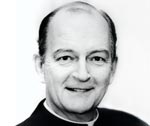
The Rev. Richard John Neuhaus, an eminent Catholic intellectual who tutored President Bush in Catholic social teaching and helped build the political coalition that made his election possible, died Thursday at age 72.
Neuhaus died soon after 10 a.m. of complications from cancer, according to a statement by First Things, the intellectual journal he founded in 1990.
Though he often portrayed himself as a simple priest, Neuhaus rose from a rabble-rousing leftist cleric in the 1960s to become a presidential mentor, helping Bush define his policies on gay marriage, abortion and stem-cell research, among other issues.
In 2005, Time magazine named the Catholic priest one of America’s 25 most influential evangelicals.
“Father Richard helps me articulate these (religious) things,” Bush said at the time. The two met nearly a decade ago as Bush was considering a run for the White House.
“Father Richard [Neuhaus] helped me craft what is still the integral part of my position on abortion, which is: Every child welcomed to life and protected by law,” Bush said in a statement Thursday. “That is the goal of this administration.”
In the 1990s, Neuhaus co-founded the group Evangelicals and Catholics Together with former Nixon White House counsel Charles Colson, which helped cement the political alliance between two groups that had long been suspicious of each other.
Bush’s election is often considered the crowning achievement of that coalition, which wed Catholic intellectualism and evangelical political savvy. After Paul Weyrich’s death in December, Neuhaus is the second leading architect of the modern religious right to die as Bush’s tenure winds to a close.
 Wrestling for Jesus, an award winning documentary, follows Timothy Blackmon, a rural South Carolina man who decided the best way to share his faith was to form an amateur Christian wrestling league to spread the Word. Blackmon, who goes by the nickname “T-Money,” faces challenge after challenge – financial, marital, spiritual – as he tries to work with this rag-tag-team group of grizzled old bikers and young skinny wrestlers.The film begins as a kind of cultural side-show, introducing you to a small circle of enthusiasts where Christian evangelism intersects a grassroots form of what WWE calls “sports entertainment.” But although the wrestling action may be overscripted, the evangelistic mission rings true as the traditional altar becomes an invitation to meet Jesus at the edge of the ring.Nevertheless, the façade of sports entertainment becomes a metaphor in the false-front marriage of one of the couples involved. When that marriage breaks up, so does the Wrestling for Jesus team. The air of unreality is capsulized first in an early scene in which one wrestler shows off the trophy he won for being the most Christlike wrestler. Behind him is a poster of a scantily clad female model draped across the hood of a sexy car. The unreality is capsulized again near movie’s end when a morose little girl uses a home karaoke machine to sing herself a sappy little princess song.And yet, and yet, there is a genuine good-heartedness that permeates all this unreality: the divorced father becomes more attentive and nurturing than ever. The leader of the fractured team pulls them back together for a benefit exhibition to support a fellow wrestler who has broken his neck. These things tip the balance of human experience in favor of hope.Filmmaker Nathan Clarke (whom, full disclosure, I count as a friend) has a wonderful eye for detail and for metaphor. In Wrestling for Jesus, he helps us see human imperfection with compassion and hope.The film is available purchase at the official website, and here’s the trailer:
https://www.youtube.com/watch?v=ncfPcYtqm5M?version=3
Born in 1936 in Ontario, Canada, to a Lutheran clergyman, Neuhaus himself was ordained a Lutheran minister, and in the 1960s, became involved in social justice causes — marching for civil rights with the Rev. Martin Luther King Jr., and against the Vietnam war with Rabbi Abraham Joshua Heschel.
Neuhaus gradually became more conservative, however, breaking with the left over affirmative action and abortion. Throughout, the unmarried priest was a prolific writer, arguing in books and essays for religion to play a robust role in American culture.
His 1984 book, The Naked Public Square: Religion and Democracy in America, was “one of the most important, debate-changing books in the history of modern conservatism,” said Peter Wehner, a former Bush White House staffer.
William McGurn, Bush’s former chief speechwriter and longtime contributor to First Things, said “His theses nailed to the wall would be that nature and politics abhor a vacuum, and that without access to transcendent truth, democracy will degrade into relativism.”
In 1990, Neuhaus converted to Catholicism, a move that merited a profile in The New York Times. He was ordained a Catholic priest the following year.
The Rev. George Rutler, a fellow New York City priest, who reportedly administered last rites to Neuhaus, said his friend’s writings in First Things raised the level of conversation in America.
“Father Neuhaus elevated the debate about secular culture by showing that theological considerations engage the highest science of the mind, and are not cultural asides,” Rutler said in an e-mail. First Things, and his monthly column, “The Public Square,” “gave us a frame of reference for talking about the marginalization of the eternal verities,” Rutler said.
The Rev. Jim Martin, the associate editor of the Jesuit magazine America, called Neuhaus “an intelligent, impassioned and articulate defender of Catholic orthodoxy, the editor of a superb intellectual journal, and arguably the leading voice in conservative Catholic circles in this country.”
Neuhaus himself seemed to define his role in his 1975 book, Time Toward Home: The American Experiment as Revelation.
“Intellectuals are, broadly understood, those people who mint and market the metaphors by which a society understands itself,” Neuhaus wrote.
Copyright © 2009 Christianity Today. Click for reprint information.
Related Elsewhere:
Christianity Today published a liveblog post that compiled reactions from others on Neuhaus’ death.
Previous CT articles on and by Neuhaus include:
A Voice in the Relativistic Wilderness | The Pope crusaded for “moral truth.” We should welcome his help. (April 4, 2005)
A Modest Step Toward Unity | Richard John Neuhaus on the Catholic bishops’ decision to join Christian Churches Together. (November 11, 2004)
Books: Inside the Vatican | The pope’s chief doctrinal officer has always been in dialogue with the Reformation traditions. Now he reveals his vision for Christianity in the new millennium. (May 18, 1998)