This life, this life and then the next / With you I have been blessed / What more can you expect / This life, this life and then the next … my universe at rest”
— from “This Life”
Springsteen’s last few records—The Rising (2002), Devils & Dust (2006), and Magic (2007)—had dabs of delight, but the projects also included darkness aplenty … and not just on the edge of town. The Rising was mostly a soul-stirring response to the events of 9/11, and while there were hints of hope and healing, that was also about the time that Springsteen, who’d long kept his political views to himself, started speaking out against the Bush administration. (He later became a vocal supporter of John Kerry and then Barack Obama in the last two elections.). Devils & Dust was in part a war protest album, rife with themes as bleak as its title. And Magic was more of the same, expressing Springsteen’s disillusionment with the state of American society and policies.
We Shall Overcome: The Seeger Sessions (2006) was more hopeful, but a) the songs weren’t his, and b) as is typical of folk music, optimism shone in spite of, rather than because of, the cultural climate.
So when Springsteen, halfway through Working on a Dream, sings a pop/candy number like “This Life” with all the giddy charm of the 60s-era Beach Boys—complete with la-la-la harmonies—and means it, you get the feeling he’s decided to move on.
Yes he can. Meet the new Boss. He really does seem to be as happy as the guy who hammed it up for the world at the Super Bowl’s halftime party.
It’s ironic that Dream was essentially birthed by the moody Magic. “What Love Can Do”—which Springsteen describes as a “love in the time of Bush” meditation—was written during the Magic sessions, but he says it felt more like the beginning of something new. So, he shelved the song for his next album, which ended up coming much sooner than expected. Already on a creative roll, Springsteen had written half of Dream within a week after Magic‘s release. A mere 17 months elapsed between the two projects—his quickest back-to-back releases since 1973.
Dream opens on an epic blue note—the somber, sober “Outlaw Pete,” an 8-minute (!) ballad about a lawless wanderer searching for something, anything, of substance: “Father Jesus I’m an outlaw, killer, and a thief / And I slow down only to sow my grief / I’m Outlaw Pete, Outlaw Pete / Can you hear me? Can you hear me?”
The Jesus reference is just the first of several spiritual nods on the album, and as if to answer Outlaw Pete’s lingering question, the second track, “Lucky Day,” points to a “room where fortune falls / On a day when chance is all / In the dark of this exile / I felt the grace of your smile / Honey, you’re my lucky day.” Right off the bat, the seeker finds grace—in the arms of a woman, but it’s grace nonetheless.
Springsteen and wife Patti have been married almost 18 years—they have three teenage children—and their love is a clear theme here. “What Love Can Do” is basically a rock ‘n’ roll read on marriage vows: “Darlin’ I can’t stop the rain / Or turn your black sky blue / But let me show you what love can do … Let me make this vow to you / Here where it’s blood for blood and an eye for an eye … Here where we bear the mark of Cain / We’ll let the light shine through / Let me show you what love can do.”
In the alt/country ditty “Tomorrow Never Knows,” Springsteen warbles, “You and me, we been standing here my dear / Waiting for our time to come / Where the green grass grows.” And on “Life Itself,” he sings, “You were life itself, rushing over me / Life itself in your heart and your eyes / I can’t make it without you.” And then, “Why do the things we treasure most slip away in time / Till to the music we grow deaf, to God’s beauty blind / [But] I can’t make it without you.”
The marital bliss continues on “Kingdom of Days”: “I count my blessings that you’re mine for always / We laugh beneath the covers and count the wrinkles and the grays / Sing away, sing away, sing away.” And “Surprise, Surprise” includes a blessing for his beloved: “In the hollow of the evening, as you lay your head to rest / May the evening stars scatter a shining crown upon your breast / In the darkness of the morning as the sky struggles to light / May the rising sun caress and bless your soul for all your life.”
When’s the last time you heard a rock superstar so unabashedly rejoice in his marriage—much less be married for almost two decades? Springsteen, raised in the Catholic church, has long been haunted by the holy, frequently acknowledging heaven’s hand in his work. In Working on a Dream, it’s clear he understands that marriage is a sacred gift from God.
It’s also clear that he understands that life itself is a gift. Last spring, Danny Federici, one of Springsteen’s best friends and a founding member of The E Street band, died of melanoma. Working on a Dream, dedicated to Federici, ends with “The Last Carnival,” a song written in his memory: “We’ll be riding the train without you tonight,” Springsteen sings, “the train that keeps on movin’ / Its black smoke scorching the evening sky / A million stars shining above us like every soul livin’ and dead / Has been gathered together by a God to sing a hymn over your bones.”
Mark Moring has written about spirituality in Springsteen’s music before, particularly here, here, and here. Note: One song on the album, “Queen of the Supermarket,” includes the f-word, but there’s no other offensive language on the album.
Unless specified clearly, we are not implying whether this artist is or is not a Christian. The views expressed are simply the author’s. For a more complete description of our Glimpses of God articles, click here.
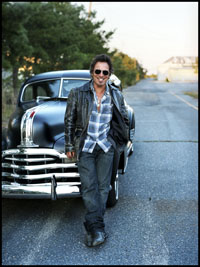
Springsteen photo by Danny Clinch
Copyright © 2009 Christian Music Today. Click for reprint information.